
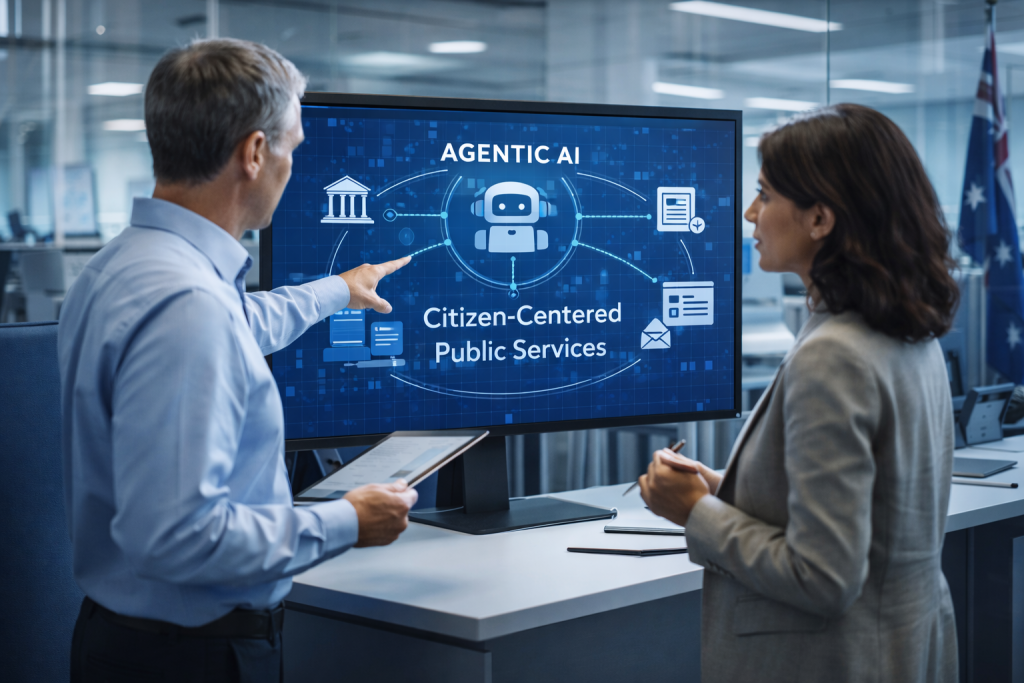
Agentic AI and the Future of Citizen-Centred Public Services
Agentic AI in public sector transformation is rapidly emerging as a critical enabler for governments seeking to deliver citizen-centered, connected, and responsive services at scale. Citizens no longer compare government experiences with other government agencies. They compare them with the best digital services they use every day.
Unified access, connected citizen journeys, empowered frontline teams, and continuous improvement are no longer aspirational goals. With the emergence of agentic AI, they are becoming achievable realities, even without dismantling existing legacy systems.
Yet for many public sector leaders, the conversation is only just beginning. Questions remain around where to start, how to scale responsibly, and how to ensure real impact rather than isolated experimentation.
From Bureaucratic Processes to Citizen-Centered Public Services
Consider what it takes to start a small business. A single intention often turns into multiple applications across licensing, taxation, environmental approvals, and regulatory bodies. Each step may sit with a different agency, system, and process.
For citizens and businesses, this feels less like a service and more like a maze.
This friction is the real driver behind the growing interest in AI within government. Expectations have shifted permanently. People now expect the same clarity, speed, and consistency from public services that they experience in the private sector.
This change forces a critical reframing. Citizen experience is no longer an optional enhancement. It sits at the heart of public value, trust, and economic participation. Governments that recognize this begin to think differently about how services are designed, delivered, and measured.
The Opportunity: A Single Intelligent Entry Point
Agentic AI offers a powerful opportunity to change how citizens interact with government.
Rather than asking users to understand government structures, agentic systems allow people to simply express an outcome in plain language. The intelligence sits behind the scenes, interpreting intent, coordinating steps across agencies, and guiding users through the journey without exposing the complexity underneath.
This approach does not require every system to be modernized at once. Instead, agentic AI operates as an orchestration layer, insulating citizens from fragmented back-end environments while enabling agencies to collaborate more effectively.
Its real strength lies in areas where processes are ambiguous, evolving, or non-linear. These are precisely the environments where traditional rule-based systems struggle and where public services often feel most frustrating.
Moving Beyond Pilots: Selecting Use Cases That Scale
One of the most common challenges in government AI initiatives is the gap between promising pilots and sustained impact. To avoid this, public sector leaders must be deliberate in how they select and frame use cases. Three questions consistently separate initiatives that scale from those that stall:
1. Does the problem suit AI?
Agentic AI excels where flexibility, interpretation, and coordination are required. It is not a replacement for deterministic processes where certainty and precision are paramount.
2. Is the problem strategically relevant?
Successful initiatives focus on challenges that could not be solved effectively before, rather than revisiting long-standing issues without clear ownership or funding.
3. Is there a clear mission?
AI projects that deliver impact are mission-driven. They are anchored to tangible human, economic, or operational outcomes and supported by executive sponsorship and cross-agency alignment.
When these conditions are in place, AI becomes a catalyst for change rather than a disconnected experiment.
How to Start: Small Steps with Strategic Intent
Large-scale transformation can feel daunting, particularly in complex public sector environments. Attempting to address every pain point at once often leads to delays, cost overruns, and loss of confidence.
A more effective approach is to begin with a focused, high-impact journey. By targeting a narrow slice of a broader problem, agencies can demonstrate value quickly, learn from real-world use, and build momentum for future phases.
This is not about limiting ambition. It is about earning it. Small, well-executed initiatives create the foundation, trust, and capability required to scale responsibly over time.
A Leadership Shift, Not Just a Technology Shift
Agentic AI introduces more than new tools. It requires a fundamental shift in how organizations think about change.
The pace of innovation is accelerating, not slowing. Solutions will continue to evolve rapidly, improving in capability, reliability, and applicability. Leaders who succeed will be those who plan with this reality in mind, investing in adaptability rather than waiting for perfect maturity.
Perhaps the most important mindset shift is recognizing that today’s technology represents the starting point, not the endpoint. The systems available now will only become more capable. The greater risk lies in delay rather than experimentation done thoughtfully and responsibly.
A Pivotal Moment for Government Service Modernization
Public sector organizations stand at a defining moment. Citizen expectations are rising, technology capabilities are advancing, and the cost of inaction is growing. Agentic AI provides a pathway to more connected, responsive, and citizen-centered services. The challenge is not whether to engage with it, but how to do so in a way that aligns strategy, governance, and execution.
At Pansoft, we work with public sector organizations to translate emerging technologies into structured, outcome-driven transformation programs. By bridging strategy and execution, we help leaders move confidently from exploration to impact.
If your organization is considering how agentic AI, automation, and modern platforms can support better public outcomes, now is the time to start the conversation.
To support implementation and capability-building alongside strategic planning, we also published a complementary article tailored for technical audiences. “Agentic AI for Developers: Best Practices” explores practical frameworks, tooling considerations, and real-world development workflows that underpin successful agentic AI delivery in large-scale public sector environments. You can read that piece here: Agentic AI for Developers – Best Practices