
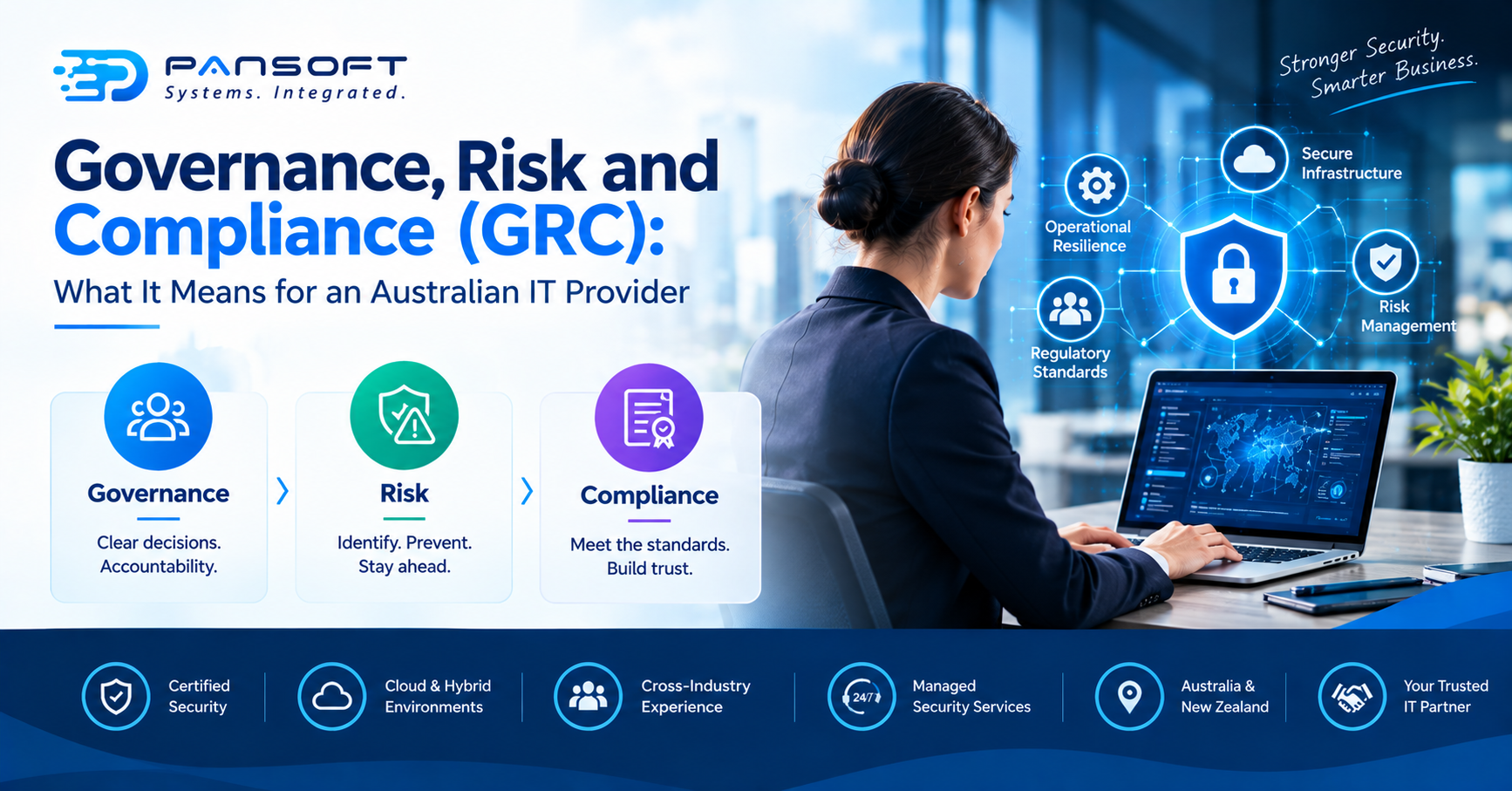
Governance, Risk and Compliance (GRC): What It Means for an Australian IT Provider
Ask an IT provider what governance, risk and compliance (GRC) means and most will hand you a slide full of jargon. Cut through it and you’re left with three fairly plain things. Clear rules about who’s actually making decisions. A habit, kept up over time, of catching problems before they land. And proof, not a claim on a website, that the provider follows the rules its clients are bound by. This doesn’t sit in one department, and it’s not a task you finish and move past. It’s more like a muscle a provider either keeps using or lets go slack, and that’s usually what separates one you can trust with your systems from one that just talks a good game.
Worth breaking down properly, so here’s each piece on its own.
Governance: Who’s on the Hook When Something Breaks
Governance is the one people trip over, probably because the word sounds like it belongs in a boardroom rather than a server room. In practice it’s fairly mundane. Someone approves a change before it goes live, rather than it just happening. Someone checks, on a schedule, whether people still need the access they were handed a year and a half ago. And when something breaks, there’s an actual order of who gets called, not a scramble to figure it out on the fly.
A technically capable team can still be missing all of this. The work itself is fine. What’s missing is the thing that catches a small slip before it turns into a genuinely bad week.
Risk: Working Out What Could Actually Go Wrong
Good risk management isn’t a workshop you run in January and forget about by March. It’s closer to a loop you never really stop running, keep asking what could fail, across systems, people, suppliers, then actually do something with the answer. Fix it. Accept it. Insure it. Cut it off.
For most Australian businesses, the shortlist doesn’t change much: someone getting into something they shouldn’t, data leaving when it shouldn’t, a service dropping at the worst possible time, or a supplier’s sloppy security becoming your headache. Identity and access management sits right at the centre of most of that, not off in a corner somewhere. Shared logins still in use. Accounts nobody remembered to switch off six months after someone left. Access sitting wider than it needs to for far too long. None of that’s rare. It’s how most breaches actually start, and every single one of those is fixable with a bit of discipline over who can touch what.
Compliance: The Rules That Apply to You, Specifically
This is where things stop being abstract, because what applies depends on your industry and where you operate. A business holding health records answers to different rules than one in finance, or one doing work for government. A handful of things do turn up almost everywhere in Australia though, the Privacy Act, whatever standards your sector carries, and increasingly, some level of alignment with the ACSC Essential Eight.
Treat compliance as something you tick off once and you’ll fall behind before you notice, because the rules keep moving. What was enough two years back often isn’t enough now, particularly around how fast a breach has to be reported and where data’s allowed to actually sit.
Why This Gets Sharper for a Combined Cybersecurity and Cloud Provider
Things tighten up for a Cybersecurity and Cloud Solutions Provider Australia businesses lean on for both infrastructure and security, mainly because you can’t really pull those two apart anymore. A cloud misconfiguration is a security problem. A loose access policy is a governance failure. A missed patch manages to be a technical gap and a compliance issue at the same time. Providers who are strong on one side and thin on the other, solid cloud skills paired with weak security, or the reverse, end up running GRC as two things that never quite talk to each other.
Cybersecurity and GRC really need to sit in the same conversation. Good technical controls only go so far without clear rules on who’s allowed to change them.
What Good GRC Actually Looks Like: Managed Security Services
Most of the time, solid GRC shows up as a managed security services function that someone’s actually watching, not just software running quietly in the background. Monitoring that gets reviewed. Incident response steps that have been tested, not written up once and left in a drawer. Access reviews that happen on a schedule rather than whenever someone remembers. Reports that land on a desk and get acted on.
It comes down less to how many certificates are framed on the wall and more to whether the daily habits hold up when something actually breaks. Worth asking a trusted enterprise IT partner that question directly before signing anything, not which tools they use, how decisions get made and escalated when things don’t go to plan.
Government and Enterprise: Where the Bar Sits Higher
For a business working as an IT provider for government and enterprise, GRC stops being background scaffolding and becomes something written straight into the contract, audit trails and reporting obligations included. Informal governance doesn’t really hold up in that world, because getting it wrong tends to be bigger news, and a lot harder to keep quiet.
Providers offering managed IT services Gold Coast and Brisbane IT consulting clients depend on need to hold that same bar across every account, not just the ones with a government name attached.
A Few Questions Worth Asking
Is this only something big organisations need to worry about?
Not really, smaller businesses can be more exposed if anything, since there’s often less structure catching a gap before it turns into something worse.
How do you actually tell if a provider’s GRC is real and not just a slide in a pitch deck?
Ask boring, specific questions. How often do access reviews actually happen. Who signs off on a change to production. What happens, step by step, the moment an incident hits. Vague answers are usually the giveaway.
Does this get set up once, or does it need ongoing attention?
Ongoing, no way around it. [The right cadence depends on your size, industry, and risk appetite, so that’s worth confirming directly with the team rather than guessing at a number.]
Where to Go From Here
If you’re not sure whether your current provider’s governance would hold up under a proper look, that’s worth a conversation rather than a guess. Get in touch with the Pansoft team for a straightforward chat about what real GRC should look like for your organisation.
:%20What%20It%20Means%20for%20an%20Australian%20IT%20Provider)
Related Posts
Top 10 Cyber Security Services in Australia: 2026 Guide
Top 10 Cyber Security Services in Australia: 2026 Guide Australians reported a cybercrime to the government once every six minutes in 2024-25, and the average…
Read More
Step-by-Step Guide to What Happens During a Cyber Security Assessment
Step-by-Step Guide to What Happens During a Cyber Security Assessment Cyber Security Assessment Services tend to follow roughly the same shape wherever you go. Someone…
Read More