
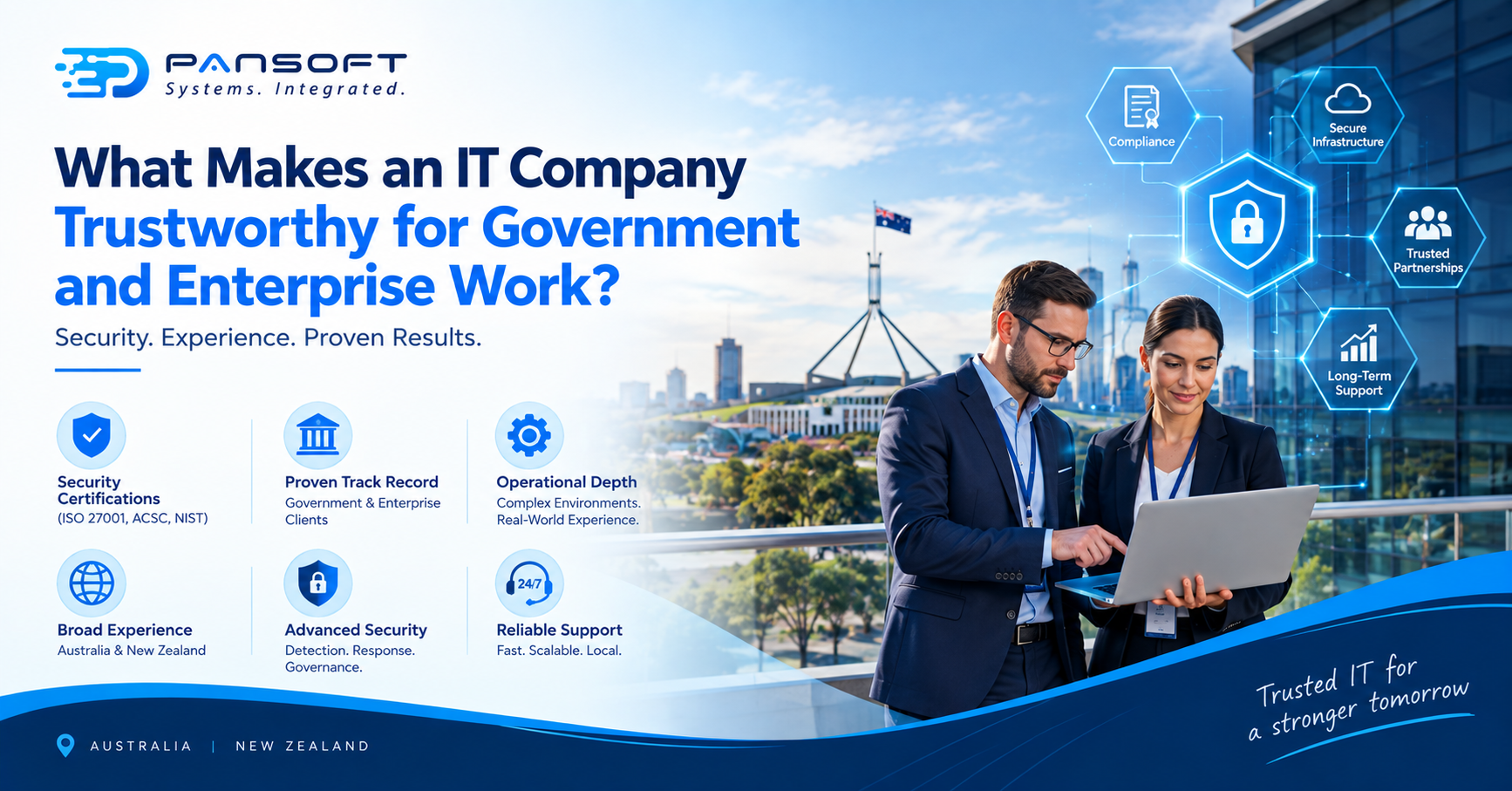
What Makes an IT Company Trustworthy for Government and Enterprise Work?
A trustworthy IT company for government and enterprise work has three things most decision-makers actually check before signing anything: verifiable security certifications, a track record with organisations that carry real compliance weight, and the operational depth to support complex environments without buckling under pressure. Everything else in this article is really just detail underneath those three points.
If you’re evaluating an IT Company Gold Coast businesses and public sector bodies can genuinely rely on, it’s worth understanding why those three factors matter more than a slick website or a long list of services.
Certifications Aren’t a Box-Tick, They’re a Filter
Government procurement teams and enterprise IT departments don’t ask for ISO 27001 certification because it looks good on a proposal. They ask for it because it’s one of the few external, auditable signals that a provider actually manages information security as a formal, ongoing discipline rather than as an afterthought bolted on after something goes wrong.
The same logic applies to frameworks like the ACSC Essential Eight or NIST alignment. These aren’t marketing badges. They represent independently verified processes around access control, incident handling, data protection, and continuous improvement. A provider without this kind of certification isn’t necessarily incapable, but they’re asking you to take their word for it, and that’s a harder sell when the stakes involve public funds or enterprise-scale risk.
Experience With Complexity, Not Just Longevity
Years in business matters, but not in the way most people assume. What actually counts is whether that time has been spent working across genuinely complex environments, multiple compliance regimes, legacy system migrations, hybrid infrastructure, and the kind of scale that smaller commercial clients rarely demand.
A provider with 10+ years IT industry experience across government, education, and enterprise sectors has almost certainly hit the edge cases that a newer or narrower provider hasn’t. They’ve dealt with audit requirements that don’t have a simple checklist answer. They’ve managed the handover risk of migrating a legacy system without downtime. That kind of pattern recognition is difficult to fake and even harder to shortcut.
A Track Record That Extends Beyond One Market
One thing worth paying attention to is whether a provider’s experience is genuinely broad or just broadly worded. A trusted enterprise IT partner that has delivered across Australia and also operates as an IT solutions provider New Zealand organisations engage with tends to have been tested against a wider range of regulatory and operational conditions than one working in a single, narrow market. Cross-border delivery forces a level of process discipline that a purely local operation doesn’t always need to develop.
This matters for government and enterprise clients specifically because their own requirements rarely sit neatly inside one jurisdiction. Data residency rules, procurement standards, and compliance obligations shift depending on where the organisation operates, and a provider who’s only ever worked in one context is more likely to be learning on the job when those requirements get complicated.
Security Depth, Not Just Security Presence
Almost every IT provider will claim to “take security seriously.” Very few can actually demonstrate layered security architecture across detection, response, and governance. The difference shows up in the detail: is there a genuine security operations capability, or just antivirus and a firewall rule set? Is incident response a documented, tested process, or a plan that exists only on paper?
For organisations weighing up a cyber security partner as part of a broader IT relationship, this distinction is worth pushing on directly. Ask what happens in the first hour of a suspected breach. A provider that has genuinely built out this capability will have a specific, practical answer. One that hasn’t will talk in generalities.
Responsiveness That Matches the Stakes
Government and enterprise environments don’t tolerate slow response the way a small business sometimes can. A payroll system down for a morning is inconvenient. A citizen-facing service down for a morning can become a public issue. This is where managed IT services Gold Coast organisations rely on need to demonstrate something concrete: documented response time commitments, 24/7 monitoring capability, and an escalation process that doesn’t depend on one specific person being available.
It’s also worth checking whether a provider’s support model scales with your organisation, rather than being sized for their smallest client. A provider offering Brisbane IT consulting alongside Gold Coast operations, for instance, signals a business built to support multiple regions and client sizes simultaneously, rather than one stretched thin the moment a second major account comes on board.
Why This Matters More for Government and Enterprise Specifically
Smaller commercial clients can often tolerate a provider learning as they go. Government departments and large enterprises generally can’t. The compliance obligations are stricter, the reputational stakes are higher, and the systems involved are frequently interconnected in ways that make a single failure point far more consequential.
This is really the core of what separates a genuinely trusted IT company Gold Coast businesses trust from one that simply lists government and enterprise clients as a market they’d like to serve. The former has built the certifications, the processes, and the operational muscle to actually deliver in that environment. The latter is still figuring out what that requires.
A Few Questions Worth Asking Directly
Does the provider need to be locally based to support a government contract?
Not always, but local presence often helps with response times and understanding regional compliance nuances.
How do I verify a provider’s security certifications are current?
Most certification bodies maintain public registries. It’s reasonable to ask a provider directly for their certificate number and issuing body rather than relying on a logo on their website.
What’s a reasonable response time to expect for a critical incident?
This varies significantly by contract and service tier.
Where to Go From Here
If you’re weighing up IT providers for government or enterprise work, the questions above are a reasonable starting point for any conversation. If it would help to talk through what this looks like in practice, get in touch with the Pansoft team, no pressure, just a straightforward conversation about what your organisation actually needs.

Related Posts
Signs Your Business Has Outgrown Its Current IT Support
Signs Your Business Has Outgrown Its Current IT Support If tickets are taking longer to close, your team keeps hitting the same recurring issues, and…
Read More
Managed IT Services Gold Coast: What Does a Managed IT Services Provider Actually Do?
Managed IT Services Gold Coast: What Does a Managed IT Services Provider Actually Do? Short version: a managed IT services provider watches, patches, backs up…
Read More