
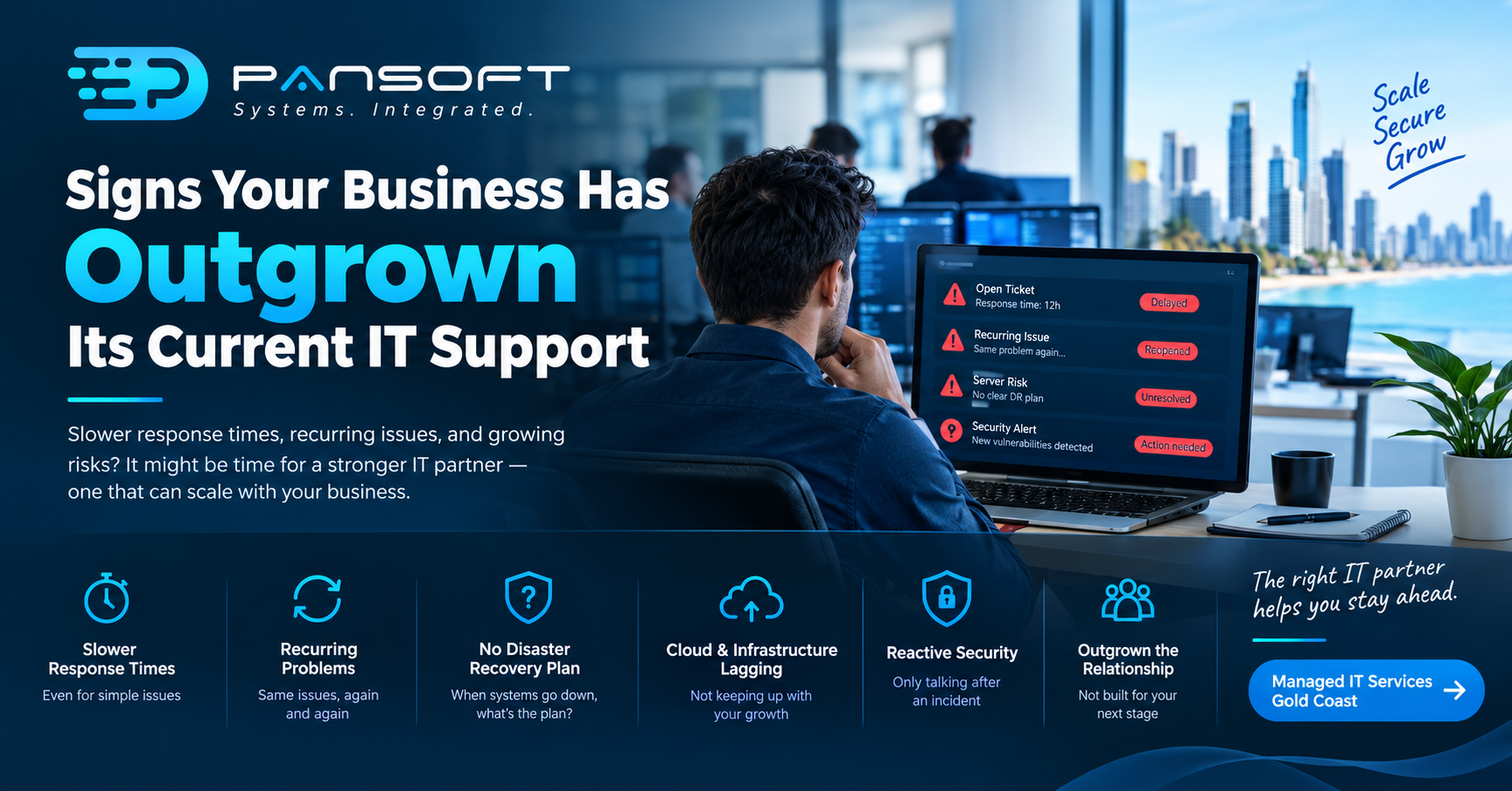
Signs Your Business Has Outgrown Its Current IT Support
If tickets are taking longer to close, your team keeps hitting the same recurring issues, and nobody can tell you with confidence what happens if a server goes down tonight your business has probably outgrown its current IT support. That’s not a criticism of the provider you started with. It’s just what happens when a company grows faster than the systems supporting it.
Most Gold Coast businesses don’t notice this shift happening. It creeps in. The IT setup that worked fine for a ten-person office starts groaning under the weight of thirty staff, three office locations, or a client base that now expects uptime around the clock. By the time the cracks are obvious a breach, a long outage, a compliance audit gone wrong the cost of catching up is far higher than the cost of scaling ahead of the problem.
Why this matters more than most business owners realise
IT support isn’t a fixed cost you set once and forget. It’s meant to scale with the complexity of what you’re running. A single technician or a small local IT support Gold Coast provider can be brilliant for a business with modest needs simple networks, a handful of applications, predictable traffic. But complexity doesn’t grow in a straight line. Add a second office, a cloud migration, a handful of new SaaS tools, and a few remote staff, and suddenly the support model that used to work is stretched thin in ways that aren’t always visible until something breaks.
The businesses that handle this well treat IT support as an evolving relationship, not a fixed contract. The ones that struggle tend to keep the same setup out of habit, long after it stopped matching what the business actually needs.
The signs to watch for
Response times are creeping up, even for small issues. When a provider is stretched across too many clients or lacks the depth of team to handle your volume, even routine requests start taking longer. If a password reset or software install now takes a day instead of an hour, that’s a resourcing problem, not a one-off blip.
The same problems keep coming back. A support desk that patches symptoms instead of fixing root causes will feel fine short-term and cost you dearly over a year. If your team is raising the same ticket every few weeks, that’s a sign the underlying infrastructure needs a proper review, not another quick fix.
Nobody has a real answer for “what’s our disaster recovery plan?” This question catches a lot of businesses out. As operations scale, so does what’s at stake if systems go down lost revenue, damaged client trust, regulatory exposure. A provider still running on a break-fix mindset usually hasn’t built this out properly, because it wasn’t needed when the business was smaller.
Your provider can’t keep pace with cloud and infrastructure decisions. Moving workloads to the cloud, securing hybrid environments, or scaling storage and compute as demand grows requires a level of engineering depth that some smaller support arrangements simply don’t have. If every conversation about cloud strategy turns into “let us look into that,” it’s worth asking whether you need a partner offering genuinely scalable IT services Australia-wide businesses actually rely on.
Security conversations feel reactive rather than proactive. As a business grows, so does its attack surface more staff, more devices, more third-party integrations. If your current provider only talks about security after something’s gone wrong, that’s a gap that gets more expensive to close the longer it’s left.
You’re outgrowing the relationship, not just the technology. Sometimes it’s less about capability and more about fit. A provider set up to service small local clients isn’t necessarily equipped structurally or in team size to deliver enterprise IT support once you’re managing multiple sites, stricter compliance requirements, or government and enterprise-grade contracts.
What “outgrowing” actually looks like in practice
It rarely arrives as one dramatic failure. It’s usually a string of smaller frustrations: a migration that took three times longer than promised, a security patch that should have been automatic, a strategic conversation your provider wasn’t equipped to have. Individually, each one seems manageable. Together, they’re a pattern worth paying attention to.
This is also where the difference between a local support desk and a genuine managed IT partner becomes obvious. The right partner isn’t just fixing what breaks they’re helping you plan two steps ahead, whether that’s infrastructure, cybersecurity, or cloud architecture built to handle where the business is heading next.
What to do about it
Start with an honest audit, not a knee-jerk switch. Look at ticket volume and response times over the last six months. Ask your current provider directly what their disaster recovery and security posture look like for a business your size. If the answers are vague, or the plan hasn’t changed since you were half the size you are now, that’s your signal.
From there, it’s worth having a conversation with a provider genuinely set up to deliver Managed IT Services Gold Coast businesses can lean on as they scale one with the depth of team and technical range to support you today and grow alongside you, rather than one you’ll need to replace again in eighteen months.
A few questions worth asking
How do I know if I need managed IT services instead of a single technician?
If your business has more than one location, handles sensitive client or financial data, or depends on systems being available outside business hours, a single technician usually can’t provide the depth or redundancy required. A managed services model spreads that responsibility across a full team.
Will switching providers disrupt our operations?
A well-run transition shouldn’t cause downtime. A capable provider will run a proper handover process documenting your environment, migrating access and credentials carefully, and scheduling any changes outside business hours.
How much does enterprise-grade IT support actually cost?
This varies significantly depending on team size, infrastructure complexity, and compliance requirements.
Where to go from here
If any of this sounds familiar, it’s worth having a conversation before the next outage forces the issue. Get in touch with Pansoft Technologies for a straightforward chat about where your current setup stands and what scaling it properly would actually involve.

Related Posts

What Makes an IT Company Trustworthy for Government and Enterprise Work?
What Makes an IT Company Trustworthy for Government and Enterprise Work? A trustworthy IT company for government and enterprise work has three things most decision-makers…
Read More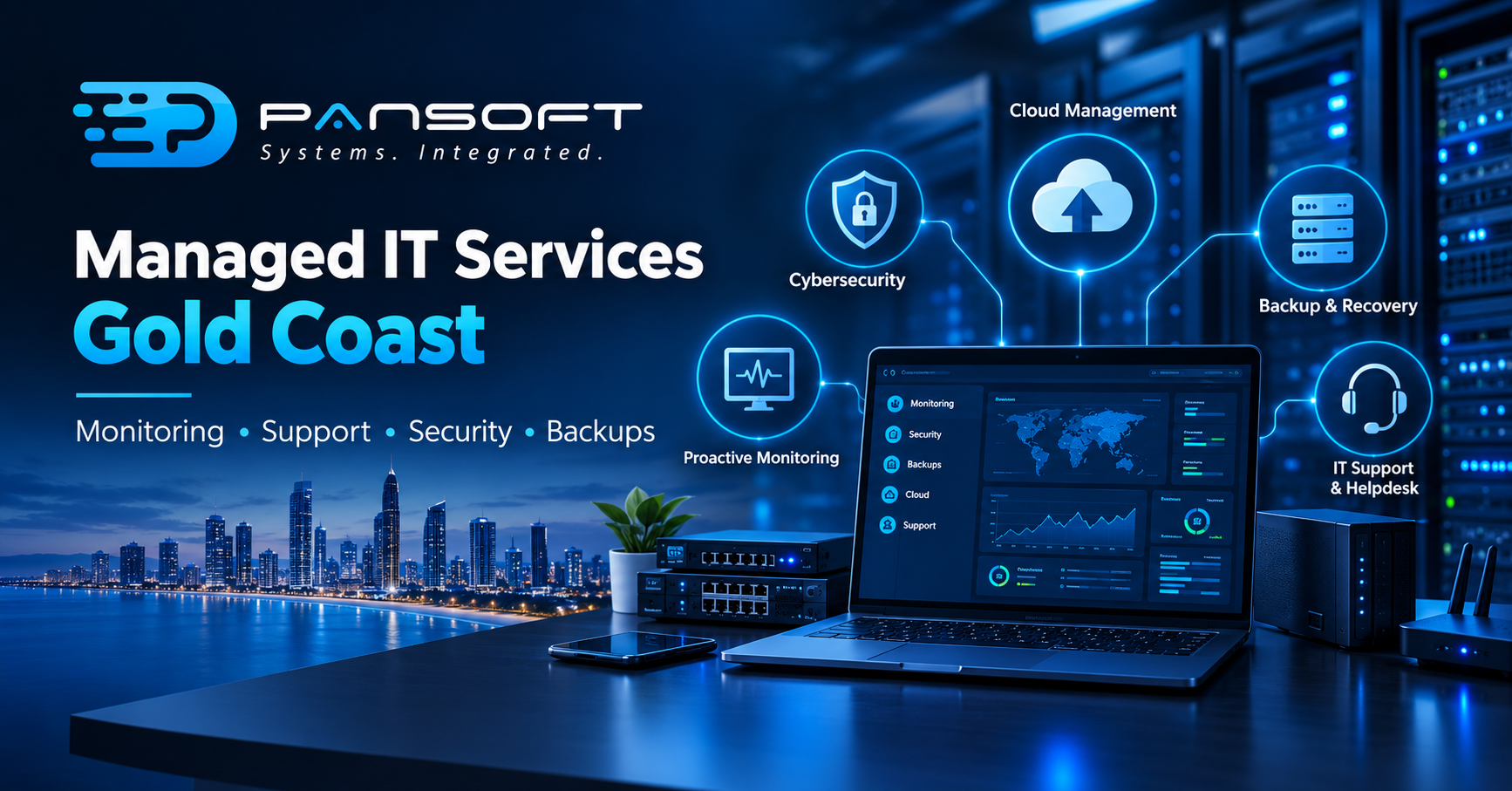
Managed IT Services Gold Coast: What Does a Managed IT Services Provider Actually Do?
Managed IT Services Gold Coast: What Does a Managed IT Services Provider Actually Do? Short version: a managed IT services provider watches, patches, backs up…
Read More