
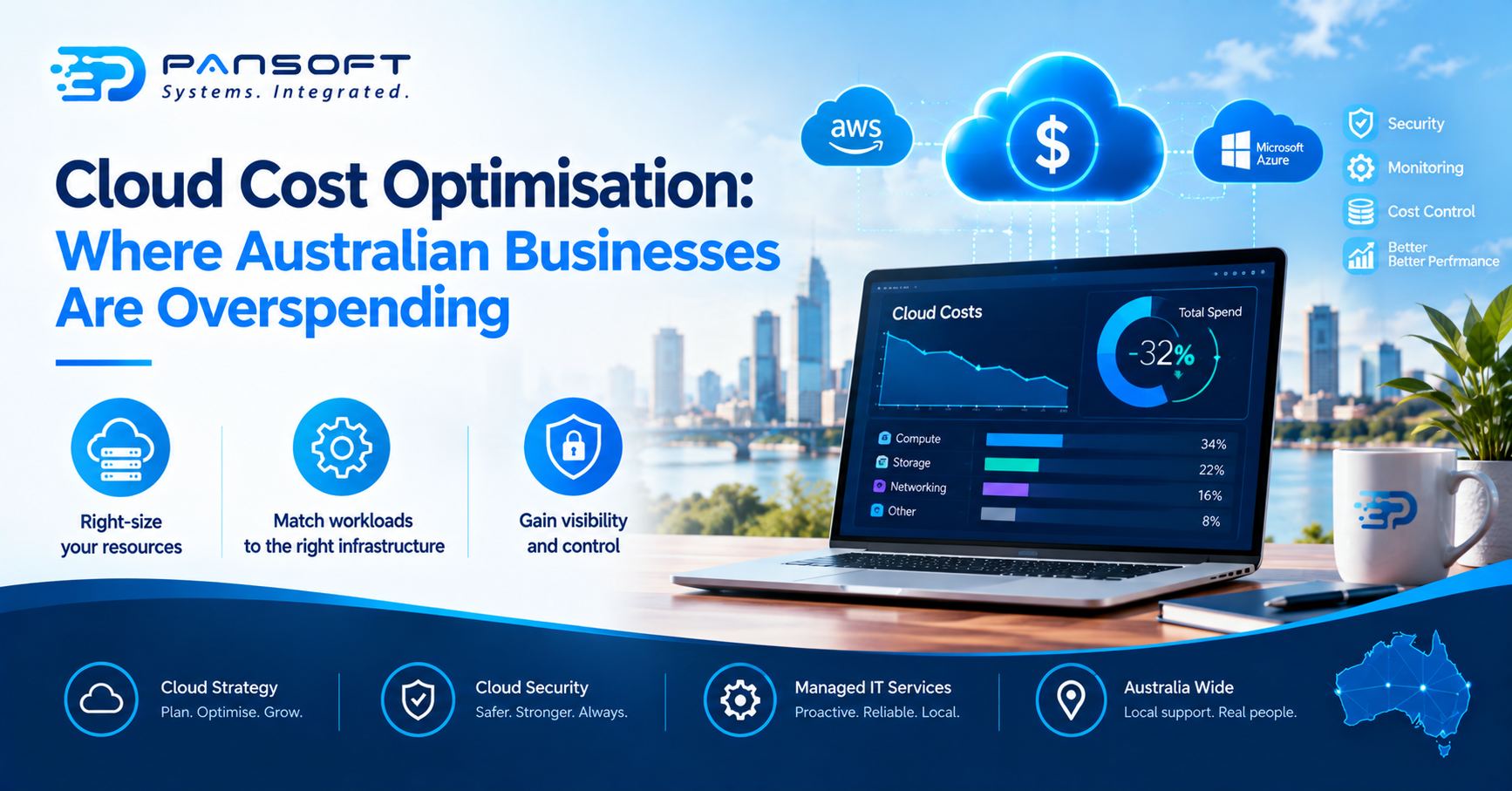
Cloud Cost Optimization: Where Australian Businesses Are Overspending
Most cloud overspend in Australian businesses comes down to three habits: paying for capacity nobody’s using, running the same workload on more expensive infrastructure than it needs, and losing track of what’s actually costing money because nobody owns the bill. Cloud cost optimisation isn’t really about finding a cheaper provider. It’s about fixing those three habits, in that order.
That’s a fairly blunt way to put it, but it saves a lot of time compared to the usual advice about “rightsizing” and “reserved instances” without explaining why those things matter in the first place.
Paying for Capacity Nobody’s Using
This is the single biggest source of waste, and it happens for a boring reason: provisioning for peak load and never scaling back down. A business sets up infrastructure to handle its busiest day, then leaves that capacity running every single day of the year, most of them nowhere near that busy.
Auto-scaling exists specifically to solve this, but a lot of businesses either never set it up properly or configure it once and forget about it as workloads change. Development and testing environments are another common culprit. They get spun up for a project, the project finishes, and the environment keeps running quietly in the background because nobody remembered to switch it off.
Running Workloads on Infrastructure That Doesn’t Fit
The second habit is subtler. A workload gets provisioned once, usually with a bit of headroom built in “just in case,” and then it sits on that same infrastructure tier for years, regardless of whether the actual usage pattern has changed.
Storage is a classic example. Data that’s accessed constantly needs to sit on fast, more expensive storage. Data that’s rarely touched, old logs, historical records, backups, doesn’t. Plenty of businesses put everything on the same tier because it’s simpler to set up, and simply never revisit that decision once things are running.
Compute has the same problem in reverse. A workload sized for a busy quarter often keeps running at that size well after demand has settled back down. Multiply that across dozens of services and the gap between what’s provisioned and what’s actually needed adds up fast.
Losing Track of What’s Actually Costing Money
The third habit is the one that makes the first two hard to fix. In a lot of businesses, cloud spend isn’t owned by anyone specific. It shows up as a single line item on a finance report, nobody’s really sure which team or project is driving it, and nobody has the visibility to ask the right questions.
This is where cloud monitoring and management stops being a nice-to-have and becomes the thing that actually saves money. Proper cost visibility means being able to see spend broken down by service, by team, by environment, so that when something spikes, someone can actually trace why and decide whether it’s justified.
Without that visibility, cost optimisation turns into guesswork. With it, most businesses find a handful of clear, addressable issues within the first proper review.
Why This Isn’t Just a Finance Problem
Here’s where things get tied together more than people expect. A lot of what drives cost also drives risk. Development environments left running aren’t just wasting money, they’re also unpatched, unmonitored surfaces that nobody’s watching. Storage that’s never been reviewed for cost is also storage that’s probably never been reviewed for who has access to it.
Good cloud security solutions and good cost management tend to go hand in hand, because both come from the same underlying discipline: knowing what you’re running, why it’s running, and who’s responsible for it. Businesses that treat cost optimisation purely as a finance exercise usually miss this connection, and end up fixing the spend problem while leaving the security gap wide open right next to it.
AWS vs Azure: Where the Cost Structures Actually Differ
Platform choice matters here too, though maybe less than people assume. Both AWS and Microsoft Azure offer genuinely solid cost management tooling, but they’re built around slightly different assumptions. AWS tends to reward granular, workload-by-workload optimisation, useful if you’ve got the internal capability to actually do that analysis regularly. Azure cloud migration often has an easier path to savings for businesses already licensed heavily through Microsoft, since existing agreements can offset a fair chunk of infrastructure cost.
Neither platform fixes bad habits on its own. A business that’s provisioning wastefully on AWS will do the same thing on Azure. The tooling helps you see the problem clearly. It doesn’t solve it for you.
Getting the Fundamentals Right First
Before diving into specific optimisation tactics, it’s worth stepping back. Proper Cloud Migration and Infrastructure Services Australia businesses actually benefit from start with the architecture decision, not the discount hunting. If workloads are placed sensibly from the outset, matched to the right storage tier, the right compute size, the right region, a huge portion of the cost problem never shows up in the first place.
This is really where a genuine cloud strategy conversation earns its keep. Not “which provider is cheaper,” but “what does this specific workload actually need, and where should it sit.” Get that right, and ongoing cost optimisation becomes maintenance rather than damage control.
A Practical Starting Point
If cost optimisation feels overwhelming, it doesn’t need a full architecture overhaul to start. A reasonable first pass looks like this:
- Identify anything running that isn’t actively being used, old test environments, orphaned storage, unused reserved capacity
- Check whether workloads are still sized for demand they no longer have
- Get actual visibility into spend by team or project, not just a total line item
- Review storage tiers against how frequently that data is actually accessed
None of this requires exotic tooling. It requires someone actually sitting down and looking, which is the step most businesses skip.
A Few Questions Worth Asking
Does cloud cost optimisation mean moving to a cheaper provider?
Rarely. Most savings come from fixing how existing infrastructure is used, not from switching platforms. Provider migration usually costs more upfront than it saves, unless there’s a specific structural reason to move.
How often should cloud spend actually be reviewed?
[Specific review cadence should be confirmed with the team based on your environment’s size and rate of change, rather than a general figure.] As a rough principle, quarterly reviews catch most drift before it becomes expensive.
Is cost optimisation a one-off project or an ongoing process?
Ongoing. A one-off cleanup helps immediately, but usage patterns shift, teams spin up new services, and without regular review the same waste tends to creep back in within a year.
Where to Go From Here
If cloud spend has been climbing without a clear reason why, that’s usually a sign it’s time for a proper look rather than another guess at what to cut. Get in touch with the Pansoft team for a straightforward conversation about your cloud implementation strategy and where the real savings are likely sitting.

Related Posts

Microsoft Azure Consulting Partner vs DIY Migration: What Actually Goes Wrong
Microsoft Azure Consulting Partner vs DIY Migration: What Actually Goes Wrong Here’s the plain version: a DIY migration tends to run fine right up until…
Read More
What Is a Common Azure Customer Cloud Migration Strategy?
What Is a Common Azure Customer Cloud Migration Strategy? Most Azure customers end up following some version of Microsoft’s own Cloud Adoption Framework, even if…
Read More