
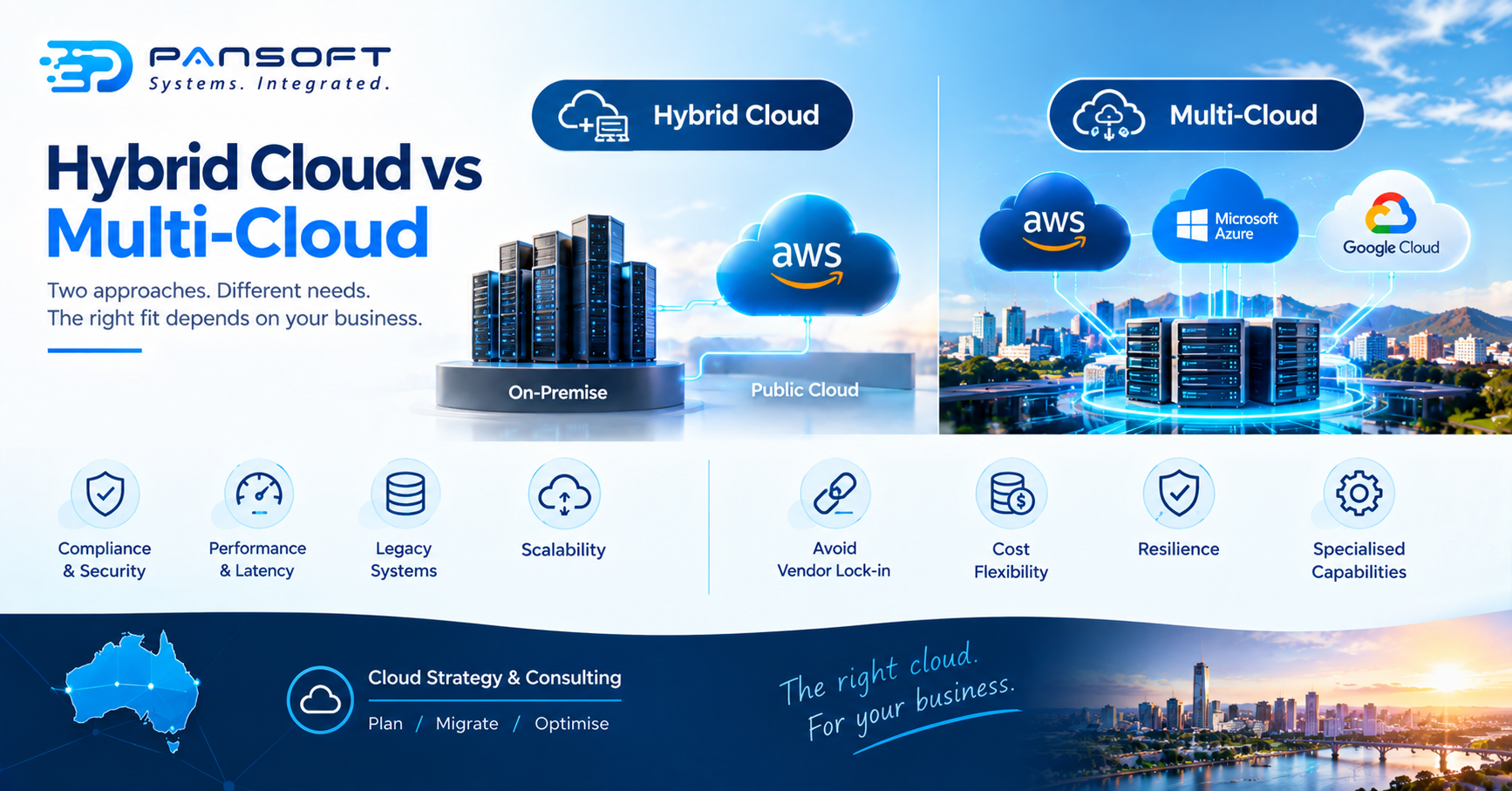
Hybrid Cloud vs Multi-Cloud: What’s the Difference and Which Fits Your Business
Hybrid cloud means running a mix of on-premise infrastructure and one public cloud platform together, as a single connected environment. Multi-cloud means running workloads across two or more public cloud providers, usually without any on-premise component involved at all. They get used interchangeably a lot, which causes real confusion when businesses are trying to plan an actual hybrid and multi-cloud strategy, so it’s worth being precise about which one you’re actually talking about before deciding which fits.
Here’s the thing most vendors won’t tell you upfront: neither approach is inherently better. Each solves a different problem, and picking the wrong one usually shows up later as unnecessary complexity or cost you didn’t plan for.
Hybrid Cloud: Keeping One Foot on the Ground
Hybrid cloud makes sense when a business has legitimate reasons to keep some systems on-premise, data sovereignty requirements, legacy applications that aren’t worth re-platforming yet, or workloads with latency needs that a data centre down the road handles better than one interstate. The public cloud component then handles everything that benefits from elasticity: burst capacity, disaster recovery, development environments, that sort of thing.
A well-designed hybrid cloud architecture treats the on-premise and cloud sides as one system rather than two separate ones bolted together. That distinction matters more than people expect. A lot of “hybrid” setups in practice are really just on-premise infrastructure with a cloud backup tacked on, no real integration, no consistent security policy across both, no unified monitoring. That’s not hybrid cloud in any meaningful sense. It’s two environments that happen to share a network cable.
Multi-Cloud: Spreading the Risk, and the Complexity
Multi-cloud gets chosen for different reasons entirely. Sometimes it’s deliberate, avoiding vendor lock-in, taking advantage of specific strengths across providers (AI tooling on one platform, cost efficiency on another), or meeting a client or regulatory requirement to avoid concentrating everything with a single vendor. Sometimes it’s accidental, different teams picked different platforms over the years and nobody’s consolidated since.
The deliberate version can genuinely strengthen resilience and give a business real negotiating leverage. The accidental version tends to just multiply your operational overhead: more platforms to secure, more skill sets your team needs to maintain, more places for configuration drift to creep in unnoticed. Multi-cloud management done properly requires tooling and governance that a lot of businesses underestimate when they start down this path.
The Real Question: What Problem Are You Actually Solving?
This is where a lot of businesses get the decision backwards. They pick hybrid or multi-cloud based on what a competitor’s doing, or because a vendor pitched it well, rather than starting from their own constraints. The better starting point is asking what’s actually driving the need: compliance obligations, cost pressure, performance requirements, or resilience against a single point of failure.
If the honest answer is “we need to keep certain data on-premise for compliance reasons but want cloud elasticity for everything else,” that’s a hybrid cloud conversation. If it’s “we don’t want to be dependent on one vendor for critical infrastructure,” that’s a multi-cloud conversation. If it’s genuinely both, and for larger enterprises it often is, you end up with something that combines both approaches, which is where things get genuinely complex and where proper cloud strategy consulting earns its keep rather than being an optional extra.
Cost: Where the Assumptions Usually Go Wrong
A common assumption is that multi-cloud automatically saves money by letting you shop around for the best price per workload. In practice, it often does the opposite once you factor in the overhead of managing multiple billing structures, duplicated tooling, and the specialist knowledge needed across platforms. Hybrid cloud has its own cost trap too: keeping on-premise infrastructure running alongside cloud spend can mean paying for both without a clear plan to retire the legacy side over time.
Proper cloud cost optimisation Australia businesses actually benefit from usually comes down to workload placement decisions made deliberately, not defaulted into. Which workloads genuinely need to sit where, and why, rather than everything ending up wherever was easiest to provision at the time.
Choosing Between AWS and Azure (Or Both)
Whichever path fits, the platform choice underneath still matters. For businesses leaning toward a single primary cloud within a hybrid setup, or comparing platforms as part of a multi-cloud strategy, AWS and Microsoft Azure both offer genuinely mature hybrid capabilities, though they approach it differently in terms of tooling and integration with existing Microsoft environments. For organisations already running Windows Server or Microsoft 365 heavily, Azure cloud migration often has a shorter path to value simply because of existing familiarity and licensing alignment. For businesses wanting the broadest service catalogue and the most mature multi-cloud tooling ecosystem, AWS tends to have the edge.
Neither answer is universal. It depends on what’s already running in your environment and where your team’s existing expertise sits.
Where Local Support Actually Matters
Getting this right isn’t purely a technical exercise. It benefits from someone who understands both the platforms and the practical realities of running infrastructure for an Australian business, data residency expectations, regional latency, and the compliance landscape specifically. Working with a provider offering genuine Cloud Solutions Gold Coast businesses can actually sit down with, rather than a call centre in a different time zone, tends to make the difference between a cloud migration strategy Australia businesses can execute confidently and one that stalls halfway through.
Proper cloud infrastructure services should cover the full lifecycle too, not just the initial migration. Ongoing monitoring, cost management, and architecture reviews as the business grows matter just as much as getting the initial cloud implementation strategy right on day one.
A Few Questions Worth Asking
Can a business move from hybrid to multi-cloud later, or does the choice lock you in?
Generally, yes, it’s not a permanent decision. Many businesses start hybrid and add a second cloud provider later as specific needs arise. The main thing to get right early is avoiding tight coupling to one platform’s proprietary tools, which makes a later shift harder.
Is multi-cloud only for large enterprises?
Not exclusively, though the operational overhead does mean it suits businesses with the internal capacity, or the right managed partner, to handle the added complexity. Smaller businesses often get more value starting with a well-architected hybrid setup first.
How long does a typical hybrid or multi-cloud migration take?
This varies significantly depending on the number of workloads, existing infrastructure, and compliance requirements involved. [Specific timelines should be confirmed directly with the team based on your current environment, rather than estimated generally.]
Where to Go From Here
If you’re trying to work out whether hybrid or multi-cloud actually fits your business, rather than just sounds right, that’s worth a proper conversation before committing to either path. Get in touch with the Pansoft team for a straightforward chat about what makes sense for where you’re at.

Related Posts
Microsoft Azure Consulting Partner vs DIY Migration: What Actually Goes Wrong
Microsoft Azure Consulting Partner vs DIY Migration: What Actually Goes Wrong Here’s the plain version: a DIY migration tends to run fine right up until…
Read More
What Is a Common Azure Customer Cloud Migration Strategy?
What Is a Common Azure Customer Cloud Migration Strategy? Most Azure customers end up following some version of Microsoft’s own Cloud Adoption Framework, even if…
Read More