
What Are Cyber Security Solutions? A Plain-English Breakdown for Business Owners
Cyber security solutions are everything a business puts in place to keep attackers out, notice when they get in anyway, and get back to normal afterwards. Some of that is software. A good deal of it is people and habits, like who approves a change to a supplier’s bank details, or who gets the phone call at 2am.
That’s why asking for “a cyber security solution”, as if it were one purchase, tends to go sideways. What you’re really building is a set of overlapping protections, sized to what your business holds and how much downtime it can stomach.
Before looking at any products, try two questions. What would hurt most to lose? And how long could you trade without your systems? Nearly everything below follows from those answers.
What are cyber security solutions made of?
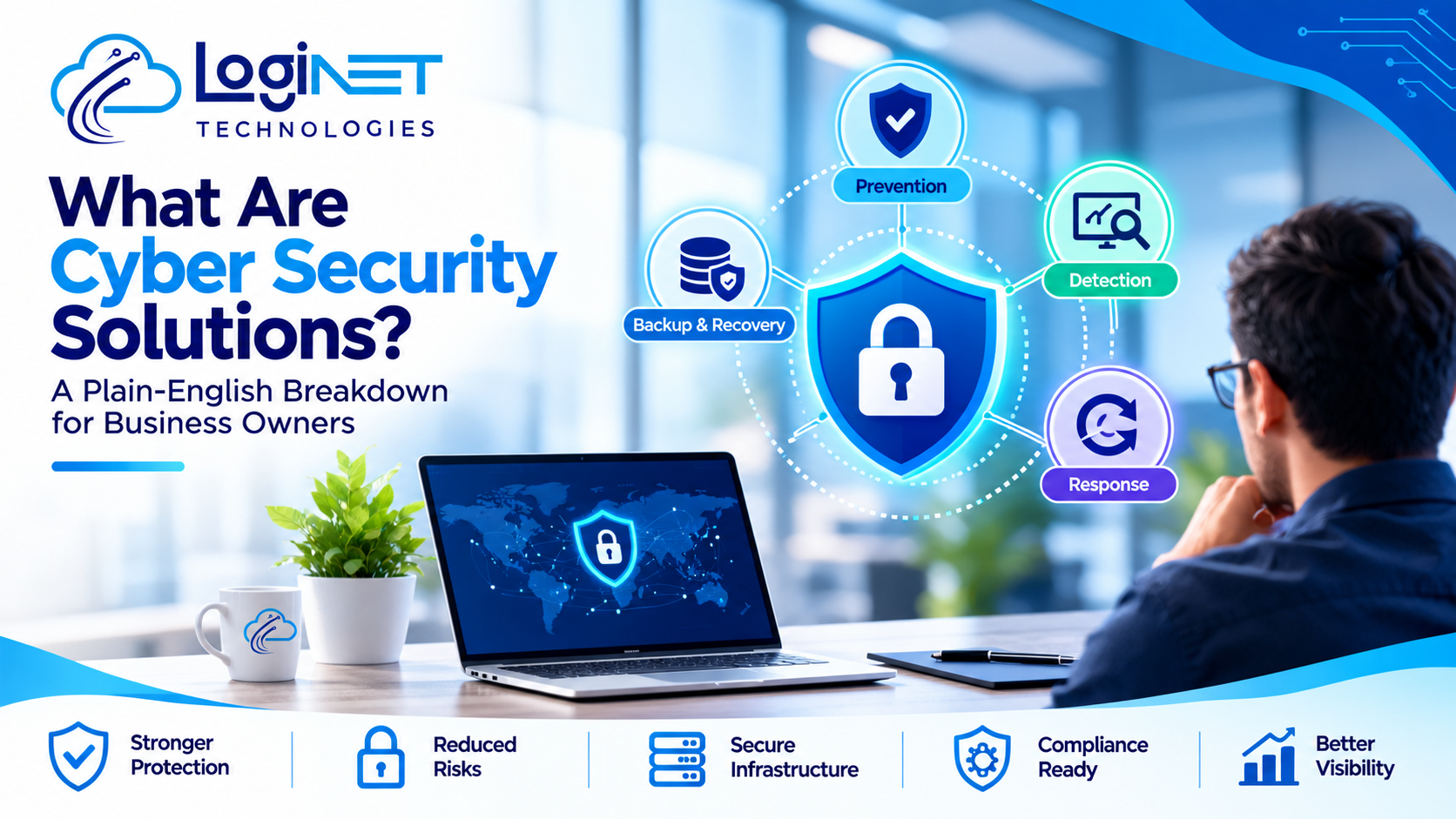
Four jobs need doing: stopping attacks, spotting the ones that slip through, responding, and keeping the whole effort accountable. Providers slice this up differently, but the jobs stay the same.
Stopping attacks is the part everyone pictures. Firewalls, endpoint protection on laptops and servers, email filtering, multi-factor authentication, patching, backups, and firm control over who can open what. Dull work, honestly. But most successful attacks still arrive through a convincing email, a reused password or software nobody got round to updating, so doing the basics properly beats buying something clever and deploying half of it.
Spotting attacks matters because eventually something will get past you. Threat detection and response means pulling signals from laptops, cloud apps, email and the network into one place, then having a person who can tell “that’s a real problem” from “that’s just Tuesday”. A dashboard full of unread alerts doesn’t count.
Responding is where many businesses find out they never made a plan. Incident response planning settles the uncomfortable questions in advance. Who can decide to pull a server offline? Who rings the insurer and the lawyer? How will customers hear about an incident, and who speaks to them? Has anyone actually tried restoring from backup? It’s far easier to work through those on a quiet afternoon than in the middle of an outage.
Accountability covers policies, staff training, supplier risk, and the evidence that you do what you say you do. Cyber security compliance in Australia depends heavily on your industry and on what your customers and contracts demand, so it’s worth knowing early which obligations actually apply to you.
Why the Essential Eight keeps coming up
If you’ve dealt with an Australian IT provider lately, someone has probably mentioned the Essential Eight. It’s a set of eight mitigation strategies from the Australian Signals Directorate, published through the Australian Cyber Security Centre. Between them they cover which software is allowed to run, keeping applications and operating systems patched, tightening Office macros and other application settings, limiting administrator access, requiring multi-factor authentication, and keeping backups you can restore from.
The ACSC’s Essential Eight maturity model defines four maturity levels, zero to three, so you can choose a target and measure yourself against it. Its advice is to bring all eight up to the same level before aiming higher, rather than polishing one control while another sits neglected.
Essential Eight alignment makes a sensible baseline, and the ACSC is upfront that it won’t stop every threat. Some organisations will need more than the eight, depending on what they run and who they serve.
Start by finding out what you actually have
Buying tools before you understand your environment is a common and expensive mistake. You end up paying twice for some protections and nothing for others. An independent security assessment fixes that by looking at your systems, accounts, data and existing controls, then comparing what it finds with a recognised baseline, the Essential Eight being the obvious one here.
Security assessment and consulting work is only worth paying for if it finishes with a ranked list. Not a hundred-page report that sits in a shared drive, but a clear view of what’s most exposed, what can be fixed quickly, what needs budget and what can wait. That list is what lets a business or IT decision-maker fund security in stages instead of treating it as one enormous, vague worry.
Doing it yourself, or getting help
Plenty of internal IT teams handle prevention well. Where they struggle is detection, because nobody can watch systems around the clock while also fixing laptops and delivering projects. This gap is why many organisations bring in managed IT security services, where an outside team handles monitoring, alert triage and response support next to your own staff.
The engine behind that model is a security operations centre: people and tooling that watch for suspicious activity and act on it. Building your own is rarely realistic for a mid-sized business, which is where a managed SOC service fits, giving you that coverage without hiring a full roster.
If you’re comparing cyber security services Australia-wide, a few questions separate substance from sales talk:
- What’s actually covered? Ask for a plain list of the systems, accounts and cloud services being monitored, and what sits outside it.
- Who acts on an alert, and when? A named person responding at 3am is worth more than a long feature list.
- How will we hear about it? Updates should make sense to your leadership team without a glossary.
Common questions
How much do cyber security solutions cost?
It varies a lot with your size, systems and the coverage you need, so a number plucked from the air wouldn’t mean much. A short conversation about your environment gets you a realistic range instead of a generic quote.
Does a small business need all of this?
Not at the same depth. Every business does need the foundations, though: multi-factor authentication, regular patching, backups you’ve tested, and a basic plan for a bad day. Monitoring and formal governance can grow alongside the business.
How can I tell whether our current protection is adequate?
It’s hard to judge from the inside, and most people overestimate their coverage. Comparing your current controls with a baseline like the Essential Eight shows where you’re genuinely protected and where you’re hoping for the best. An assessment puts evidence behind that comparison.
Talk it through with Pansoft
If you’re not sure where your business stands, a conversation is an easy place to begin. Pansoft can talk you through what a sensible setup might look like for your size and risk, with nothing to sign and no pressure to proceed. There’s more on our approach on the cyber security page, and you’re welcome to get in touch whenever it suits.

Related Posts

Cyber Security for Small Business in Queensland: Where to Start First
Cyber Security for Small Business in Queensland: Where to Start First Start with an assessment, not a shopping list. Before you commit to any cyber…
Read More
What Is a Managed Cyber Security Service, and What Should Be Included?
What Is a Managed Cyber Security Service, and What Should Be Included? Picture a login alert going off at 2am on a Saturday. The only…
Read More