
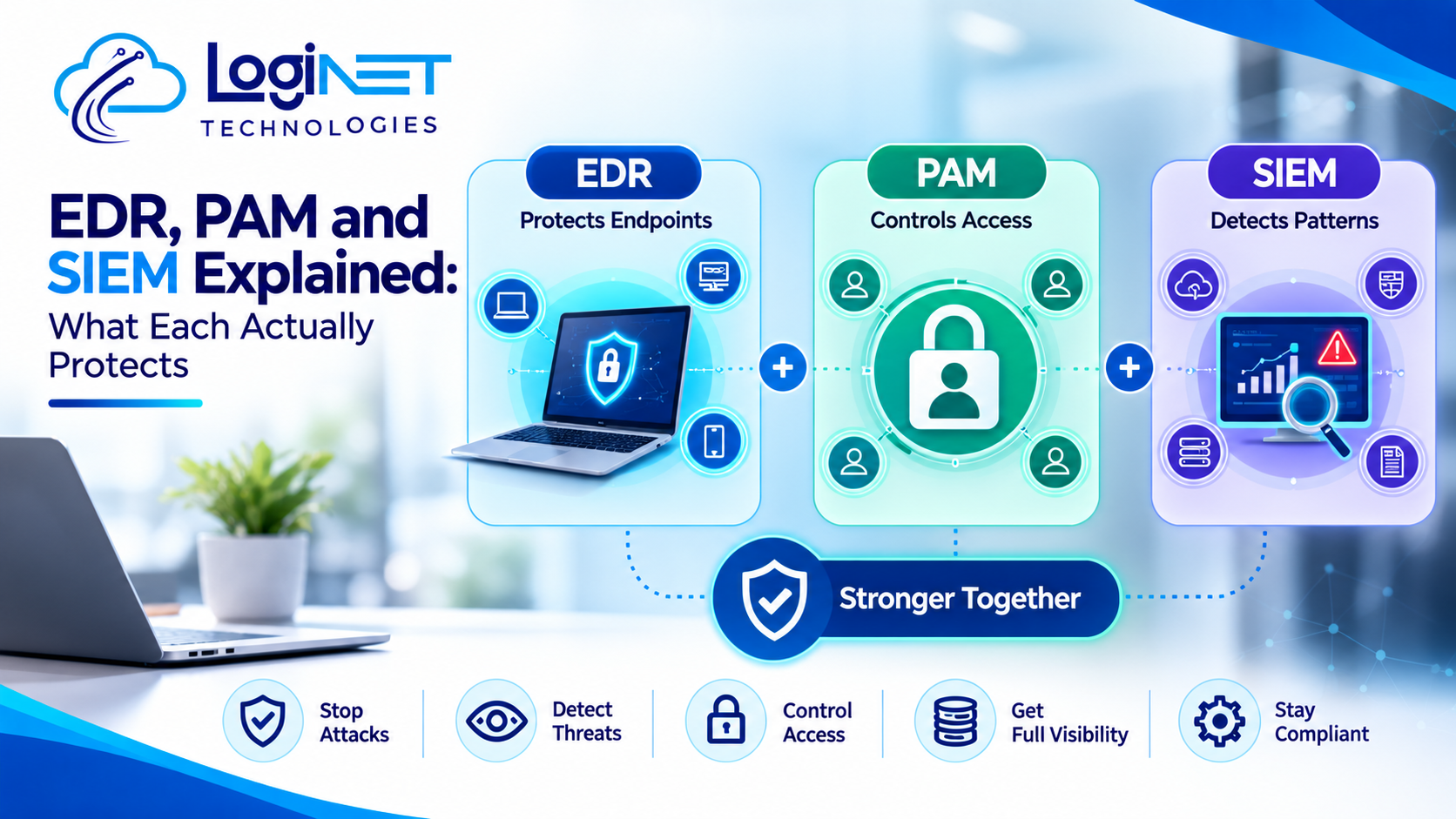
EDR, PAM and SIEM Explained: What Each Actually Protects
What is EDR solution in cyber security? It’s the question most vendors lead with, and someone asked me last week why their IT provider wanted three different security tools when, in their mind, one should probably do the job. Fair thing to wonder. But EDR, PAM and SIEM aren’t really competing for the same job. They’re not even close. Each one covers something the other two genuinely can’t.
EDR watches devices. PAM watches access. SIEM watches patterns across everything else. Skip one and there’s a hole, full stop, no matter how good the other two happen to be.
EDR: the thing watching your laptops and servers
Endpoint detection and response sits directly on the device, laptop, server, whatever, and looks for behaviour that’s off. Not a known virus signature (that’s what old antivirus did, and badly). Behaviour. A process launching other processes it has no reason to launch. A pile of files getting encrypted one after another, fast. A machine suddenly trying to phone home to a server it’s never once talked to.
Good EDR doesn’t sit on that information. It cuts the device off the network immediately, before a human’s even looked at it, and lets someone investigate from a position where the damage has already stopped spreading. That’s really the whole value proposition here, speed. Old antivirus told you something bad already happened, after the fact, usually too late to matter. EDR is trying to catch it mid-swing.
What it won’t do is see outward. One compromised laptop is one data point. It has no way of knowing that forty other machines across two offices just started doing the exact same thing at the exact same time. That’s not what it’s built for.
What is SIEM solution in cyber security? It’s the thing that fills the gap EDR leaves open.
Security information and event management tools pull logs in from basically everywhere, firewalls, apps, cloud services, the EDR agents themselves, and line it all up so a pattern actually shows itself.
One failed login means nothing. Genuinely nothing. Fifty failed logins against fifty separate accounts, all inside two minutes, from an IP that’s never shown up before? That’s a different story entirely. EDR might catch one of those fifty on one machine and stop there, job done as far as it’s concerned. SIEM is the thing that notices all fifty belong together and treats it as one real incident instead of fifty alerts nobody’s going to bother opening.
This is also just how a functioning Security Operations Centre actually runs day to day, for what it’s worth. Nobody’s sitting there manually comparing a dozen log files hoping something jumps out. The correlation’s already done. The analyst’s job starts where the SIEM’s work ends.
What is PAM solution in cyber security? A different conversation altogether.
This one’s not really about watching activity at all. It’s about who’s allowed near the dangerous stuff in the first place, domain admin accounts, database credentials, root access into whatever cloud environment you’re running. Privileged access management makes sure that kind of access only exists when it’s genuinely needed, only for as long as it’s needed, and gets logged the whole way through.
Attackers know exactly where to aim, and it’s rarely a regular employee’s laptop. Get into a domain admin account instead, and suddenly you’ve got the keys to more or less everything. PAM cuts that risk down by removing standing access wherever it can, forcing an approval step before anything sensitive happens, and keeping a proper record of who did what, when, so there’s something to look back on if it ever goes wrong.
Here’s the thing though, it’s one of the most commonly skipped pieces. Plenty of businesses have decent endpoint protection, reasonable monitoring, and then somehow a dozen people still walking around with full admin rights they haven’t used since March. Nobody did that on purpose. It just happens over time, and it’s usually one of the first things to surface during a proper security assessment and consulting review.
Why running just one of these leaves a gap
Strong EDR without any PAM in place still leaves you exposed if someone gets hold of a privileged account, because endpoint tools were never built to govern access to begin with, that’s simply outside their job description. Solid PAM without SIEM means there’s nobody watching for a wider attack that a single stolen credential might be the opening move of. And a good SIEM running without EDR means device-level detection is slower across the board, since you’re relying on other logs eventually catching what’s happening on that one machine.
All three together is closer to what actual threat detection and response looks like in practice. Not a single tool attempting to be everything. A few tools, each quietly handling a different part of the problem an attacker would otherwise just walk straight through.
And yes, compliance has opinions about this too
For a lot of Australian businesses this stopped being optional a while ago. Cyber security compliance Australia expectations, particularly around Essential Eight alignment, increasingly assume this exact layered setup. Restrict admin access. Watch for anything that looks wrong. Have an actual, tested plan for incident response planning, not a document nobody’s opened since the day it was written, relying on someone just happening to notice a problem.
None of this means buying all three tools on the same Tuesday afternoon out of panic. It means figuring out honestly where the current gaps sit, and closing them in whatever order actually matters most for your situation, rather than scrambling to cover everything at once after something’s already gone sideways.
A Few Questions Worth Asking
Do small businesses actually need all three?
Not necessarily, not all at once, and definitely not at full enterprise scale right out of the gate. A lot of smaller businesses start with solid endpoint protection and tighter access rules, then add proper monitoring once things get more complicated. What matters is what’s actually being protected and what a breach would realistically cost.
Budget’s tight, which one comes first?
Depends on where the actual gap is. If nobody’s keeping track of who holds admin rights, PAM usually buys more immediate risk reduction than stacking another monitoring tool on top of access controls that are already shaky.
Can we just set these up and leave them running?
Not really. These tools raise flags and enforce rules, sure, but somebody still has to look at what those flags mean and act on them. That’s the actual job of a managed security function, not the tools themselves, turning raw alerts into something that gets dealt with instead of piling up unread.
Where to Go From Here
Not sure where your setup’s actually thin across these three? Worth finding out properly instead of guessing. Get in touch with the Pansoft team for a straightforward chat about what your environment needs.

Related Posts
Top 10 Cyber Security Services in Australia: 2026 Guide
Top 10 Cyber Security Services in Australia: 2026 Guide Australians reported a cybercrime to the government once every six minutes in 2024-25, and the average…
Read More
Step-by-Step Guide to What Happens During a Cyber Security Assessment
Step-by-Step Guide to What Happens During a Cyber Security Assessment Cyber Security Assessment Services tend to follow roughly the same shape wherever you go. Someone…
Read More