
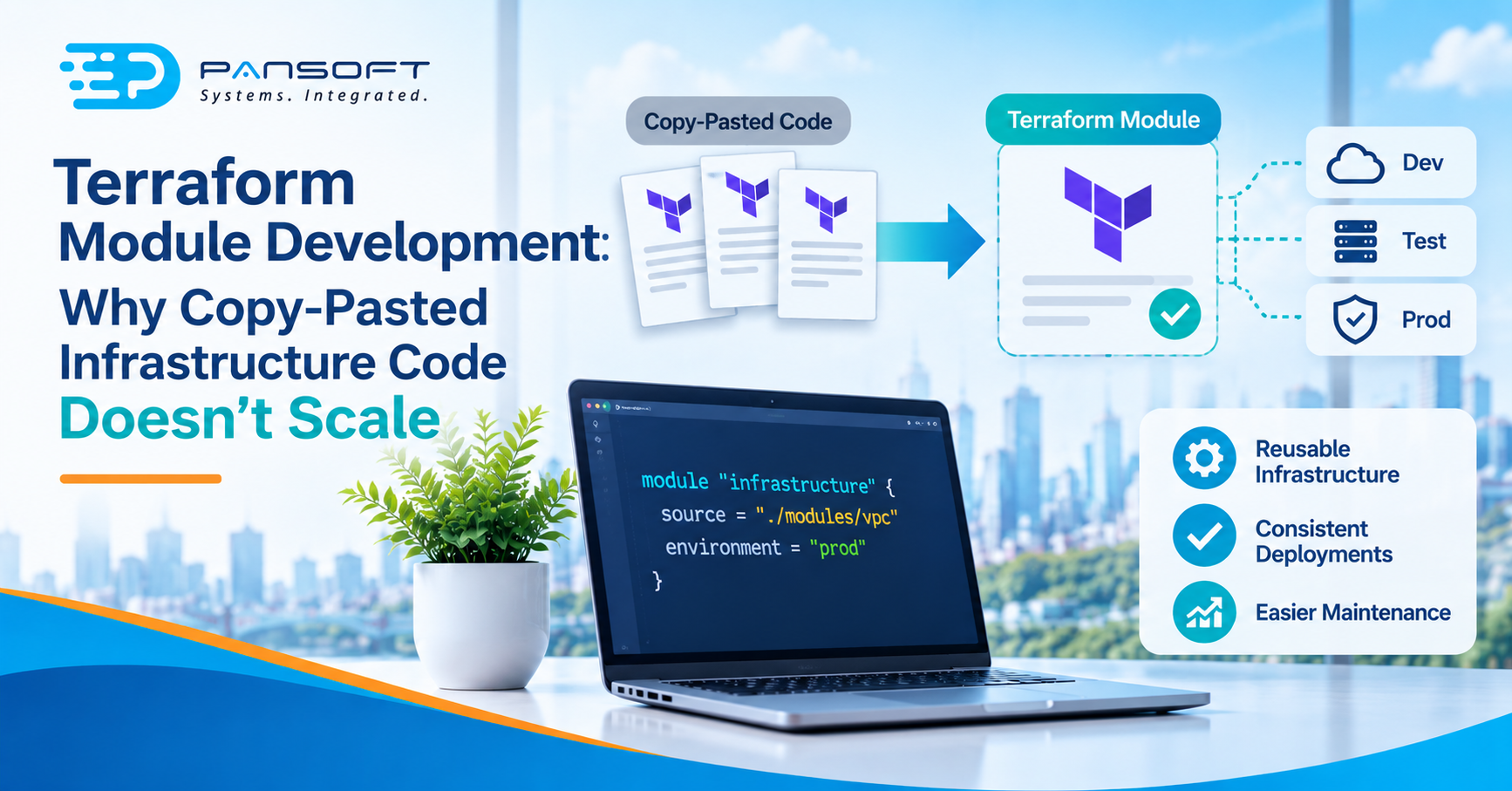
Terraform Module Development: Why Copy-Pasted Infrastructure Code Doesn’t Scale
Terraform Module Development replaces copy-pasted infrastructure code with one versioned definition that many environments share, so one fix reaches everywhere. It only pays off when a module describes a real concept. Wrapping single resources or nesting modules deeply just moves the mess somewhere else.
This is for IT leads and engineers whose Terraform files are starting to look like photocopies of each other. It sits alongside our wider DevOps guides.
Why does copy-pasted infrastructure code stop working?
Because every copy becomes a separate thing to fix. Change a firewall rule or a tagging standard and you have to find every duplicate, edit each one and hope none was missed.
Infrastructure as Code (IaC) is meant to make environments repeatable. Copy and paste quietly undoes that. The copies start identical, then someone tweaks one for an urgent job and doesn’t touch the others. Six months on, “the same” environment exists in four slightly different versions, and nobody can say which one is right.
That’s a gut-check you can run today. Pick two environments that should match and compare their files. If the differences surprise you, you’ve already got the problem.
What is a Terraform module, and when is it worth writing?
HashiCorp defines a module as a container for multiple resources that are used together. The point of writing one is to describe infrastructure by its architecture, not only by its individual objects.
The documentation sets a clear bar. A good module should raise the level of abstraction by describing a new concept in your architecture, and its example is a Consul cluster on AWS built from several resources. It also says HashiCorp doesn’t recommend modules that are thin wrappers around a single resource type, and warns that over-using modules can make a configuration harder to understand and maintain.
So the question isn’t “can this be a module?” It’s “does this group of resources mean something to the business?” A standard network layout, a hardened database setup or a cluster for container orchestration all qualify. One storage bucket with a renamed argument doesn’t.
How should a module be laid out?
Keep it boring and predictable. For modules that live in their own repository, Terraform describes a standard structure. The root module is the only required element. The recommended minimum files are main.tf as the primary entry point, variables.tf for variable declarations and outputs.tf for outputs.
Documentation is lighter than people expect. HashiCorp says the README doesn’t need to list inputs and outputs, because tooling generates that. Nested modules go under a modules/ subdirectory, called with relative paths.
One rule matters more than layout. HashiCorp strongly recommends keeping the module tree flat, with only one level of child modules in most cases. Modules should receive their dependencies from the root module instead of calling each other, so the same pieces can be connected in different ways.
| Choice | What HashiCorp’s documentation says | Why it matters |
|---|---|---|
| Wrapping one resource | Not recommended as a thin wrapper | Adds a layer without adding meaning |
| Depth of module calls | Keep the tree flat, one level in most cases | Deep nesting is hard to read and debug |
| Pinning a module | Use a version constraint, or a Git tag or commit | Callers choose when they take a change |
| Refactoring | Use moved blocks and keep the history | Existing resources aren’t destroyed |
The verdict: a few well-chosen modules beat a library of tiny ones. If you can’t explain a module in a sentence, it probably isn’t one yet.
How do you change a shared module without breaking everyone?
By versioning it, so callers choose when to move. For registry modules you add a version argument with a constraint. For Git-hosted modules, Terraform uses the default branch unless you pin a revision, such as a tag like v1.2.0 or a commit. After changing the source or version, you rerun terraform init, and the -upgrade flag moves an installed module to the latest version your constraint allows.
Refactoring is the trickier part. A moved block lets you change a resource’s address without destroying it. HashiCorp strongly recommends keeping all historical moved blocks from earlier versions, because removing one is a breaking change. For a private module where every user has applied the new version, removal can be safe.
This is where Terraform Infrastructure Automation earns its keep: module changes should be tested and promoted through a pipeline, not applied from a laptop. That’s the territory of CI/CD pipeline consulting Australia teams look for, and our DevOps consulting page covers that side. Checking plans for risky changes, such as open network rules, is part of everyday DevSecOps practices.
What might this look like in practice?
This is a hypothetical, not a client story. Picture a firm with three environments, each a copy of the same files. A security change means editing three places, and the production copy missed one last quarter.
The fix isn’t a big rewrite. They pick the part that’s duplicated most, the network layout, and turn it into one module with a pinned version. Test and production both call it. They use moved blocks so existing resources aren’t rebuilt.
It takes care and a quiet window. And some things will stay out of modules, because they only exist once.
What should you ask a provider?
Good Terraform Implementation help should start with your duplicated code, not with a module catalogue. Our Terraform page is the place to begin, and these questions are worth asking:
- Which parts deserve to be modules? Ask them to explain each choice in a sentence.
- How are versions pinned and promoted? And who decides when production takes a new one?
- What happens to existing resources? Ask how they’ll avoid destroying and rebuilding anything.
- How are modules tested before release? A named step in the pipeline, not “we check it”.
- Who maintains them afterwards? Modules need an owner, or they decay.
Quick questions
Is every Terraform configuration already a module?
Yes, in a sense. HashiCorp says the .tf files in your working directory form the root module. So you don’t need to adopt anything new to start. You extract a child module when a group of resources keeps repeating, and leave the rest alone.
Do we need modules if we only have one environment?
Probably not yet. Modules earn their cost when the same pattern is used more than once. With a single environment, a clear, well-organised root module may be simpler. If a second environment is coming, that’s a good moment to extract the first one.
How do we know a module is ready for other teams?
HashiCorp treats a nested module with a README as usable by an external user, and one without as internal. That’s advisory, not enforced. Beyond that, ready means it’s versioned, explained in a sentence, tested in the pipeline, and owned by a named person.
Want to talk it through?
If your Terraform files are starting to look like photocopies, get in touch and tell us what you run today. We’ll give you an honest view on whether modules are worth it yet, and no pressure either way.

Related Posts

Enterprise SD-WAN Platform Australia Buyers, Essential Multi-WAN Checks
Enterprise SD-WAN Platform Australia Buyers, Essential Multi-WAN Checks By the Pansoft Technologies team | Published 6 November 2026 | Last reviewed: November 2026 An enterprise…
Read More
What Is Zero-Touch Deployment? Essential Facts for Multi-Site Rollouts
What Is Zero-Touch Deployment? Essential Facts for Multi-Site Rollouts By the Pansoft Technologies team | Published 6 November 2026 | Last reviewed: November 2026 Zero-touch…
Read More