
SD-WAN vs Traditional WAN: What Changes for a Multi-Site Business
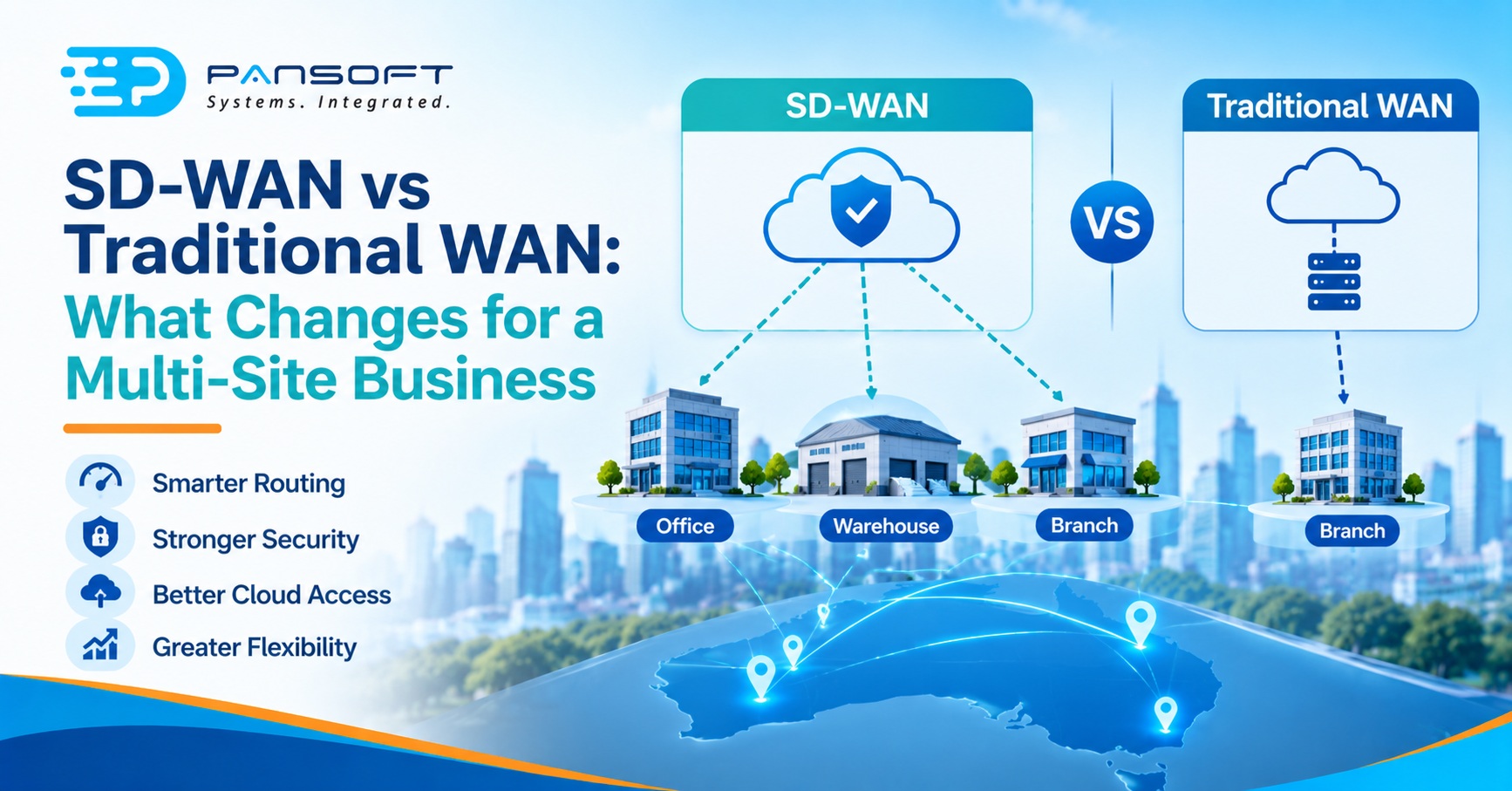
For SD-WAN solutions Australia businesses compare, the core change is control: software picks the path for each application across several connections, instead of every site depending on one fixed carrier circuit. It isn’t automatically cheaper or better. It depends on your sites.
This is for owners and IT leads running several offices, stores or depots, and deciding whether the WAN needs rethinking. It builds on our enterprise networking guides.
What’s the real difference between SD-WAN and a traditional WAN?
A traditional WAN ties each site to a carrier-provisioned circuit, with paths the carrier largely decides. SD-WAN sits on top of whatever connections you have and chooses between them using rules you set.
The industry body MEF framed it in 2019 as SD-WAN running over-the-top on a variety of underlay networks, “likely in combination”, to deliver application-aware, policy-driven connectivity, as reported by Light Reading. The words that matter are “application-aware” and “policy-driven”. Video calls, card payments and a nightly backup can each be treated differently, which a single fixed circuit can’t do.
What changes day to day?
Mostly how fast you can change things, how quality is handled, and where security gets applied. The comparison below comes from Cloudflare’s explainer. Cloudflare sells networking services and gives no benchmarks or pricing, so read the claims as direction, not measurement.
| Area | Traditional WAN (MPLS-style) | SD-WAN | Watch for |
|---|---|---|---|
| Changing policy | Routes changed manually, slower provisioning | Policies set centrally and pushed to all locations | Someone has to own those policies |
| Quality of service | Often includes quality-of-service guarantees | Uses best-effort internet and may see occasional packet loss, which smart steering usually offsets | Ask how failover is tested |
| Encryption | Not natively encrypted, so a separate VPN is needed | Security can be integrated directly | Integrated isn’t the same as designed |
| Cloud access | Needs a specialised service or a direct route to each cloud | Smart routing speeds up cloud applications | Check the cloud design too |
| Cost | Described as costly and slower to set up | Described as often more flexible and cost-effective | Verify against real quotes |
The verdict: SD-WAN wins on agility and cloud access. A traditional WAN’s strength is predictable, carrier-backed quality. Neither is right for every site, and the quality guarantees matter most for a handful of critical ones.
Do SD-WAN solutions in Australia mean replacing the whole WAN?
Not necessarily, and not everywhere at once. Plenty of businesses end up with a mix, where critical sites keep a carrier circuit and smaller ones move to internet-based links. For enterprise network infrastructure with different site types, that’s often the sensible answer, and it’s worth saying plainly to anyone who suggests ripping everything out.
Start by sorting your sites into those that need guaranteed quality and those that mostly need reliable, secure access to cloud tools. Then design from that list.
What does the Australian connectivity picture add?
Mainly this: your sites won’t all have the same options. nbn says each site might have access to different nbn technologies, so you may need different solutions at each location, and it recommends checking what’s available at every site first. It also offers project management for businesses connecting multiple or complex locations, and tailored migration plans for each one. That nbn guidance doesn’t mention SD-WAN, so it’s a planning point, not a product claim.
That’s why SD-WAN deployment Australia projects should begin with a site-by-site audit before any equipment is chosen. nbn’s other tips are plain common sense: name a contact at each location and decide which applications need redundancy. Enterprise network design Australia wide is mostly this unglamorous groundwork, and our SD-WAN page covers the technology side.
Where do cloud and security fit?
If you use Azure, the cloud is part of the WAN. Microsoft describes Virtual WAN as a cloud-based SD-WAN that can interconnect with premises-based SD-WAN. In its Learn documentation, the branch device remains the place where traffic optimisation and path selection is enforced. It lists four ways to connect, and notes that with a direct IPsec link some vendor-specific optimisation may not be supported.
Security deserves the same early attention. Cloudflare says SD-WAN allows direct integration of advanced security measures, but that’s a possibility, not a default. Network security architecture should be drawn before the first branch is cut over, not added after. And if some servers still live in a data centre, treat that as a hub in the design. Data centre infrastructure services belong in the same plan as the branches.
Who runs it afterwards?
Someone must own policies, links and failover. Microsoft lists a managed hybrid WAN model, where the SD-WAN design, orchestration and operations are delivered by the provider. That’s the idea behind many managed network services: you buy the outcome, and the provider runs the moving parts.
It’s a legitimate choice, but it moves responsibility rather than removing it. Know which parts you’ve handed over.
What might this look like in practice?
This is a hypothetical, not a client story. Picture a firm with a head office, a warehouse and nine small branches. Each has its own link, and cloud apps are slow at the branches.
They keep a guaranteed circuit for head office and the warehouse, add internet-based links for the branches, and write rules so payments and video calls take priority. It isn’t cheaper in every month, and it needs someone to look after the rules. But a failed link at a branch stops being a stopped branch.
What should you ask a provider?
Our network infrastructure services page is a good place to start. Whoever you speak to, these are worth asking:
- Which of our sites need guaranteed quality? And which don’t?
- What connections will each site use? Check them against what’s actually available at that address.
- How is failover tested? Ask to see it, not just read about it.
- Who writes and changes the policies? A named person.
- What’s the exit path? What happens to the equipment and the links if you move on?
Quick questions
Can SD-WAN and MPLS be used together?
Yes. Cloudflare notes MPLS can be part of an SD-WAN, so the two aren’t mutually exclusive. A common design keeps a carrier circuit for the sites that need it and uses internet links elsewhere. The skill is deciding which sites get which.
What happens if one connection drops?
That’s the reason for using more than one. MEF’s definition describes the underlay as likely a combination of networks, and the policy engine decides where traffic goes. How quickly it recovers depends on the design, so ask for a failover test.
Who’s responsible if we connect SD-WAN to Azure ourselves?
You are, in some models. Microsoft’s documentation says that when an SD-WAN virtual device is deployed in your own virtual network, you’re responsible for operating it, including high availability, scalability and routing. A managed model shifts that to a provider.
Want to talk it through?
If you’re weighing up SD-WAN for your own sites, get in touch and tell us what you run today. We’ll give you an honest view on what changes for you, and no pressure either way.

Related Posts

Enterprise SD-WAN Platform Australia Buyers, Essential Multi-WAN Checks
Enterprise SD-WAN Platform Australia Buyers, Essential Multi-WAN Checks By the Pansoft Technologies team | Published 6 November 2026 | Last reviewed: November 2026 An enterprise…
Read More
What Is Zero-Touch Deployment? Essential Facts for Multi-Site Rollouts
What Is Zero-Touch Deployment? Essential Facts for Multi-Site Rollouts By the Pansoft Technologies team | Published 6 November 2026 | Last reviewed: November 2026 Zero-touch…
Read More