
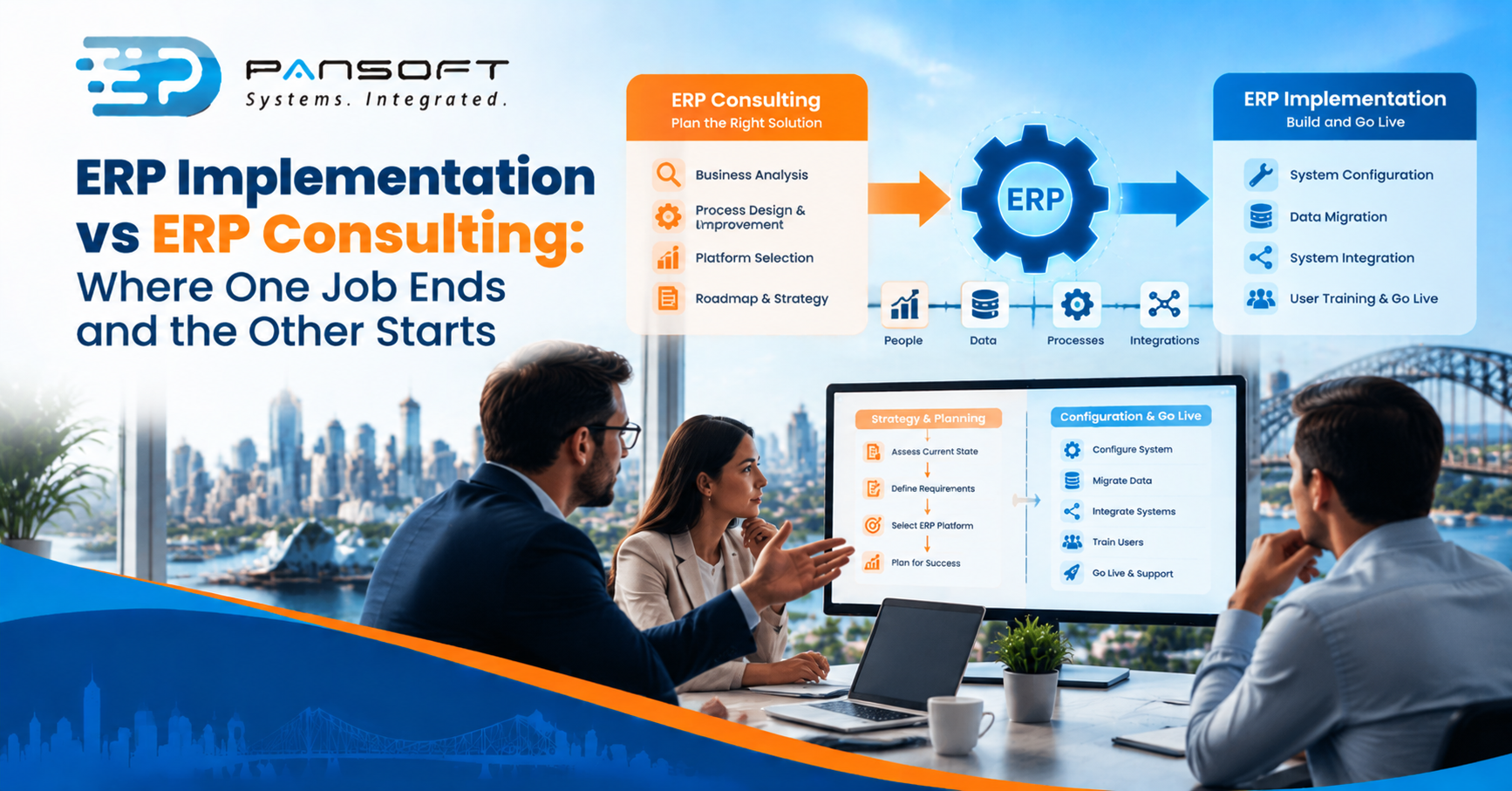
ERP Implementation vs ERP Consulting: Where One Job Ends and the Other Starts
Consulting decides what to buy and how your processes should change. Implementation configures the system, moves your data and takes it live. For ERP implementation services Australia wide, the risky part is the handover between the two, so agree who owns it early.
This is for finance, operations and IT leaders planning an ERP project and trying to work out who they need and when. You’ll get a plain comparison, the grey areas where projects slip, and questions to ask any provider.
What’s the difference between ERP consulting and ERP implementation?
Consulting answers “what should we do?” and implementation answers “now build it.” One produces decisions and a plan. The other produces a working system. Most providers sell both, which is fine, as long as you can see where one stops.
| ERP consulting | ERP implementation | |
|---|---|---|
| Main question | Which platform, which processes, what scope? | How do we configure, connect and launch it? |
| Typical output | Requirements, a platform recommendation, a plan | A configured system, migrated data, trained users |
| Process work | Reviews how you work today and proposes changes | Builds the agreed processes into the system |
| Data | Decides what data matters and who owns it | Cleans, maps, loads and checks it |
| Main risk | A recommendation based on thin information | A build that drifts from what was agreed |
Use a consultant first when you haven’t chosen a platform or your processes are messy. Go straight to implementation when the platform is picked and the scope is written down. If neither is true, you’re not ready for a build yet.
Where does one job actually end and the other start?
Five pieces of work sit in the middle, and each is easy to assume someone else is doing. Name an owner for every one in writing.
- Process design. Business process re-engineering sounds like consulting, but the detail gets settled during configuration.
- Data migration plan. Who decides what moves, what gets cleaned and what’s left behind.
- Customisation decisions. What you change in the system versus what you change in how you work.
- Integration needs. Which tools the ERP must connect to, such as payroll, CRM, banking or Microsoft 365, and who tests them.
- Acceptance criteria. What “done” means, agreed before the build, not argued at the end.
On the process side, ERP projects tend to go better when they’re treated as business process transformation and not a software install. Moving a bad process into a new system just gives you the same problem with a better screen.
What goes wrong at the handover?
The pattern is usually thin records and unclear ownership. The Audit Office of New South Wales reviewed the state’s large SAP-based shared services program (myWorkZone) in its State Agencies 2024 report, as covered by iStart. It found data migration plans, tests, reconciliations and sign-offs were missing or late, training attendance wasn’t benchmarked, and excessive user access plus weak segregation of duties had crept in as many agencies onboarded.
That’s a very big program, so don’t read it as a forecast for yours. The lesson scales down, though. Migration evidence, training and access controls are the things that get skipped when two teams each assume the other has them.
Picture a 60-person distributor. The consultant recommends a platform and writes requirements. A different firm implements it. Nobody owned the migration plan, so the opening balances don’t reconcile and the first month-end takes twice as long. That’s a hypothetical, but every part of it is avoidable.
Do you need both, and should it be one provider?
You need both functions, but not always from separate firms. A single provider cuts handover gaps and keeps one team accountable. A separate consultant gives you an independent view, which matters if you suspect a recommendation might follow what the implementer already sells.
If you use one provider for ERP consulting services Australia wide and the build, ask them to show you how they’d justify a platform they don’t sell. If you split the work, make sure the consultant’s documents are specific enough for another firm to build from.
How do the platform and customisation choices change the work?
They set the size of the implementation job. Pansoft works across SAP, Oracle and ERPNext, and each brings different migration paths, configuration limits and licensing. Our SAP services page lists strategy, implementation and S/4HANA migration, and the Oracle page covers consulting, implementation, integration and data migration, so you can see the pieces side by side.
Customisation is where scope grows quietly. ERP customisation and integration add cost and testing, and heavy changes can make upgrades harder. A good rule is to change your process first and the system second, and to ask any provider how a customisation will survive the next upgrade. ERP data migration is the same: start the clean-up early, because bad data found in the final weeks causes the delays that hurt.
What should you ask before you sign?
- Who writes the data migration plan, and who signs off the reconciliation?
- Which processes will change, and who approves those changes?
- What’s in scope for customisation, and what happens to it at upgrade time?
- Which systems must connect to the ERP, and who tests each one?
- How is training measured, not just delivered?
- What does support look like after go-live?
Pansoft’s ERP solutions page lists strategy and consulting, implementation, customisation, integration, data migration and managed services under one roof, with an eight-step implementation process. Hold us to the same questions.
Frequently asked questions
Should the same company do consulting and implementation?
It can, and it reduces handover gaps. The trade-off is independence, so ask the provider to explain why their recommended platform suits you over alternatives. If you split the work, make sure the consultant’s documents are detailed enough for another firm to build from.
When should data migration planning start?
At the start, during consulting and requirements, not near go-live. Decide early what data moves, who owns it and how you’ll check it. Cleaning and reconciling data takes longer than most teams expect, and late surprises are a common cause of delays.
Is ERP customisation a bad idea?
Not always, but it should be a last resort. Change your processes first, then customise only where the business genuinely needs it. Each change adds testing and can complicate upgrades, so ask how any customisation will be supported through future versions.
Want a second opinion on your ERP plan?
If you’re deciding between consulting, implementation or both, get in touch with Pansoft on (07) 5646 4560 or through the contact page. There’s no pressure. We’re happy to read your scope and tell you where the gaps are, even if you end up with another provider.

Related Posts
Enterprise SD-WAN Platform Australia Buyers, Essential Multi-WAN Checks
Enterprise SD-WAN Platform Australia Buyers, Essential Multi-WAN Checks By the Pansoft Technologies team | Published 6 November 2026 | Last reviewed: November 2026 An enterprise…
Read More
What Is Zero-Touch Deployment? Essential Facts for Multi-Site Rollouts
What Is Zero-Touch Deployment? Essential Facts for Multi-Site Rollouts By the Pansoft Technologies team | Published 6 November 2026 | Last reviewed: November 2026 Zero-touch…
Read More