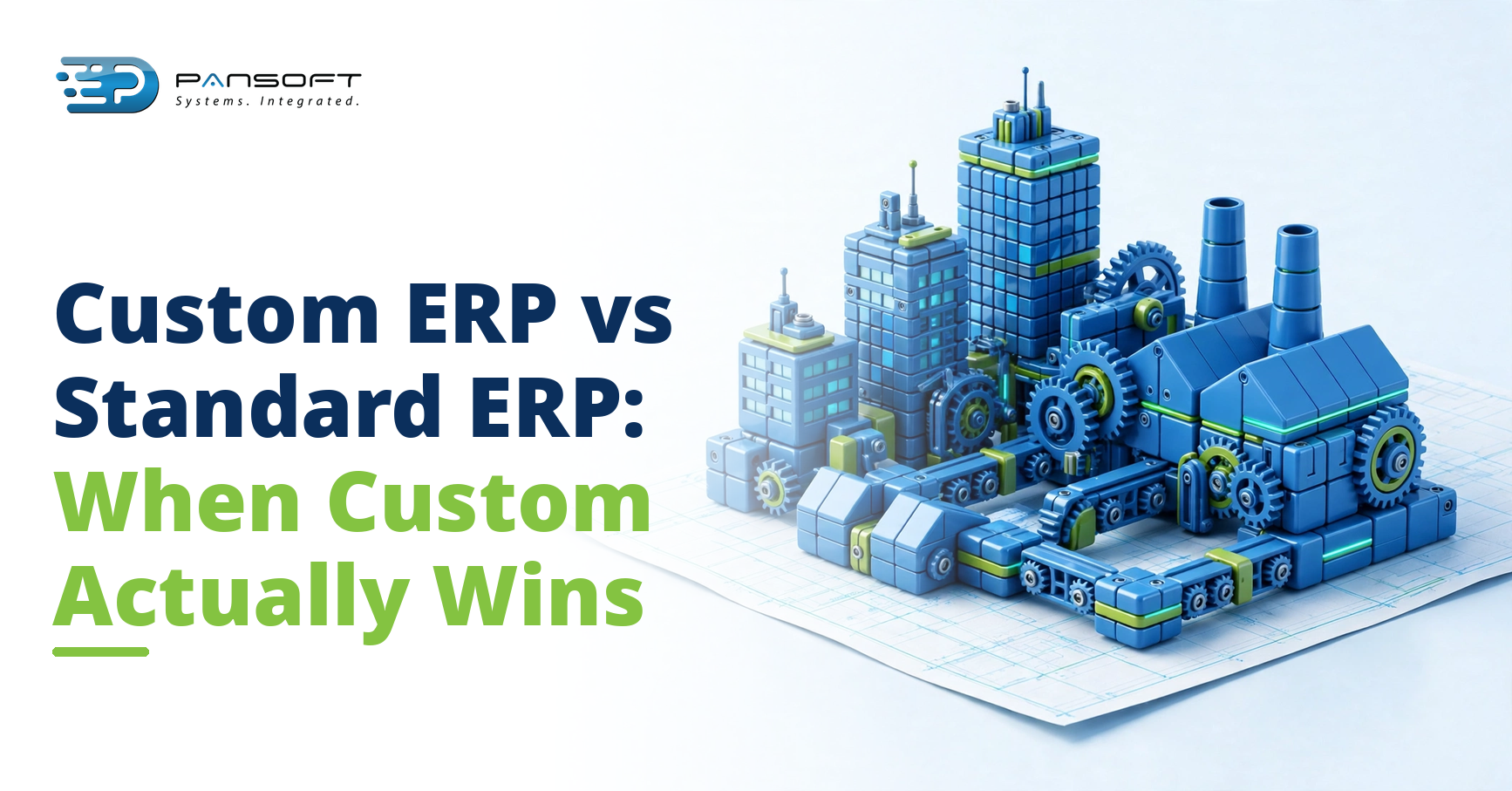
Custom ERP Development vs Standard ERP Software: When Custom Actually Wins
By the Pansoft Technologies team | Published 16 November 2026 | Last reviewed: November 2026
Custom ERP wins when the way you run the business is the reason customers choose you, and a standard package would force you to reshape proven processes to fit the software. For most organisations, a standard ERP with careful configuration is faster to launch, simpler to maintain, and the right call. Custom ERP Development Australia is worth the investment only when your processes are genuinely different, not just familiar.
This is for business owners, operations managers, and IT decision-makers comparing a custom build with a standard ERP package.
What does a standard ERP package actually give you?
A standard ERP package gives you pre-built modules for finance, inventory, sales, purchasing, and often HR, all designed to work together from day one. These modules reflect how thousands of businesses operate, so implementations move quickly: much of the thinking is already done. You configure settings, import data, train the team, and go live.
That maturity is the main argument for standard software. The trade-off is fit. A package encodes common practice, so any process that works differently in your business must either change or be worked around. Small workarounds are harmless. A dozen of them, spread across departments, quietly becomes the system your team actually uses, with spreadsheets filling the gaps.
Standard does not mean small. Many Australian businesses run substantial operations on Oracle-based ERP platforms and similar enterprise systems. The question is never whether standard software is capable. It is whether your business is comfortable running the way the software expects.
When does a custom build genuinely win?
A custom build wins when your processes are the advantage. Consider a hypothetical example: a Queensland manufacturer that quotes complex, made-to-order jobs using pricing rules built up over twenty years. Those rules live in the heads of three estimators and a maze of spreadsheets. A standard package would handle the quoting only after the rules were simplified to fit its model, and that simplification would cost the business the very accuracy that wins it work. That is a genuine case for custom.
Other genuine cases include unusual compliance workflows, multi-entity structures with shared services, and operations where the product itself is configured per order. In these situations, Business Process Automation is often the real prize: the software encodes exactly how your best people work, and the business stops depending on memory and manual handoffs.
There is also a middle signal worth watching. If a standard package needs heavy customisation to be usable, you may end up with the worst of both worlds: a system that behaves like custom software but still has to survive vendor upgrades. When the customisation list is longer than the configuration list, price the custom option honestly.
What does custom ERP cost over its lifetime?
Custom software costs more upfront, and anyone who tells you otherwise is selling something. Discovery, design, build, testing, training, and data work all sit inside the project, and each phase needs your team’s time as well as the developer’s. Timelines vary widely with scope.
The fair comparison is lifetime cost, not project cost. Standard software spreads its cost across licence or subscription fees, implementation, and the internal effort of adapting processes. Custom software concentrates cost in the build and then needs an ongoing budget for hosting, maintenance, and gradual improvement. Neither model is free after go-live. The difference is who controls the pace of change: with custom software, it is you.
One cost deserves its own warning. ERP data migration is the part most budgets underestimate, because the work is not moving data but cleaning it. Duplicate customers, inconsistent product codes, and a decade of free-text fields all surface during migration. Budget for cleansing as its own task, whichever path you choose.
How does the cloud change the decision?
Cloud delivery has changed the maths for both options. A custom system no longer needs a server room, and a standard package no longer needs a long hardware procurement cycle. Modern Cloud ERP Architecture means either choice can run on infrastructure that scales with demand, with backups and security handled by specialists.
The cloud also changes how systems connect. Open APIs are now the norm, so a standard core can exchange data with specialised tools, and a custom build can use proven cloud services instead of reinventing them. The decision shifts from “build or buy everything” to “which parts are truly ours?” Most good answers are a mix.
What if the real problem is disconnected systems?
Before choosing either path, check whether the real pain is the ERP at all. Many businesses run a capable core system alongside a CRM, a warehouse tool, and an online store that barely speak to each other. Staff re-enter orders, stock figures disagree, and reports are assembled by hand. New software will not fix that. Connection will.
ERP Integration Services exist for exactly this situation: linking the systems you already own so data flows once, correctly, and visibly. An integration-first approach sometimes reveals that the current ERP is fine and the gap was always the plumbing. It can also de-risk a later decision, because clean integrations make a replacement or a custom build easier.
Sometimes the honest answer is business process re-engineering before any software decision. If a process is slow because it has five approval steps no one can explain, automating it will only make the delay arrive faster. Fix the process, then choose the software. You may have started by searching for “SAP implementation partner Gold Coast” or comparing big-name packages. That research is useful, but the brand matters less than the fit.
How do you make the call?
Use the table below as a starting point, then test it against your own processes.
| Factor | Standard ERP | Custom ERP |
|---|---|---|
| Time to launch | Weeks to months | Months, including discovery and build |
| Fit to unique processes | Good for common processes | Built around your processes |
| Ongoing maintenance | Vendor updates, tested by you | You or your partner maintain it |
| Upgrades | Regular vendor releases | Change happens on your schedule |
| Cost shape | Subscription or licence plus implementation | Build cost plus maintenance budget |
Ask three questions before you decide. First, which of our processes would we refuse to change, and why? Second, how much customisation would a standard package need before it felt right? Third, who will own the system in three years, and do they have the budget to keep improving it? An ERP consulting Australia discussion that starts with your processes rather than a product demo will usually reach the right answer faster. See our ERP solutions for how both paths look in practice.
FAQ
How long does a custom ERP build take?
It depends on scope, data quality, and how available your team is during discovery and testing. A focused build with clear requirements moves much faster than a broad one with shifting scope. Agree the scope in writing before the build starts.
Can we start with standard software and move to custom later?
Yes, and many businesses do. The key is data portability: choose a standard package that exports your data cleanly, keep integrations documented, and avoid deep customisations that lock you in. A later move is then a project, not a rescue.
Will a custom ERP be harder to support?
It needs a clear owner, good documentation, and a support arrangement agreed before go-live. Standard software spreads support across a vendor ecosystem, while custom software concentrates it.
Want to talk it through?
If you are weighing a custom build against a standard package, it is worth a conversation before you commit either way. Pansoft Technologies has delivered enterprise software since 2011, holds ISO 27001:2021 certification, and is appraised at CMMI Level 3, supporting clients across the Gold Coast, Brisbane, and Australia-wide. To start the conversation, get in touch and tell us how your team works today. We will talk through your processes first, then the software.

Related Posts
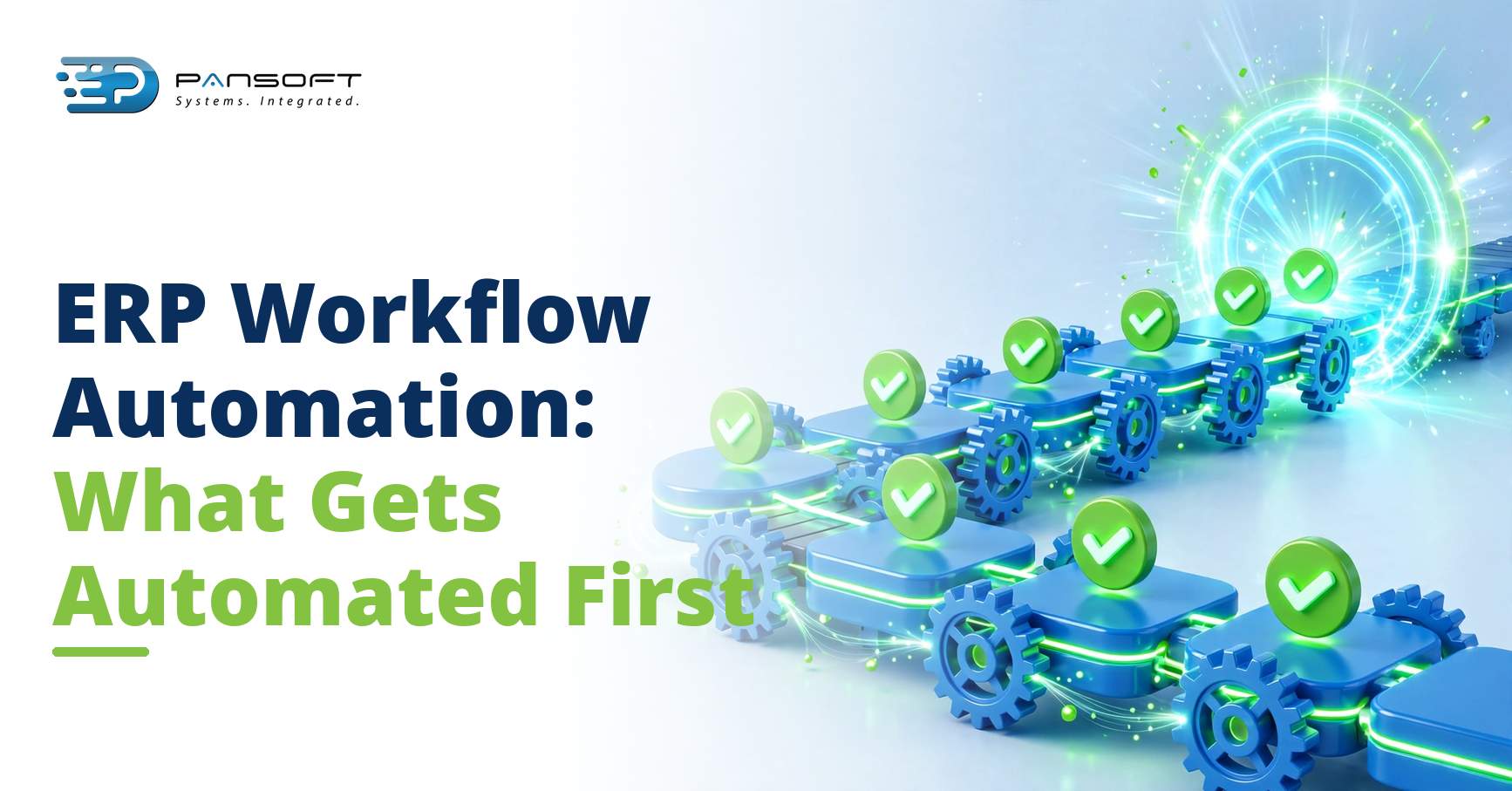
ERP Workflow Automation Explained: What Gets Automated First
Start with approvals, invoice matching, and the repetitive data entry your team repeats every day. Those workflows carry the most delay and the most errors, and automating them changes nothing about how the business thinks. ERP Workflow Automation pays off fastest when you automate one proven process at a time, measure the result, and only then move to the next.
Read More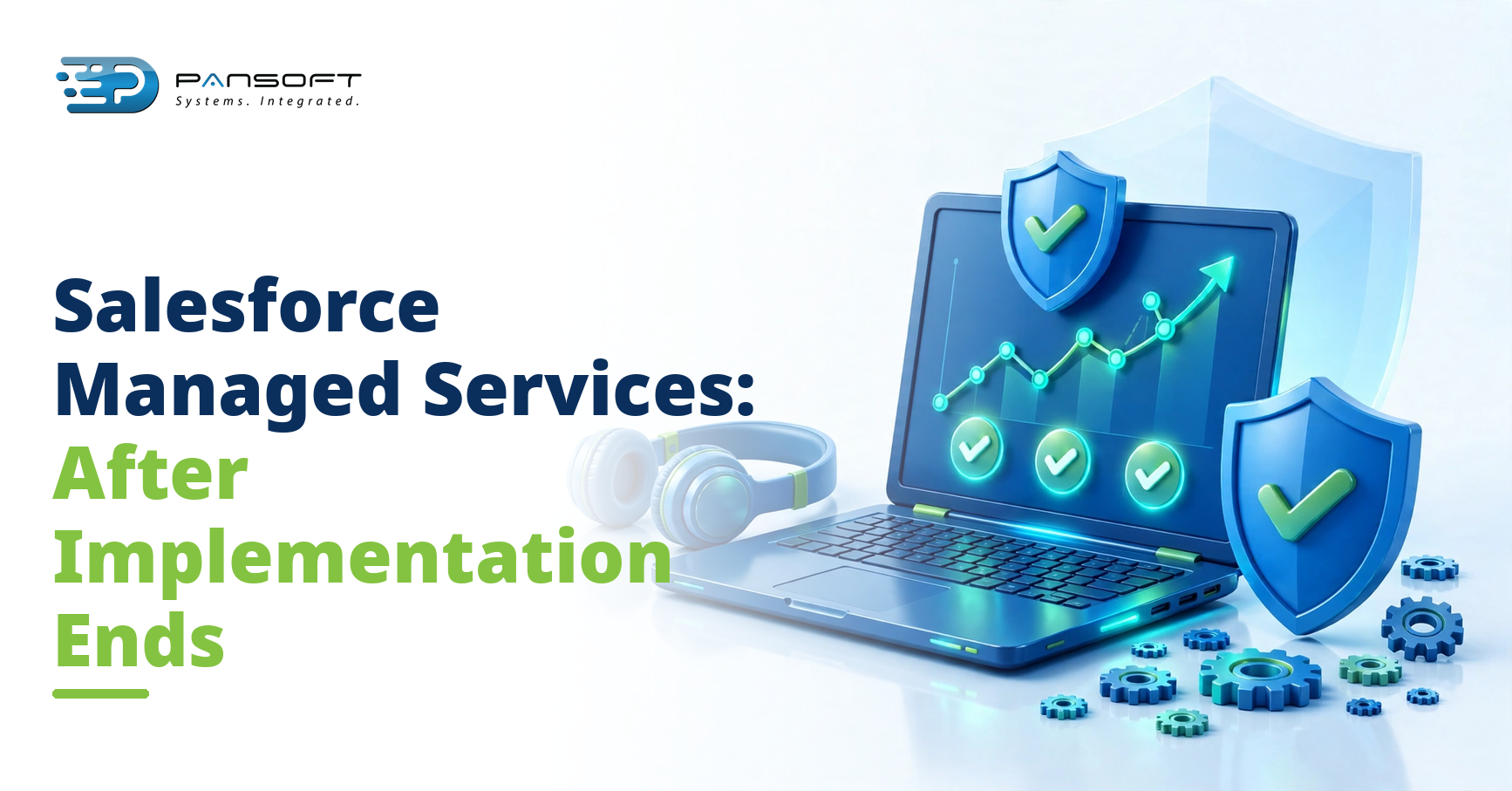
Salesforce Managed Services: What Happens After the Implementation Ends
After a Salesforce implementation ends, the system still needs daily care: user support, small changes, release updates, data quality checks and someone to call when a report breaks on the morning of a board meeting. Salesforce Managed Services Australia is the arrangement that covers that ongoing work, so the system keeps improving instead of slowly drifting out of step with the business.
Read More