
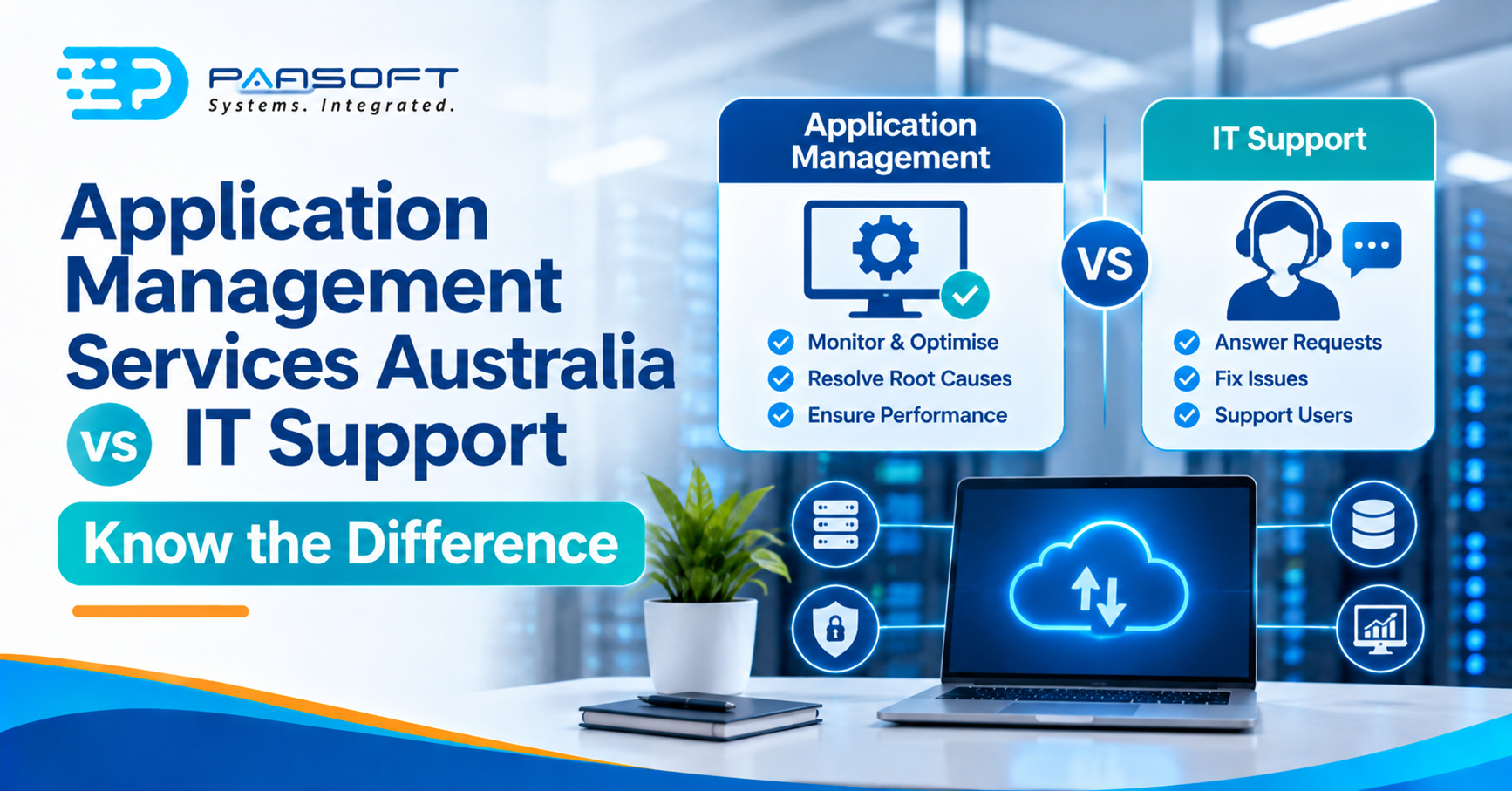
Practical Application Management Services Australia vs IT Support
By the Pansoft Technologies team | Published 5 November 2026 | Last reviewed: November 2026
Application Management Services Australia means a provider owns an application’s day-to-day health: monitoring, patching, tuning and fixing root causes. IT support answers user requests and works through tickets. For a business-critical application you usually need both, with clear lines between them.
This is for business and IT decision-makers whose help desk keeps passing the same application problem around. It supports our application management services page, and it’s about who owns what.
What does application management actually cover?
The ongoing care of a business application after it goes live. One vendor guide, SmartDev’s explainer, defines it as the ongoing management, support, maintenance and improvement of business applications once they’re in operational use. (SmartDev sells these services, so read its framing with that in mind.)
The activities it describes are worth knowing: monitoring application health and performance, restoring service when something breaks, finding the root cause of repeat problems, applying security patches and version upgrades, tuning performance, and running changes through a controlled process of assessment, testing, approval and validation. It also separates small enhancements, which sit inside the service, from larger changes, which it describes as separate projects with their own governance.
That last point matters for budgets. A new feature isn’t “application management”. It’s a build.
How do Application Management Services Australia differ from IT support?
Ownership. A service desk is the front door for users. Application management is responsible for the application itself.
Macha’s glossary (a software vendor) describes a service desk as the single point of contact between an IT organisation and its users, covering incidents, service requests and related processes. That’s a good description of what your staff see: they ring, they log a ticket, someone responds.
The lines do blur, because both touch incidents and change. The test is simple. If the same fault keeps coming back, who is accountable for removing the cause? If the answer is “whoever picks up the next ticket”, nobody owns it.
| Question | IT support (service desk) | Application management |
|---|---|---|
| Who’s it for? | Users with a request or problem | The application and the business process it runs |
| What starts the work? | A ticket or call | Monitoring, a schedule, or a recurring fault |
| What’s the focus? | Respond and restore | Keep healthy, prevent repeats, improve |
| Who needs to know the app? | General skills often suffice | Deep knowledge of the specific application |
| How is it judged? | Tickets answered and resolved | Stability, performance and fewer repeat issues |
The verdict: IT support suits password resets and “my screen’s frozen”. Application management suits “the finance system slows to a crawl every month-end”. Most businesses need both, and it helps to name which one owns each type of problem.
Which applications need this most?
The ones your business can’t run without, and the ones that live a long time. Take Oracle’s E-Business Suite. Oracle announced on 24 March 2025 that Premier Support for EBS 12.2 is extended through at least 2036. That’s a long runway, and it means these systems will keep running, and keep needing care, for years. Vendor support covers the vendor’s product. It doesn’t know your customisations, your integrations or your month-end timing.
Whether it’s an ERP, a customer portal or a custom-built tool, the pattern is the same. Someone has to watch it, patch it and notice when it slows down, and that someone shouldn’t be whoever happens to answer the phone. If you need Oracle EBS support specifically, ask who actually has hands-on experience with your version and your customisations.
Where does infrastructure end and the application begin?
Underneath the application sits the platform: servers, networks, hosting. Server and network administration keeps those running. Cloud Managed Services, in general, cover the hosting platform when the application runs in the cloud.
The catch is the gap in the middle. An application slowdown can come from the app, the database, the server or the network, and each team can honestly say their part is fine. Application management earns its keep by owning the symptom end to end, then working with whoever owns the cause. If you split the work among several providers, agree in writing who leads when the cause isn’t clear.
When is it a project, not a service?
When you’re changing what the application does. Adding a new workflow, building an integration or rebuilding a screen is development work, and it deserves its own scope and budget. For that, our software development team is the right conversation. If the change involves a customer-facing site or portal, it’s closer to web development.
Mixing the two causes trouble. A monthly service fee shouldn’t quietly absorb a six-week build, and a project shouldn’t leave the application with no owner afterwards.
A hypothetical: the 120-person business with a slow finance system
This is a hypothetical, not a client story. Picture a 120-person business whose finance application slows down at month-end. Staff log tickets. The help desk restarts a service, the slowdown eases, and the ticket closes. Next month it happens again.
Nobody looked at why. With application management, someone watches performance across the month, spots the pattern, finds the cause (a report, a database job, a server limit) and fixes it before the next close. The tickets stop, and that’s the real measure of success.
What should you ask an Application Management Services Australia provider?
- Which applications do you know well? Specific names and versions, not “all of them”.
- What counts as in scope? Particularly small enhancements versus projects.
- Who owns repeat problems?
- How do you work with our other providers?
- What do we get reported each month? Ask for stability and repeat-issue trends, not just ticket counts.
What are the next steps?
- List your business-critical applications.
- Note which keep causing repeat problems.
- Write down who owns each one today.
- Decide what’s a service and what’s a project.
- Book a short conversation with a provider about taking ownership of the worst offender first.
FAQ
Is application management the same as managed IT services?
No. Managed IT services usually cover broad support and infrastructure for the whole business. Application management focuses on specific business applications, their health and their change process. Many businesses use both, and the contract should say where one stops and the other starts.
Does application management include new features?
Small improvements usually do, according to SmartDev’s description. Larger changes are treated as separate projects with their own governance. Agree the boundary in writing before you sign, so a monthly fee doesn’t quietly turn into a development budget, or the reverse.
Do I still need a help desk?
Yes. Users still need a front door for everyday requests, such as access and device issues. Application management works behind it, taking the application problems the help desk can’t resolve. Set up a clear hand-off so tickets don’t bounce between the two.
Want to talk it through?
If an application keeps causing repeat problems, you’re welcome to get in touch. We’ll talk through what’s happening and who should own it, with no pressure.

Related Posts
Enterprise SD-WAN Platform Australia Buyers, Essential Multi-WAN Checks
Enterprise SD-WAN Platform Australia Buyers, Essential Multi-WAN Checks By the Pansoft Technologies team | Published 6 November 2026 | Last reviewed: November 2026 An enterprise…
Read More
What Is Zero-Touch Deployment? Essential Facts for Multi-Site Rollouts
What Is Zero-Touch Deployment? Essential Facts for Multi-Site Rollouts By the Pansoft Technologies team | Published 6 November 2026 | Last reviewed: November 2026 Zero-touch…
Read More