Practical Computer Vision Australia Guide, and When NLP Fits Better
By the Pansoft Technologies team | Published 5 November 2026 | Last reviewed: November 2026
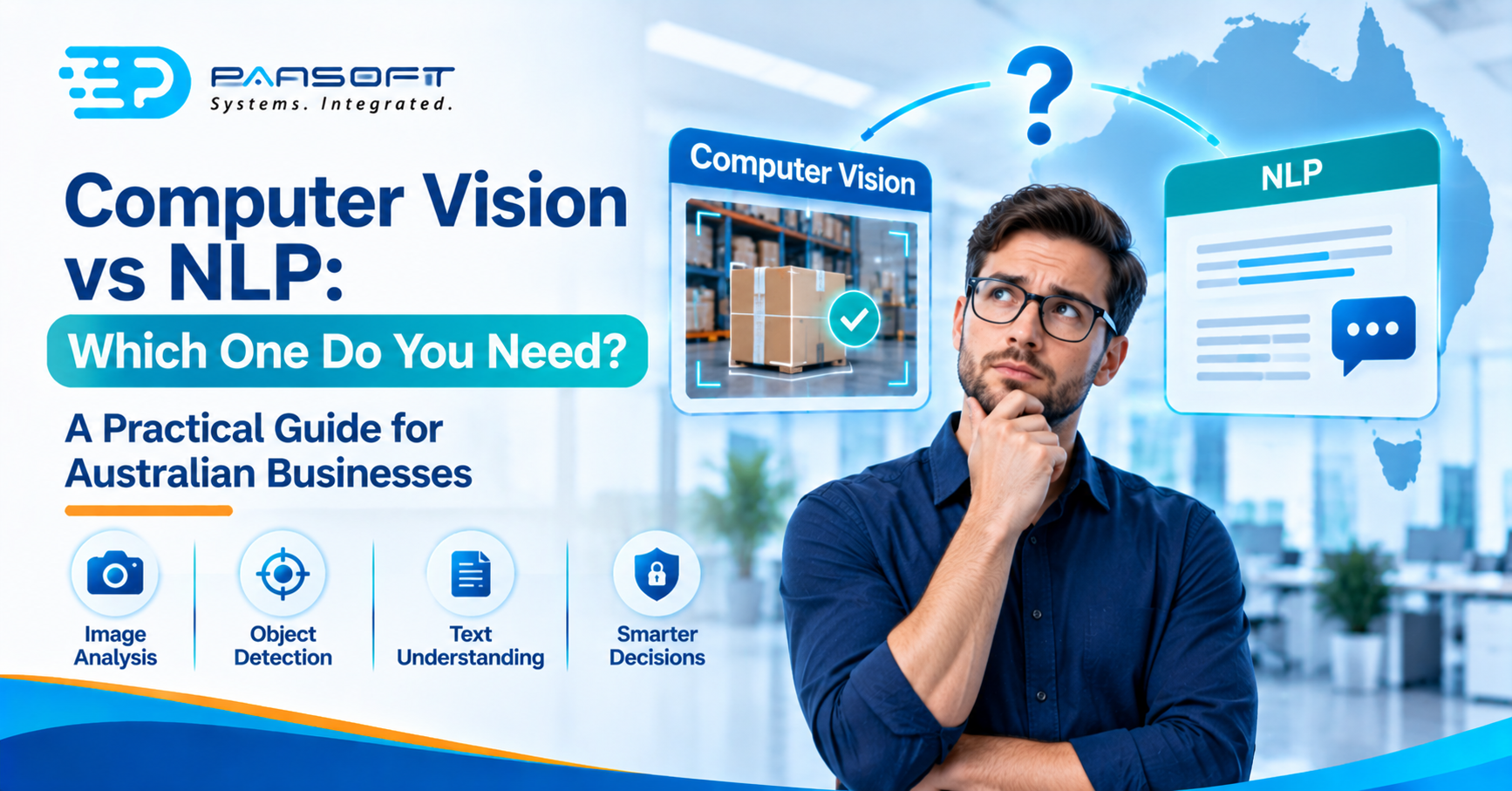
Computer vision Australia projects suit problems where the input is images or video, like inspecting products or reading scans. Natural language processing suits text, like sorting emails or pulling terms from contracts. Pick by your data, not the technology, and check privacy early.
This is for business and IT decision-makers who’ve heard both terms in the same sales pitch and want to know which one applies. It supports our AI and machine learning page, and it starts with the data you already hold.
What is the difference in plain terms?
One reads pictures. The other reads words. Microsoft Learn defines computer vision as the area of AI that deals with the analysis of visual input, such as photographs, videos and live camera feeds. It lists model types including image classification (predicting the main subject of an image), object detection (finding where specific objects are) and semantic segmentation (identifying the pixels that belong to an object).
Microsoft Learn’s page on natural language processing describes NLP as a broad term for AI models and techniques that make sense of language. Its text analysis tasks include language detection, text classification (including sentiment), key-term and entity extraction, personal information detection and redaction, and summarisation.
That’s the whole split. The rest of this article is about choosing between them.
Which one fits your problem? Five checks
Ask these in order. Most projects get decided by the first two.
1. What does the input look like? Photos, video or camera feeds point to computer vision. Emails, tickets, contracts and reports point to NLP. Scanned forms are both: the page has to be read as an image first, then the words understood. Microsoft describes its Document Intelligence service as using OCR and deep learning models to extract text, key-value pairs, tables and structured data from forms and documents.
2. What decision should it support? “Is this part damaged?” is a vision question. “Which of these 4,000 emails are complaints?” is a language question. Write the decision down first, because it often shows which technology you need, and sometimes that you need neither.
3. Do you have examples to learn from? Image classification, per Microsoft, learns from training images labelled with their subject. Someone has to supply and label those. We can’t give a reliable number of examples you’d need, and no source we checked states one. It depends on the task and the variation in your images.
4. What are the privacy implications? This matters more than people expect, and it differs between the two (see the next section).
5. How will you check it works? Agree what “good” looks like before the build, and who reviews the errors.
Does privacy change the choice for computer vision Australia projects?
It can. Images of people are a different risk from text about invoices.
For faces, the OAIC published updated facial recognition guidance on 29 July 2026. It covers organisations considering the technology in high-volume, publicly accessible spaces such as retail shopfronts, and clarifies how exceptions to the consent requirement for sensitive information, including biometric information, apply. The Commissioner said “A precautionary approach to the deployment of FRT is required under Australian law.” Each proposal is assessed case by case. This is not legal advice, and facial recognition is only one slice of computer vision.
For text, the OAIC’s guidance on commercially available AI products says entering personal information into an AI tool is a use or disclosure under APP 6, and recommends not entering personal information, especially sensitive information, into publicly available chatbots. Email and ticket text is full of it.
The practical point: a computer vision Australia project that inspects stock on a conveyor raises a very different privacy question from one that watches people in a shop. Treat them differently from day one.
How do NLP and Generative AI solutions relate?
Closely. Microsoft says NLP is the foundation on which generative AI large language models are built. So tools that draft and summarise text are one family of language technology, not a separate thing.
That also means the privacy points above apply to them. If staff paste customer text into a public tool to summarise it, you’ve made a disclosure. Decide the rules before the habit forms.
| Your data | Likely fit | What to watch |
|---|---|---|
| Product or site photos, video | Computer vision | Labelled examples, lighting and angle variation, privacy of any people in shot |
| Emails, tickets, contracts | NLP | Personal information in the text, accuracy checks |
| Scanned forms and invoices | OCR first, then NLP | Image quality, how errors are caught |
| Spreadsheets and databases | Neither first | Often a reporting job, see data analytics |
The verdict: match the technology to the data type. If your data is already in tables, start with data analytics and BI work, since a dashboard may answer the question before any model does.
A hypothetical: the claims team with photos and emails
This is a hypothetical, not a client story. Picture a distributor whose claims team receives photos of damaged goods and free-text emails explaining what happened. Staff compare the two by hand.
Which technology? Both, eventually. But you wouldn’t build both at once. You’d pick the side with the most volume and the cleanest data, prove it, and add the other later. If the photos are inconsistent and the emails are tidy, start with the language side. If a shared record of each claim across suppliers became important later, that’s a blockchain conversation, not a starting point.
What should you ask a provider?
- What decision does this support? If they can’t say, they’re selling a tool.
- What labelled data do we need to supply?
- How are people in images or personal details in text handled?
- How will accuracy be measured, and who reviews the errors?
- Can you help us with a wider plan? A provider of AI Strategy and Consulting Services should place this project in the context of your other priorities.
What are the next steps?
- Write down the decision you want to support.
- Check what data you have, in what format.
- Flag any personal or sensitive information in it.
- Decide how success will be measured.
- Book a short conversation with a provider about which side to try first.
FAQ
Can one project use both computer vision and NLP?
Yes. Scanned documents are a common case, where text is read from the image and then analysed for meaning. Microsoft describes document services that extract text, key-value pairs and tables from forms. Start with the side that has more volume and cleaner data.
Do I need a lot of labelled images?
For image classification, models learn from training images labelled with their subject, so you need examples. We can’t give a reliable number, and no source we checked states one. It depends on the task and how much your images vary, so test with a small set.
Is facial recognition allowed for Australian businesses?
It isn’t banned outright, but the OAIC says each proposed use must be assessed case by case against the Privacy Act, and that a precautionary approach is required. Biometric information is sensitive information. Get legal advice before you deploy it in a public-facing space.
Want to talk it through?
If you’re deciding where to start, you’re welcome to get in touch. We’ll talk through your data and the decision you want to support, with no pressure.

Related Posts

Enterprise SD-WAN Platform Australia Buyers, Essential Multi-WAN Checks
Enterprise SD-WAN Platform Australia Buyers, Essential Multi-WAN Checks By the Pansoft Technologies team | Published 6 November 2026 | Last reviewed: November 2026 An enterprise…
Read More
What Is Zero-Touch Deployment? Essential Facts for Multi-Site Rollouts
What Is Zero-Touch Deployment? Essential Facts for Multi-Site Rollouts By the Pansoft Technologies team | Published 6 November 2026 | Last reviewed: November 2026 Zero-touch…
Read More