
What Does a DevOps Services Engagement Actually Deliver?
DevOps services Australia providers deliver should leave you with a repeatable, automated way to build, test, release and run software: working pipelines, environments defined in code, monitoring, security checks and a team that can run it without calling the vendor every week.
This is for IT managers and owners weighing a DevOps engagement who want to know what they should be able to see, run and measure at the end. Pansoft’s DevOps services page lists the full range.
What should you have in hand when the engagement ends?
A working release process, environments you can rebuild from code, monitoring that tells you when something breaks, security checks in the pipeline and enough documentation for your own team to run it. Tools on their own don’t count.
| Deliverable | What you should get | How to check it |
|---|---|---|
| Release pipeline | Build, test and deploy steps that run automatically on each change | Watch a real change go from commit to production |
| Environment code | Infrastructure described in files kept in version control | Ask them to rebuild a test environment from scratch |
| Container platform | Applications packaged and run on a managed platform, where it suits | Ask what happens when one fails |
| Monitoring | Dashboards and alerts on the things that hurt you | Trigger a test alert |
| Security checks | Scans and secrets handling inside the pipeline | See a build fail because of a real finding |
| Handover | Runbooks, access and a trained internal owner | Have your team do a release without the provider |
Choose the full set when you release often and lose time to manual steps. A smaller scope, such as one pipeline, suits a team that just needs releases to stop being stressful. If nothing on this list would change how you work, you may not need an engagement yet.
Pansoft’s DevOps page describes a five-stage approach: assess, design, automate, deploy, then monitor and optimise. Whatever a provider calls its stages, each should leave you something you can check.
What does CI/CD pipeline implementation involve?
It turns your manual release steps into an automated sequence that builds, tests and deploys each change. The work starts by writing down how you release today, because you can’t automate steps nobody has agreed on.
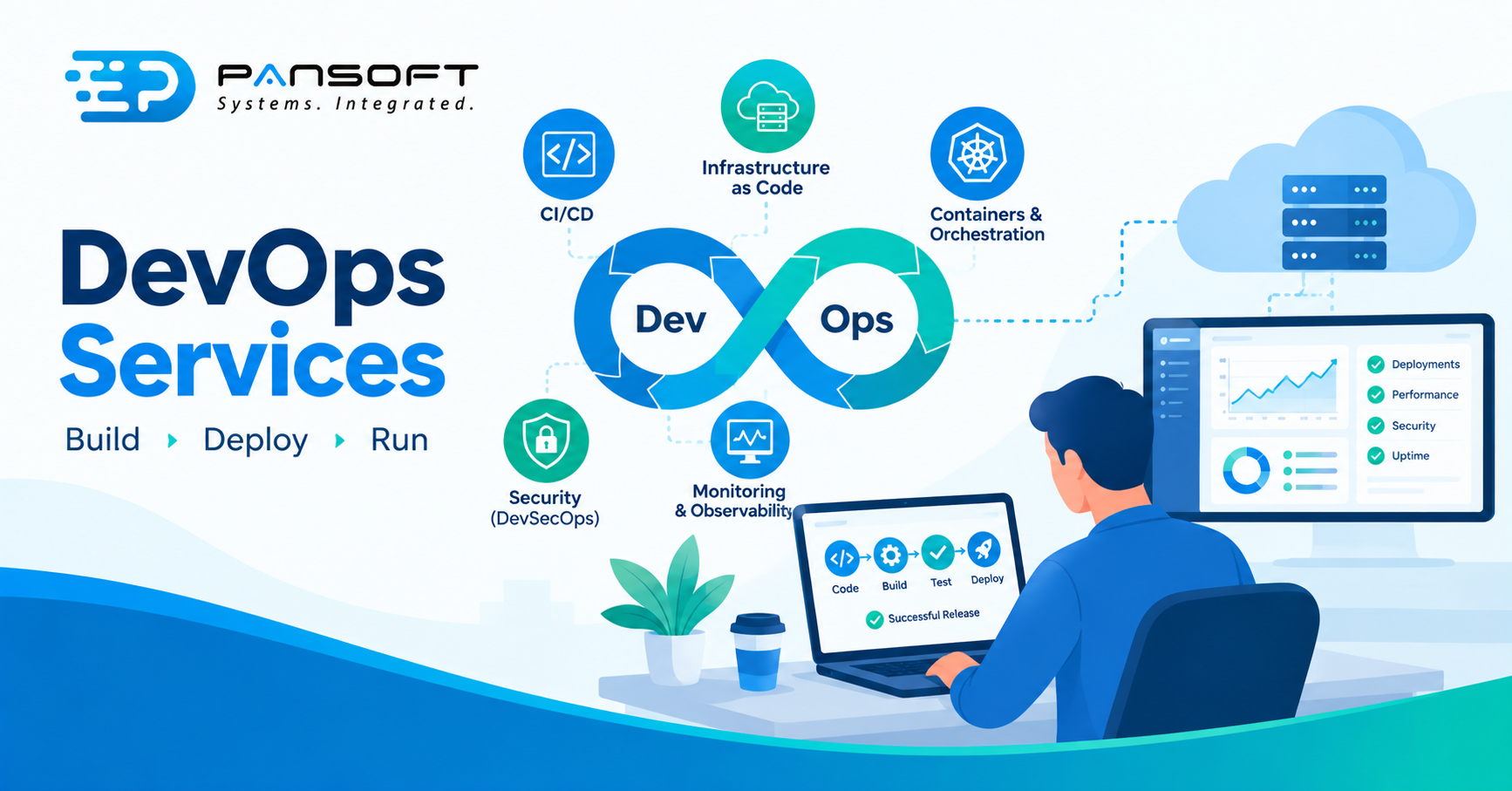
Pansoft’s page lists Azure DevOps, GitHub Actions, GitLab CI/CD, Jenkins and Bitbucket Pipelines as platforms it works with. It also lists release methods such as blue-green deployments, canary releases, rolling updates and automated rollbacks. Pick the platform your team already knows where you can, and see Pansoft’s CI/CD page for how that work is described.
How does Infrastructure as Code (Terraform) fit in?
It replaces clicking through cloud consoles with files that describe your environments, so you can review, repeat and rebuild them. You write the configuration, Terraform plans the changes, and you approve before it applies anything.
HashiCorp describes Terraform as an infrastructure as code tool, and says its configuration files can be versioned, reused and shared. That plan step before any change is the safety net worth asking about.
Here’s the hidden cost. Terraform keeps a state file as the source of truth for what exists. Someone has to own it, protect it and control who can change it. HashiCorp notes that its own HCP Terraform service adds shared state and role-based access for teams, so ask your provider where yours will live. Agree that before go-live, not after the first mix-up. Pansoft’s Terraform page covers this work.
Where do containers and monitoring come in?
Containers package an application so it runs the same everywhere, and container orchestration runs and replaces them for you. They suit systems with many parts or uneven demand. A small, steady application often doesn’t need them, and a provider who insists otherwise without asking questions is worth questioning.
Pansoft’s page lists Docker, Kubernetes, Amazon EKS, AKS, GKE and OpenShift, and its Kubernetes page goes further. For monitoring, it lists Prometheus, Grafana, ELK Stack, OpenSearch, Splunk and Datadog. The tool matters less than whether an alert reaches a person who can act on it.
What does DevSecOps add?
Security checks inside the pipeline instead of at the end. The US National Cybersecurity Center of Excellence (NCCoE) describes DevSecOps as integrating security as a fundamental component of DevOps, with checks built into the pipeline to detect vulnerabilities early.
If you ask for DevSecOps services Australia wide, expect specific checks. Pansoft’s page lists SAST, DAST, container and infrastructure scanning, dependency and secret management, compliance validation and policy as code.
Two honest limits. The NCCoE calls its project a demonstrative applied research effort, so treat it as a reference, not a certificate. And good DevSecOps practices will sometimes stop a build because a scan found something real. That’s the point, so agree beforehand who decides whether a finding blocks a release.
What does it look like in a real team?
Picture a 60-person property software company where one senior developer does the monthly release over a weekend. This is a hypothetical, not a client story. The first deliverable isn’t a tool. It’s the release steps written down. Then the pipeline, then environments in code, then monitoring.
Success looks like a junior developer releasing on a Tuesday afternoon without a phone call to the senior one.
How do you know it worked?
Measure delivery before and after. DORA’s five software delivery metrics cover throughput (change lead time, deployment frequency and failed deployment recovery time) and instability (change fail rate and deployment rework rate).
DORA, whose page was last updated in January 2026, adds some cautions. Don’t set the metrics as targets, because that invites gaming. Don’t rely on a single metric. Don’t compare unlike applications. Use them to track your own improvement, and get a baseline before the work starts.
What should you ask a provider?
Ask for specifics, not slogans. Searching for CI/CD pipeline consulting Australia wide returns plenty of names. If you’re not sure what you need yet, DevOps consulting is the place to start, before anyone chooses tools.
- Which of these deliverables are in scope?
- Who owns the Terraform state and the pipeline credentials after handover? In writing.
- What will we see in the first few weeks?
- How will you measure improvement? Baselines first, then results.
- What happens when it breaks at 2am? Who answers, and how fast.
Quick questions
How long does a DevOps engagement take?
It depends on scope, so be wary of fixed answers from anyone who hasn’t seen your systems. A single pipeline is a smaller job than pipelines, environments, containers and monitoring together. Ask for stages with something visible at the end of each.
What’s the difference between DevOps and DevSecOps?
DevOps joins development and operations around automated delivery. DevSecOps builds security checks into that same process, so problems surface during the build rather than after release. You can add those checks to an existing pipeline, so it needn’t be a separate project.
Is DevOps only for big teams?
No. The aim is a release process that’s repeatable and low-stress, which helps any size of team. A small team might start with one pipeline and monitoring, then add environments in code later. Scope to the pain you actually have, not to a full toolchain.
Want to talk it through?
If you’re unsure what a DevOps engagement should cover for your team, there’s no pressure. Pansoft can look at how you release today and where the time goes. You can get in touch whenever suits you.

Related Posts

Enterprise SD-WAN Platform Australia Buyers, Essential Multi-WAN Checks
Enterprise SD-WAN Platform Australia Buyers, Essential Multi-WAN Checks By the Pansoft Technologies team | Published 6 November 2026 | Last reviewed: November 2026 An enterprise…
Read More
What Is Zero-Touch Deployment? Essential Facts for Multi-Site Rollouts
What Is Zero-Touch Deployment? Essential Facts for Multi-Site Rollouts By the Pansoft Technologies team | Published 6 November 2026 | Last reviewed: November 2026 Zero-touch…
Read More