DevOps Transformation vs a One-Off DevOps Project: Which Does Your Business Need
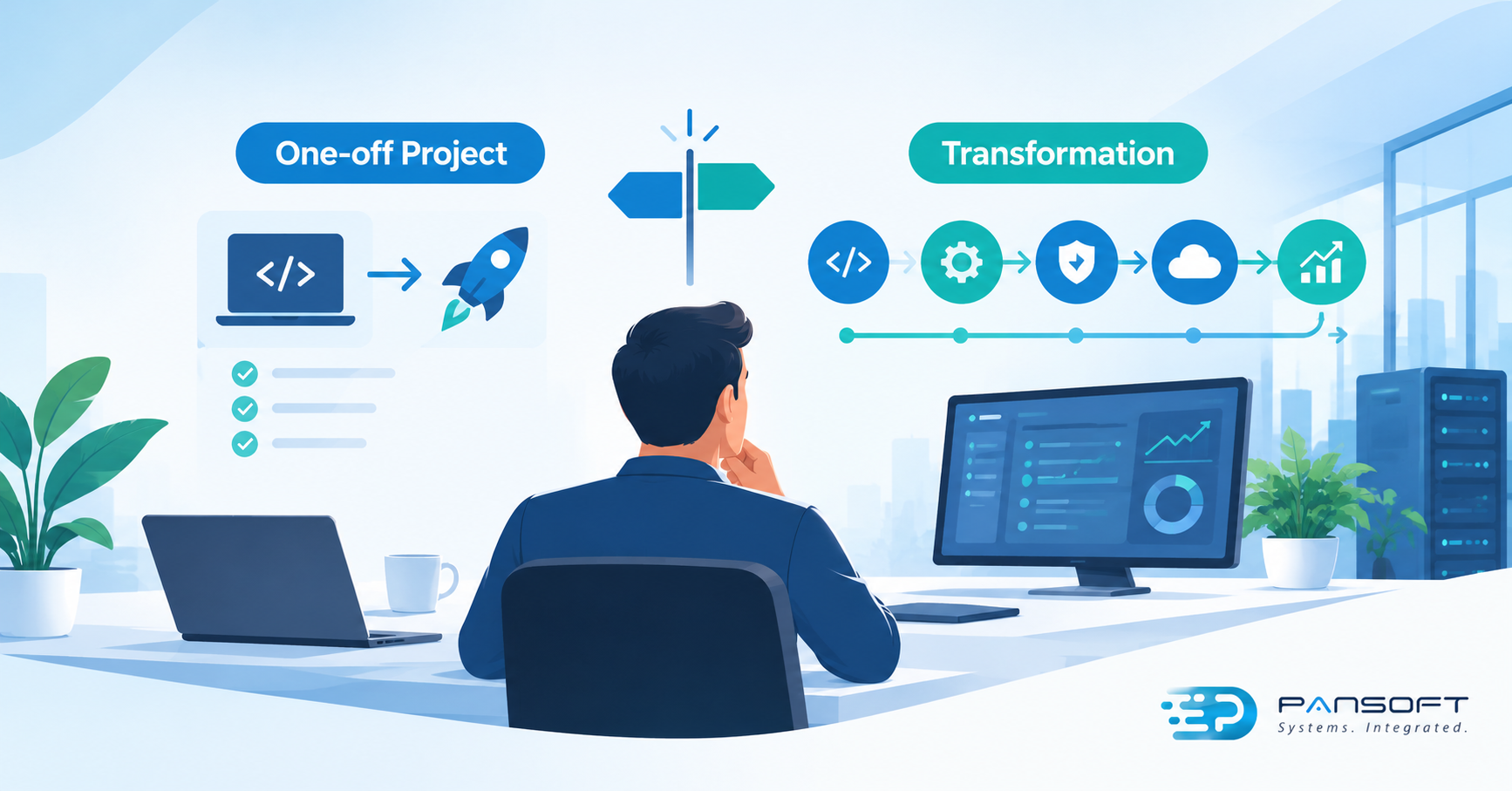
DevOps Transformation Services suit businesses whose delays come from how teams, tools and approvals work together. A one-off DevOps project suits one well-defined problem, like a slow release pipeline. Many businesses start with a project and grow into a transformation.
Who this is for
IT managers, CTOs and business owners deciding whether to fund one piece of DevOps work or commit to a longer change program. If you’re comparing options before speaking to a provider, this should help you ask better questions.
What counts as a one-off DevOps project?
A one-off project is bounded work with a start, a finish and something you can point to at the end. Think of rebuilding a deployment pipeline, writing infrastructure as code for an environment someone built by hand, or setting up container orchestration for a single application.
It works well because the scope is clear. You know what done looks like, you can price it, and the team that inherits it can keep it running. A project suits a business whose people already work well together and whose problem is a missing or broken piece of technology.
The limit shows up afterwards. A new pipeline doesn’t change who approves releases, how developers and operations hand work to each other, or who owns the pipeline in six months. If those habits stay put, things drift back to how they were.
What does a DevOps transformation involve?
A transformation treats delivery as a system, not a tool. It follows the work from idea to production: who writes it, who tests it, who approves it, who deploys it and who gets the call when it breaks. Then it changes the parts that cause delay or risk, which usually means a mix of technology, process and ways of working.
That’s why transformations run over months rather than weeks, and why they rarely end with a handover document and a handshake. They tend to start with a baseline of how delivery works today, move through a short list of agreed improvements, and keep checking whether releases are actually getting smoother.
A Techwell article on DevOps culture makes the same point from the practitioner side. It describes the cultural changes as the toughest part of a transformation and warns that spending too much effort on tool selection takes time away from the transformation itself. Tools are easy to buy. Changing who talks to whom is harder.
How do the two compare?
| Question | One-off project | Transformation |
|---|---|---|
| Typical trigger | A specific broken or missing piece, like a slow pipeline | Repeated delays, failed releases or friction between teams that no single tool explains |
| Scope | Fixed up front | Staged, adjusted as you learn |
| Who’s involved | Usually one technical team | Development, operations, security and often the business side |
| What you walk away with | A working system and documentation | New ways of working plus the systems that support them |
| Main risk | The fix doesn’t stick because habits stay the same | Losing momentum, or trying to change too much at once |
| Cost shape | Easier to scope to a fixed deliverable | Harder to fix in advance, so better handled in stages |
If you can describe the problem in one sentence and name the system that needs fixing, start with a project. If the honest description is “releases are slow and nobody agrees why”, you’re looking at a transformation.
Which one does your business need?
A project is probably enough when:
- You can name the specific bottleneck.
- Your teams already collaborate well and just lack the right tooling.
- Someone inside the business is ready to own the result once it’s delivered, and has the time to do it properly.
A transformation is the better fit when:
- Fixes work for a few months, then fall over.
- Developers, operations and security each describe the problem differently.
- Releases depend on one or two people who know how everything fits together.
- Security review happens at the end, so problems turn up when they’re most expensive to fix.
Picture a business that spends a few weeks rebuilding its release pipeline. Deployments get faster. Six months later releases are slow again, because the approval chain never changed and the person who built the pipeline has moved on. The project did its job. The problem it was bought to solve was bigger than the project.
Can you start with a project and still plan for more?
Yes, and it’s often the sensible way in. A well-chosen first project proves value quickly and shows you where the real obstacles are, with a longer plan sitting behind it. A pipeline rebuild, for example, tells you fast where handoffs break and who’s waiting on whom.
If you go that way, ask for CI/CD Pipeline Design that your own team can run and extend, documented well enough that it doesn’t live in one person’s head. Our CI/CD service covers this kind of work. Security belongs in the pipeline from the start too. Adding DevSecOps practices later is possible, but it’s slower and usually more disruptive, which is why DevSecOps Consulting is worth including in the first scope rather than the third.
What should you ask a provider?
When you’re comparing DevOps Consulting Services Australia wide, a few questions separate the useful conversations from the sales pitches:
- Will you scope a project, a transformation or both, and why?
- How will we know, in plain terms, that delivery has improved?
- What happens to the work once you leave, and who on our side owns it?
- Which of our existing tools do you expect to keep?
That last one matters more than people expect. Many delivery problems come from how tools are connected and who owns them, not from the tools themselves. A good provider of DevOps Transformation Services should start with a baseline of how delivery works today, not a shopping list.
Where does Pansoft fit?
Pansoft works with businesses on DevOps, whether that’s a defined piece of work or a longer program. You can read more about the individual services on our DevOps page and our CI/CD page. The thinking behind both is the same: fix the thing that’s actually slowing you down, and make sure it stays fixed.
Common questions
How long does a DevOps transformation take?
It depends on your size and how many teams are involved, so no honest provider can quote a fixed length without looking at your environment. They’re usually staged over months rather than delivered in one go, with early improvements arriving along the way.
Can we start with a project and move to a transformation later?
Yes. Pick a project that targets a real bottleneck, document it well and keep the scope honest. What you learn about handoffs, approvals and ownership usually shapes the longer plan. The risk is treating the project as the finish line instead of the first step.
Do we need to replace our existing tools?
Not necessarily. Many delivery problems come from how tools are connected and who owns them, rather than the tools themselves. A sound assessment starts with what you already run and only recommends something new where it solves a specific problem.
If you’d like to talk it through, get in touch with Pansoft. A short conversation about how your releases work today is a reasonable place to start, and there’s no pressure to commit to anything.

Related Posts
Enterprise SD-WAN Platform Australia Buyers, Essential Multi-WAN Checks
Enterprise SD-WAN Platform Australia Buyers, Essential Multi-WAN Checks By the Pansoft Technologies team | Published 6 November 2026 | Last reviewed: November 2026 An enterprise…
Read More
What Is Zero-Touch Deployment? Essential Facts for Multi-Site Rollouts
What Is Zero-Touch Deployment? Essential Facts for Multi-Site Rollouts By the Pansoft Technologies team | Published 6 November 2026 | Last reviewed: November 2026 Zero-touch…
Read More