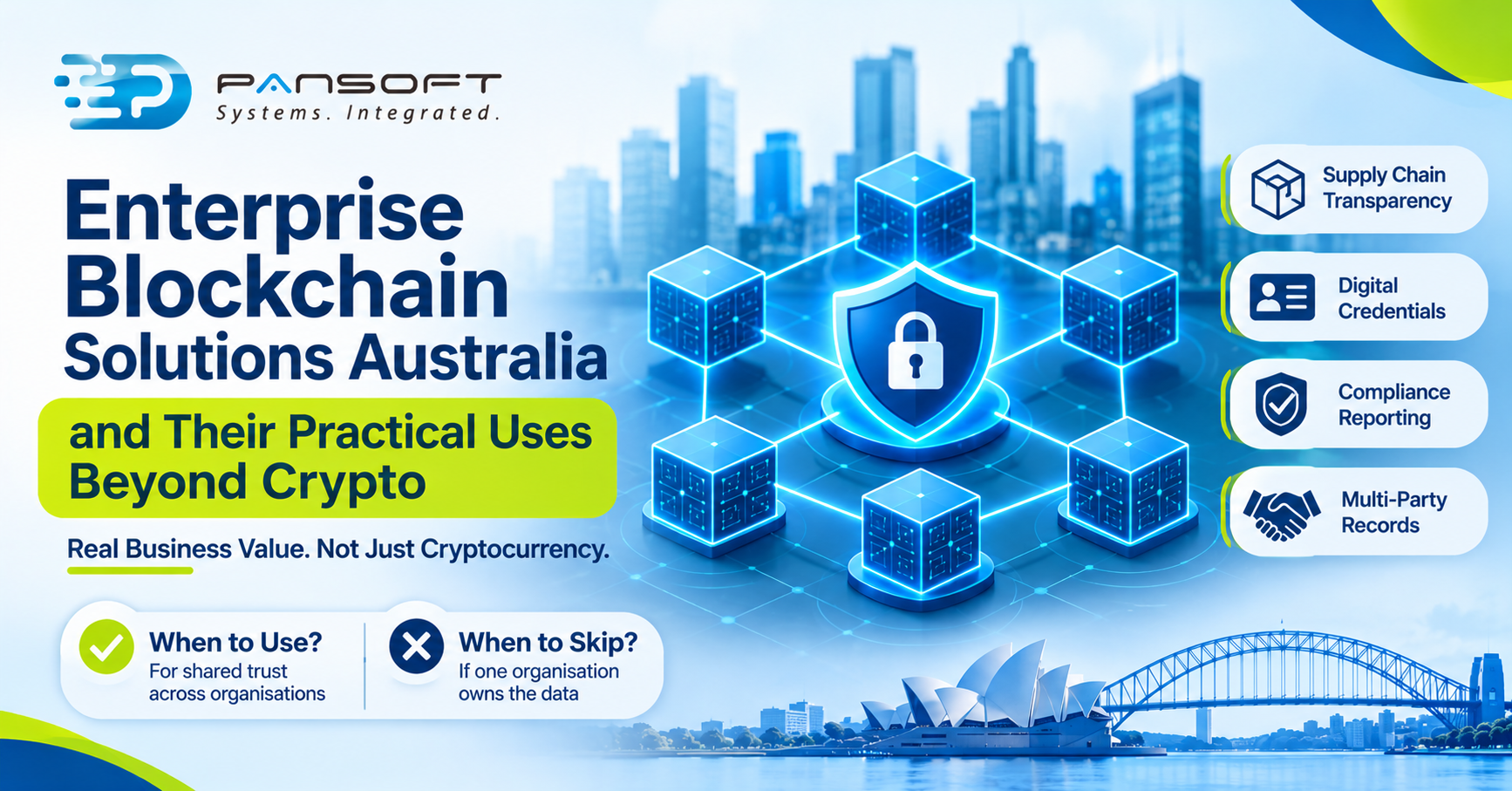
Enterprise Blockchain Solutions Australia and Their Practical Uses Beyond Crypto
Enterprise Blockchain Solutions Australia are worth considering when several organisations need one shared record they all trust, like supply chains, credentials or compliance reporting. When a single organisation controls the data, a normal database is usually simpler to run and easier to change.
This is for business and IT decision-makers who’ve been pitched a blockchain and want a straight read on whether it fits. It connects to our blockchain services page, but the honest answer here is sometimes “don’t”.
Is enterprise blockchain the same as crypto?
No. Crypto networks are open to anyone. Enterprise platforms are different. Hyperledger Fabric’s documentation describes it as a permissioned platform where participants are known to each other, each with a cryptographic identity, rather than anonymous.
Fabric also supports private channels, so only the members of a sub-network see a given set of transactions. That matters in business. A supplier and a retailer might share a ledger without every competitor on it seeing their terms.
What do Enterprise Blockchain Solutions Australia actually get used for?
Four areas come up repeatedly in the sources we checked. Fabric lists banking, finance, insurance, healthcare, human resources and supply chain as target settings. NIST’s 2018 report outlines banking, supply chain management and tracking insurance transactions. Australia’s own National Blockchain Roadmap, released in February 2020, points at supply chains, identity and credentialing, and reducing compliance costs.
| Use | Why a shared ledger might fit | What to watch |
|---|---|---|
| Supply chain records | Many parties add to one history | Everyone must agree to take part and enter accurate data |
| Credentials and identity | Several issuers and checkers need one record | Governance of who can issue and who can read |
| Compliance reporting | The Roadmap funded pilots (up to $3 million each) for critical minerals certification and the food and beverage sector | Pilots aren’t proof of broad adoption |
| Multi-party financial or insurance records | Several firms update one shared record | Performance and legal fit (see the ASX case below) |
The verdict: the pattern across all four is several organisations, no single owner, and a record that has to stand up when they disagree. If your use case doesn’t look like that, keep reading before you spend anything.
When does a blockchain not make sense?
When one organisation owns the data. Then you’re paying for agreement between parties who don’t exist.
NIST’s report put it bluntly: use blockchain if it’s appropriate, and the authors wrote it to help people see past the hype. Lead author Dylan Yaga said you do still need trust, just not in a trusted third party like a bank. NIST also notes blockchain systems place high demands on network resources.
The most expensive Australian example is the ASX. According to Information Age (22 November 2022), the exchange scrapped its blockchain-based CHESS replacement in November 2022 and wrote off roughly A$250 million. An independent Accenture review reported technical issues including high latency and concurrency, and concluded the business workflows weren’t suited to a distributed environment. It’s one project, not a verdict on the technology. But it shows that fit and design matter more than the label.
What does it take to build one?
Delivering Enterprise Blockchain Solutions Australia takes less magic than the pitch suggests. Fabric’s smart contracts, called chaincode, can be written in general-purpose languages such as Java, Go and Node.js, and they run in isolated containers. In practice that means smart contract development is mostly software engineering with a heavy governance layer on top.
The hard parts sit around the code. Who runs a node? Who approves a new member? What happens when two parties dispute an entry? A team doing Hyperledger development spends as much time on those questions as on the code, because the answers become the network’s rules. A provider offering Blockchain Development Services should ask about them in the first meeting, not the last.
How does it connect to your data and AI plans?
A ledger records what happened. It doesn’t tell you what it means. Once several parties are writing to the same record, the next question is usually reporting: patterns, exceptions, trends. That’s a job for data analytics and BI, working off the ledger’s data.
Some teams then ask whether AI and machine learning can flag anomalies or forecast from that history. It’s a fair question, but treat it as a second phase. If the shared record isn’t accurate and agreed first, anything built on it inherits the problems.
A hypothetical: the produce supplier group
This is a hypothetical, not a client story. Picture five regional food producers and two retailers who each keep their own spreadsheets about batches and certificates. When a retailer asks which farm a batch came from, it takes a week of emails to piece together.
A shared ledger could hold one agreed history. But before building it, you’d ask whether a shared database run by one of them would do the job, whether all seven will actually enter data, and who pays for the network. If the answer to the second question is “probably not”, the project is already in trouble.
What should you ask a provider?
- What problem needs more than one organisation to agree? If you can’t name the parties, you may not need a blockchain.
- Why not a shared database? A good provider has a real answer.
- Who governs the network after go-live?
- How will performance be tested before commitment?
- What can we reuse if we stop?
What are the next steps?
- Name the parties who’d share the record, and why they don’t already trust one owner.
- Test the idea against a plain shared database first.
- Check data quality and who enters it.
- Agree governance before anyone writes code.
- Talk to a provider about a small, bounded proof of concept.
FAQ
Does enterprise blockchain mean using cryptocurrency?
No. Enterprise platforms like Hyperledger Fabric are permissioned, so participants are known and identifiable, and you don’t need a public token to run one. The ledger records business events between organisations, such as supply chain steps or credentials, instead of acting as money.
Is blockchain just a slower database?
Sometimes, yes, if only one organisation writes to it. The point is shared agreement between parties who don’t want one owner. NIST also notes blockchain systems place high demands on network resources, so test it against a shared database before you commit.
Do we need blockchain before we invest in analytics or AI?
No. Most analytics and machine learning work runs on ordinary data sources. A shared ledger only makes sense if several organisations need one agreed record. Fix your data quality first, then ask what a ledger would add before you buy.
Want to talk it through?
If you’re weighing up a use case, you’re welcome to get in touch. We’ll give you a straight view, including when the answer is to skip it.
Sources

Related Posts
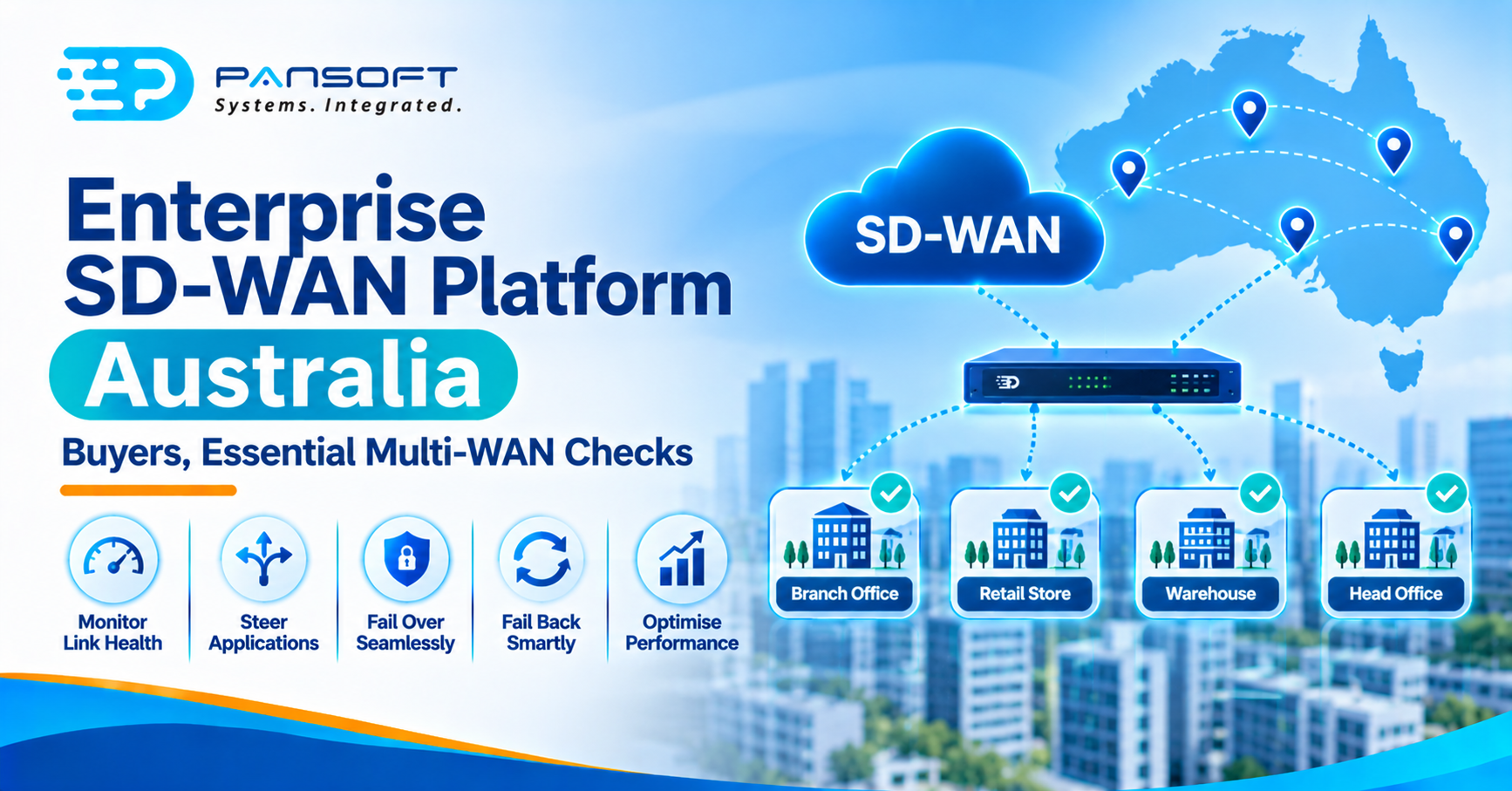
Enterprise SD-WAN Platform Australia Buyers, Essential Multi-WAN Checks
Enterprise SD-WAN Platform Australia Buyers, Essential Multi-WAN Checks By the Pansoft Technologies team | Published 6 November 2026 | Last reviewed: November 2026 An enterprise…
Read More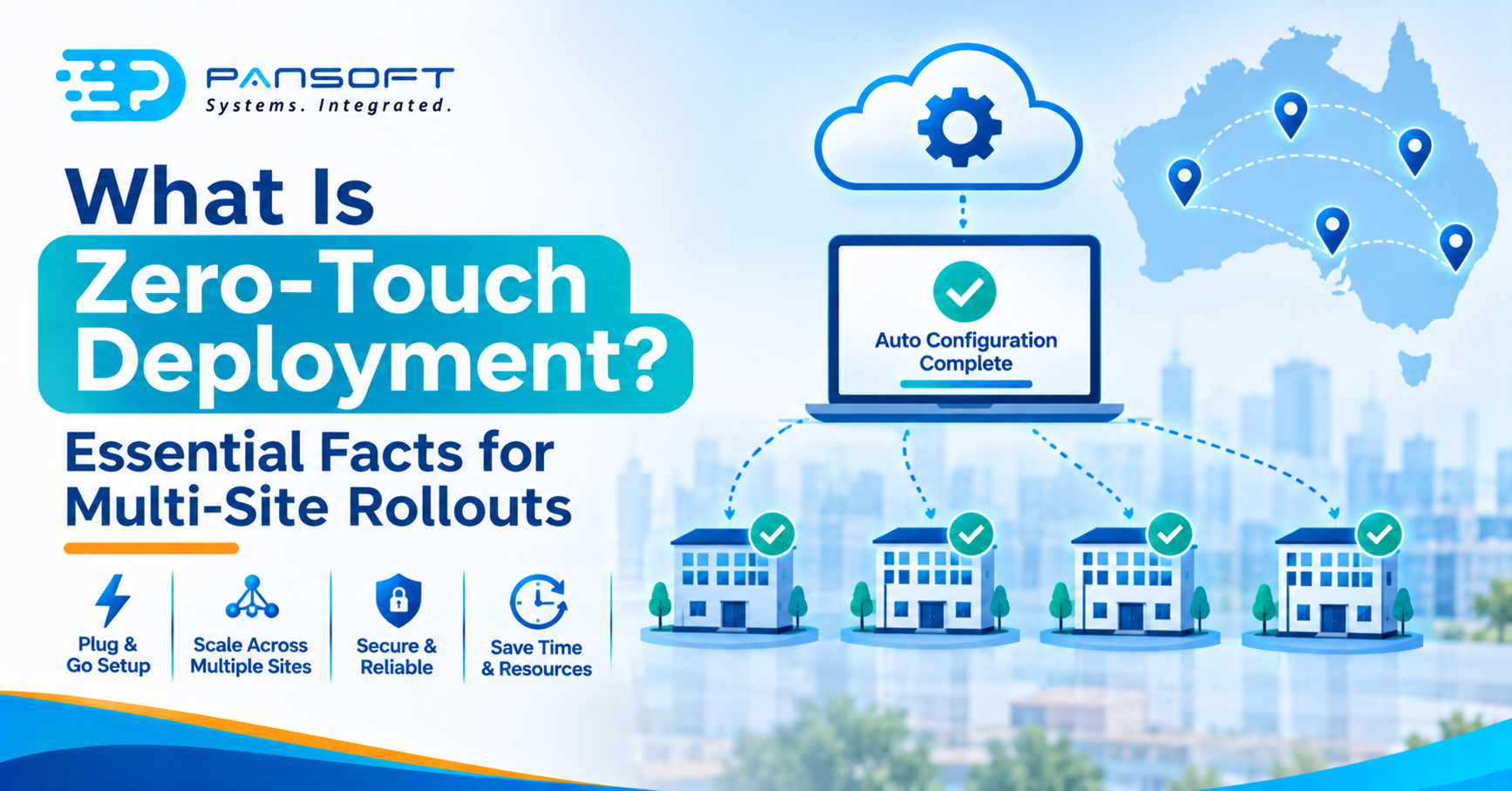
What Is Zero-Touch Deployment? Essential Facts for Multi-Site Rollouts
What Is Zero-Touch Deployment? Essential Facts for Multi-Site Rollouts By the Pansoft Technologies team | Published 6 November 2026 | Last reviewed: November 2026 Zero-touch…
Read More