
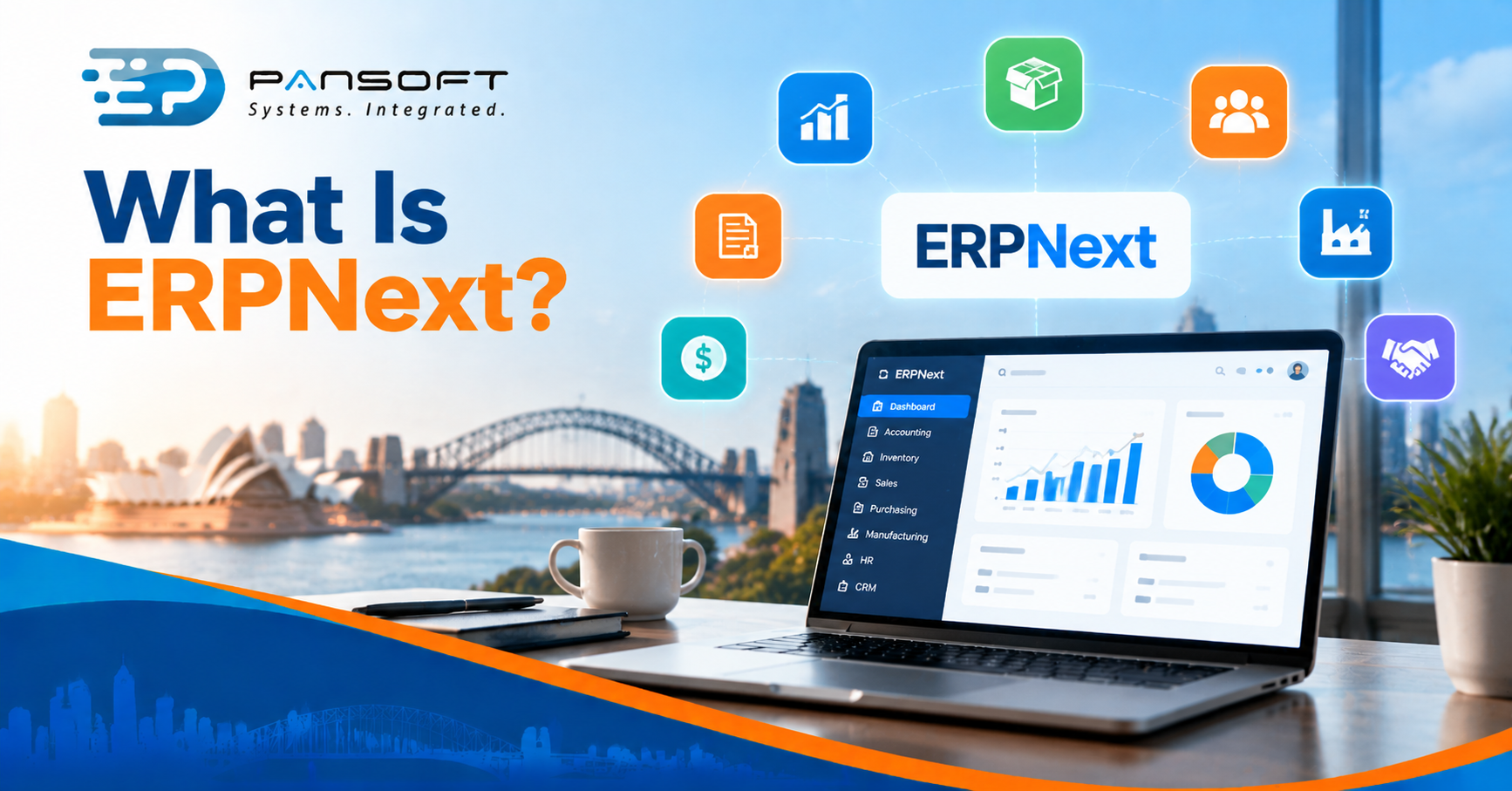
What Is ERPNext, and Why Are Australian SMEs Choosing Open Source ERP?
ERPNext is a free, open source ERP covering accounting, inventory, manufacturing, HR and CRM. The licence costs nothing, but setup, Australian tax compliance and ongoing support still do, so look for ERPNext implementation services Australia teams that cover all three.
This is for owners and finance or operations managers at small and mid-sized businesses weighing ERPNext against bigger, pricier platforms. We don’t have reliable figures on how many Australian businesses pick open source ERP, so instead of guessing, you’ll get what it is, where it fits and what to check.
What is ERPNext?
It’s business software that runs finance, stock, sales, purchasing, production and people in one system. The official documentation says ERPNext is open source under the GNU General Public Licence v3 and built on the Frappe Framework, a web framework in Python and JavaScript. Its core modules include accounting, human resources, CRM, manufacturing, order management and asset management.
Open source means you can see and change the code, and you don’t pay a licence fee for the software. It doesn’t mean the project is free. That’s the part buyers often miss.
Why do some Australian businesses consider open source ERP?
Three reasons come up most. First, no licence fee, which lowers the entry price. Second, flexibility: the code can be changed to fit how you work. Third, choice of where it runs and who supports it, since you’re not tied to one vendor.
For open source ERP Australia buyers, that mix can be appealing when the business has outgrown spreadsheets or basic accounting software but doesn’t need a large enterprise platform. Pansoft describes ERPNext on its ERPNext solutions page as open source with no licence fees. That’s our claim about the software, so test it against the full cost below.
What does “free” actually leave out?
The licence is free. Everything around it isn’t. This table shows where the effort and cost land.
| Area | What’s free | What you still pay for |
|---|---|---|
| Software | The ERPNext code and its licence | Nothing for the licence itself |
| Implementation | Nothing | Configuring it to your processes, testing, training |
| Australian compliance | Community add-ons exist | Setup, testing and checking against your accountant’s needs |
| Data migration | Nothing | Cleaning, mapping and loading your records |
| Customisation | Nothing | Building and maintaining changes |
| Hosting and security | Self-hosting costs only your time | Servers, backups, updates, monitoring, or a hosting plan |
| Upgrades and support | Community help | Someone accountable when things break |
Open source can still cost less overall, especially in licences. But don’t compare “free” to a quote. Compare total cost over a few years.
How does ERPNext cope with Australian requirements?
Through add-ons, and you need to check them. ERPNext itself doesn’t mention Australia in its documentation home page. A community app, ERPNext Australian Localisation, published by Arus Ignite on the Frappe Cloud marketplace and licensed under GPL v3, covers GST postings, BAS reports, an Australian chart of accounts and ABA files for bulk supplier payments.
The listing is useful for what it admits. It requires ERPNext version 15.74 or above, needs supplier and customer tax categories set up properly, and doesn’t mention payroll or ABN validation. It also shows 836 installs but no reviews yet. So ask any provider how they’d handle payroll, and have your accountant test BAS and ABA output before you rely on them.
When does ERPNext fit, and when doesn’t it?
It fits growing small and mid-sized businesses with fairly standard processes and a wish for flexibility. It’s less comfortable when you need a large vendor-backed ecosystem, heavy industry-specific features out of the box, or the support structure of a global vendor.
If you outgrow it, or your needs sit at the large-enterprise end, there are other routes. Our ERP solutions overview compares Pansoft’s approach across platforms, and Oracle is one of the bigger options we work with.
What should good ERPNext consulting and customisation look like?
It should start with your processes, not the software. Good ERPNext consulting services begin by mapping how you work today, then deciding what to keep, change or drop. That’s business process re-engineering, and it’s cheaper to do on paper than in configuration.
ERPNext customisation needs a rule: change as little as you can, and keep changes upgrade-friendly. Pansoft’s page says its customisation aims to maintain upgrade compatibility, which is the right goal for any provider. And ERP data migration deserves its own plan, because cleaning your records is slow and rarely optional.
What should you ask a provider?
- Which ERPNext version will you use, and how will upgrades be handled?
- How will you set up and test GST, BAS and bank payments for us?
- How do you deal with payroll, which the Australian add-on doesn’t list?
- Who writes the data migration plan, and who signs off reconciliation?
- Where will it be hosted, and who owns backups and security?
- What does support look like after go-live, and who’s accountable?
Frequently asked questions
Is ERPNext really free?
The software licence is free, because ERPNext is open source. You still pay for implementation, data migration, customisation, hosting, training and support. Compare total cost over several years, not just the licence line, and ask for a written scope showing what’s included.
Can ERPNext handle GST and BAS?
Through a community localisation app, yes. Its listing describes GST postings, BAS reports and ABA files, but it needs a recent ERPNext version and careful tax set-up, and it doesn’t list payroll. Have your accountant test the outputs before go-live.
Can we host ERPNext ourselves?
Yes, but it makes you responsible for servers, backups, security updates and upgrades. A hosted plan moves that work to a provider. Pansoft’s page lists both cloud and on-premises options, so decide who’ll own the day-to-day work before you choose.
Want a second opinion on ERPNext?
If you’re weighing ERPNext against other options, get in touch with Pansoft through the contact page. There’s no pressure. We’re happy to look at your needs and tell you honestly whether ERPNext fits, even if it doesn’t.

Related Posts
Enterprise SD-WAN Platform Australia Buyers, Essential Multi-WAN Checks
Enterprise SD-WAN Platform Australia Buyers, Essential Multi-WAN Checks By the Pansoft Technologies team | Published 6 November 2026 | Last reviewed: November 2026 An enterprise…
Read More
What Is Zero-Touch Deployment? Essential Facts for Multi-Site Rollouts
What Is Zero-Touch Deployment? Essential Facts for Multi-Site Rollouts By the Pansoft Technologies team | Published 6 November 2026 | Last reviewed: November 2026 Zero-touch…
Read More