
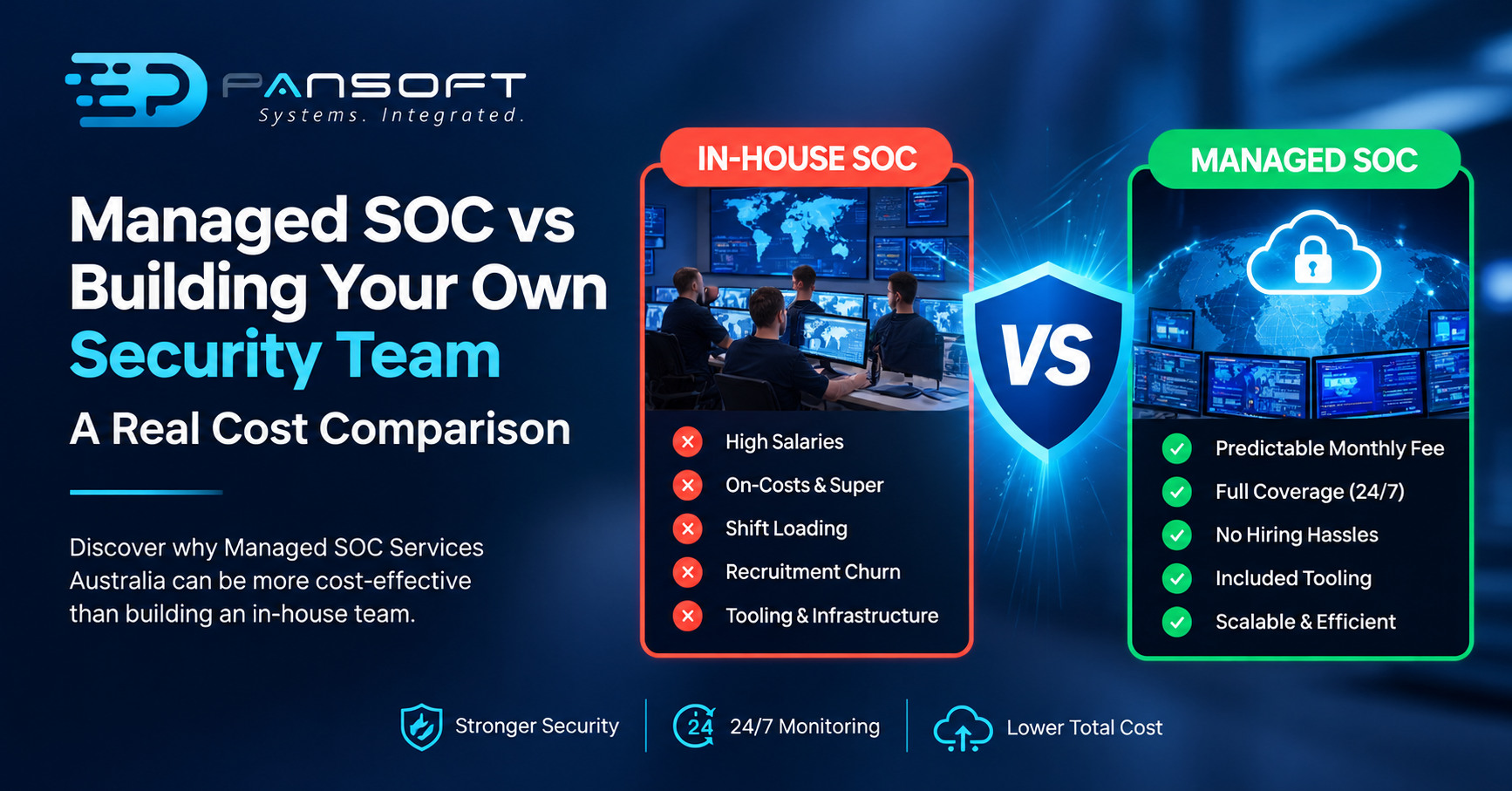
Managed SOC vs Building Your Own Security Team: A Real Cost Comparison
Run the numbers properly and Managed SOC Services Australia comes out meaningfully cheaper than building the same coverage in-house. Not because the subscription fee is small. Because the in-house side carries a long list of costs that never make it into the first draft of anyone’s budget.
This isn’t an argument against building your own team. Some businesses have the scale to run one well. It’s that for most of the businesses Pansoft works with, the comparison only tells the truth once every on-cost, every licence and every recruitment cycle gets counted, not just the salary figure someone writes on a whiteboard in the first planning meeting.
What a 24/7 In-House Security Team Actually Costs
Four to five analysts. Minimum. Covering a genuine round-the-clock roster across AEST, AEDT and AWST without gaps takes that many people, and most business owners are surprised the first time someone actually says the number out loud.
Salary doesn’t tell the whole story on its own. Security analyst roles in Australia typically advertise somewhere between $95,000 and $150,000 depending on seniority. What actually lands on the business’s books is higher, once superannuation, payroll tax, workers compensation and shift loading stack on top of that advertised figure.
Superannuation, Payroll Tax and Workers Compensation
Super’s the easiest number to pin down, so start there. The Superannuation Guarantee hit its final scheduled rate of 12% on 1 July 2025, confirmed by the ATO. Every dollar of base salary carries that 12% automatically, before anything else gets added.
Payroll tax comes next, and it moves around depending on which state the business is in and how much of the total wage bill clears the relevant threshold. In Queensland, that’s commonly in the low single digits of total wages once a business is over the line. Workers compensation adds its own percentage again, set by industry classification and claims history, not a flat number you can quote from memory.
Here’s where it lands once you add it up. Australian payroll teams commonly work to a rule of thumb that on-costs add around 25% to 30% on top of base salary, once super, payroll tax, workers comp and leave provisions are all counted. Take a five-analyst roster averaging $120,000 base each. The fully loaded cost sits somewhere between roughly $750,000 and $780,000 a year. That’s before a single dollar goes toward tooling. Worth saying plainly: this is a worked example built from the confirmed 12% super rate and those commonly cited on-cost ranges, not a figure pulled from any one business’s actual payroll.
Shift Loading for a Genuine 24/7 Roster
Penalty rates haven’t even entered the picture yet, and a real 24x7x365 roster can’t dodge them. Nights, weekends, public holidays, all of it adds loading on top of ordinary hourly rates the moment a roster actually covers every hour of the day. It’s one more gap between the number a business starts budgeting with and the number the roster actually costs.
Recruitment Churn and Retention
Here’s the part that catches most businesses off guard. SOC analyst tenure in Australia is widely reported to sit around 18 to 24 months. That’s not a slow trickle of people leaving. It’s a recurring event, built into the role. Demand for the skillset runs high, and analysts move toward senior positions fast once they’ve got a couple of years behind them.
Every departure means the business is back in a hiring cycle. Advertising, interviewing, onboarding, and absorbing weeks of reduced effectiveness while the new hire learns the environment from zero. Nobody puts that in the original budget. It shows up anyway, roughly every eighteen months to two years, per seat on the roster, whether it was planned for or not.
Platform Engineering Overheads
Then there’s the platform itself. A SIEM or XDR tool, Microsoft Sentinel, CrowdStrike, whichever one fits, has to be bought, deployed and kept tuned as threats shift. Licensing usually runs on ingestion, so the bill climbs with log volume and endpoint count. For a mid-sized environment, that commonly lands in five or six figures a year on its own, before counting the engineering time it takes to keep detection rules current. Tally that up and the tooling line can rival what it costs to employ a junior analyst.
SOC as a Service: What the Subscription Actually Replaces
SOC as a Service (SOCaaS) folds all of that, staffing, tooling, tuning, the churn risk, into one predictable fee. It costs less for a straightforward reason: nothing’s been stripped out, the platform and the analyst team are shared across every client the provider has, instead of being carried by one business alone.
Onboarding reflects it too. Two to six weeks from signing on to active monitoring is typical, against three to six months for an internal team to reach a baseline anyone would actually trust. The infrastructure already exists. The tuning’s already been done, across dozens of environments, long before a new client signs anything.
Side-by-Side Cost Comparison
| Factor | In-House 24/7 SOC | Managed SOC Services Australia |
|---|---|---|
| Minimum roster headcount | Four to five analysts, minimum, for full shift coverage across AEST, AEDT and AWST | Shared across the provider’s client base. No dedicated hires needed |
| Total annual payroll load (AUD, incl. on-costs) | Roughly $750,000 to $780,000 for a five-analyst roster averaging $120,000 base, with 12% superannuation, payroll tax, workers compensation and leave provisions included | One predictable subscription fee, typically a fraction of that loaded payroll figure |
| Tooling and licensing overhead | SIEM/XDR purchase plus ingestion-based licensing, often five to six figures a year, plus ongoing tuning effort | Included in the service, already tuned across multiple client environments |
| Recruitment and retention burden | A hiring cycle roughly every 18 to 24 months per seat, given typical SOC analyst tenure, plus onboarding downtime each round | Sits entirely with the provider. No recruitment cycle for the client |
| Operational ramp-up time | Three to six months to a dependable detection baseline | Two to six weeks from onboarding to active monitoring |
| Response SLAs | No guaranteed benchmark. Depends entirely on internal staffing levels at any given moment | Industry-standard benchmarks commonly sit at a Mean Time to Acknowledge under 15 minutes for critical alerts, and a Mean Time to Respond under 60 minutes to first containment |
Treat all of this as a market snapshot, not a quote. Your headcount, your existing tooling, your state’s payroll tax threshold and your industry classification for workers comp will move the real number up or down.
Where the Financial Impact Really Shows Up
Here’s what the invoice never shows. 24/7 Threat Monitoring and Incident Response earns its keep in the incidents that never happen, or happen small instead of large. A compromised account caught in minutes barely registers. Left alone over a long weekend, that same account hands an attacker days to move around. Stolen data. A ransomware payload. Downtime. The recovery bill. Add it up and it routinely dwarfs a year of subscription fees several times over.
Threat Detection and Response running continuously is what keeps that window small enough to limit how far ransomware actually spreads before anyone notices. That’s really where the financial exposure of a slower internal setup lives. There’s a compliance angle too. Businesses working toward ACSC Essential Eight alignment often find a managed SOC’s ongoing log review already covers requirements around multi-factor authentication and administrative privilege monitoring that would otherwise need a dedicated internal process just to keep pace.
Insurance has its own stake in this now. Insurers increasingly list continuous monitoring, documented incident response and MFA as conditions of cover, not optional extras, and a business that can’t evidence these at renewal risks a higher premium at best, a declined policy or a disputed claim at worst. A managed SOC hands over exactly what underwriters are asking for: monitoring logs, a documented response process, a record of how past alerts were actually handled.
None of this sits apart from the rest of a business’s security posture. A SOC watching well-configured systems catches a lot more than one watching a patchwork of half-tuned tools. That’s why most engagements start with a security review to map what actually needs watching, feeding into a broader security programme instead of sitting there on its own.
Frequently Asked Questions
Is a managed SOC actually cheaper, or just cheaper upfront?
Both. The subscription sits below the fully loaded in-house payroll and tooling cost from month one, and it stays there, since a provider doesn’t repeat the recruitment and ramp-up costs a business would face internally every 18 to 24 months.
Does switching to a managed SOC mean giving up control?
Most engagements agree upfront exactly what a provider can act on directly and what still needs the client’s sign-off. So no, not really. Control comes down to what’s negotiated at the start, not something that quietly disappears once the contract’s signed.
At what point does an in-house team actually make financial sense?
When a business has the ongoing scale and budget to sustain a full roster year-round, churn included. Not just enough funding for one or two staff. Below that line, the shared-cost model behind Managed SOC Services Australia tends to win on the maths alone.
Do these figures include GST or other taxes?
They don’t. Everything here is a pre-tax indicative estimate built from published Australian rate data, not a formal quote, worth checking against your actual state, industry classification and current payroll setup before it goes anywhere near a real budget.
Want a cost comparison scoped to your actual numbers instead of the general figures above? That’s worth a direct conversation. Pansoft runs it as a straightforward architectural and cost-scoping review, looking at your current headcount, your existing tooling, and what coverage would genuinely cost either way. Get in touch with Pansoft to work through the real numbers for your business.
Learn more about managed SOC services in Australia.

Related Posts

Enterprise SD-WAN Platform Australia Buyers, Essential Multi-WAN Checks
Enterprise SD-WAN Platform Australia Buyers, Essential Multi-WAN Checks By the Pansoft Technologies team | Published 6 November 2026 | Last reviewed: November 2026 An enterprise…
Read More
What Is Zero-Touch Deployment? Essential Facts for Multi-Site Rollouts
What Is Zero-Touch Deployment? Essential Facts for Multi-Site Rollouts By the Pansoft Technologies team | Published 6 November 2026 | Last reviewed: November 2026 Zero-touch…
Read More