
What Does an Oracle Consulting Engagement Actually Involve?
By Pansoft Technologies team | Last reviewed: October 2026
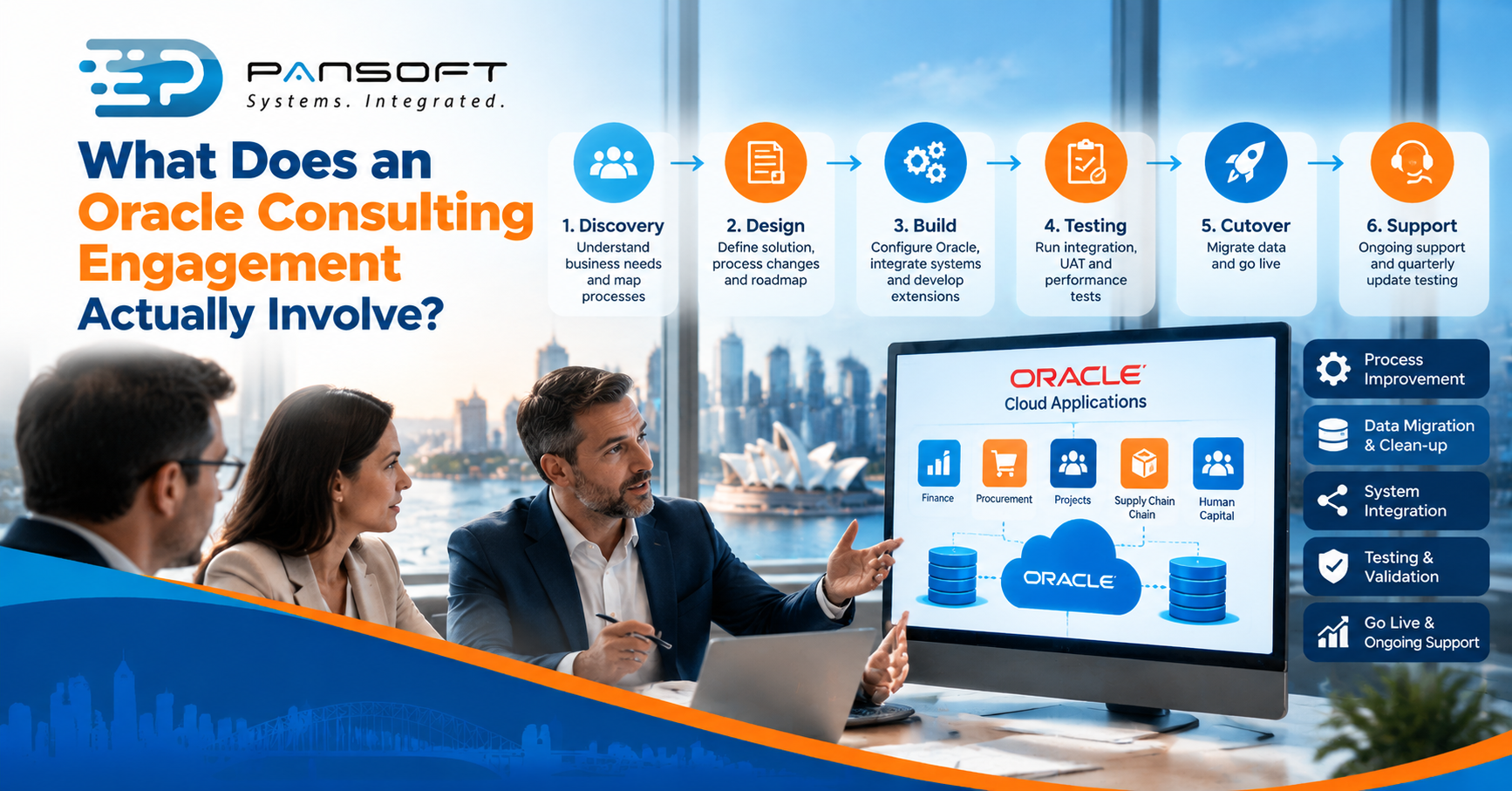
An Oracle consulting engagement runs in stages: discovery, design, build, testing, cutover and support. Oracle Consulting Services cover the software, but most of the effort goes into process decisions, data clean-up and testing, so your own people are involved from week one.
This guide is for finance, operations and IT leads who want to know what they’re signing up for before they sign. If you’re still comparing platforms, Pansoft’s ERP solutions overview is the wider starting point.
What happens before anyone touches the software?
Discovery comes first. Consultants map how your business really runs, agree scope, and decide which processes to keep, change or drop. Skip it and you build the wrong thing quickly.
This is where business process re-engineering earns its keep. Someone sits with finance, procurement and operations and walks through order-to-cash, procure-to-pay and record-to-report as they happen day to day, not as the policy document says. Oracle’s own guidance notes that a rollout can be a big bang or phased, by geography or by business process, so scope and phasing get settled here. Oracle Implementation Services usually start from that signed-off plan.
What do the build and test stages involve?
Build means configuring the standard product to match the agreed design, then adding integrations, reports and extensions only where standard falls short. Testing follows in layers, and each layer needs somewhere to run.
That last part catches people out. Oracle’s ERP team notes that a new cloud subscription includes one production and one test environment, with extra test environments available to buy. Their suggested plan separates development, conference room pilots, mock data conversions, integration testing, system and user acceptance testing, performance testing and dress rehearsals. Nobody wants to discover in month five that three of those are fighting over one environment. Plan it in the first month.
How does ERP data migration work?
Old data gets cleaned, mapped into Oracle’s load templates and pushed through staging tables into the live ones. The loading is mechanical. Deciding what deserves to come across isn’t.
Oracle’s file-based data import works from spreadsheet templates, which generate CSV files, which are zipped, uploaded and loaded into interface tables before import processes move the data into the application. Oracle’s own guidance warns that deleting or reordering template columns makes the load fail, and that templates can change between releases. So every mock load needs rerunning after an update.
Picture a distributor with ten years of supplier records, a good share of them duplicates. The template will happily accept every one. Someone in the business has to decide which survives, and no consultant can make that call for you.
What changes once you go live?
Support doesn’t stop at go-live, because Oracle’s cloud applications update every quarter and you can’t skip an update. Someone has to test your configuration against each release.
Oracle’s Fusion team says test environments update on the first Friday of the update month and production two weeks later, which is your testing window. New features ship switched off and need an opt-in, but Oracle still expects you to retest integrations, extensions, reports and workflows each time. It recommends a small cross-functional team to own that. Plenty of projects forget to name one.
Where does the database side fit?
Oracle Database Services cover the data layer under many business applications: upgrades, performance tuning, and moves to the cloud. They run as their own stream, with their own dates, separate from an ERP rollout.
The dates have shifted lately. The Register reported that Oracle extended Premier Support for Database 19c to 31 December 2029, with Extended Support to 31 December 2032, and that 26ai Premier Support is slated to end in 2031. For Oracle Solutions Australia projects, location also comes up early. OCI Database Migration is available in Oracle’s Sydney and Melbourne regions, so a cloud move doesn’t have to mean leaving the country. Ask any provider where your applications and backups will actually sit.
Who does what at each stage?
| Stage | What consultants usually do | What your team usually does | Where it often goes wrong |
|---|---|---|---|
| Discovery | Map processes, set scope and phasing | Explain how work really happens, name decision-makers | Scope agreed before process owners are in the room |
| Design and build | Configure, build integrations and reports | Decide chart of accounts, approvals, cost centres | Customising where standard would do |
| Data migration | Build and run load templates | Clean the data and sign it off | Dirty data found at the first mock load |
| Testing | Run integration and performance tests, support UAT | Run UAT on real scenarios | UAT squeezed into the final week |
| Go-live and support | Cutover, early-life support, update testing | Use the system, report issues | Nobody owns quarterly update testing |
Consultants carry the technical build, but the decisions and the data belong to you. If your team can’t free up time for those, a delivery partner can’t make up the difference.
Is Oracle the right fit, or should you look at SAP?
Oracle suits businesses that want a cloud ERP on largely standard processes and are ready to adopt them. If you’re on SAP ECC today, you’re also on a clock, and the comparison should be fair.
SAPinsider says mainstream maintenance for ECC 6.0 is scheduled to end in December 2027, with a transition option potentially stretching to 2033 for select customers. Pansoft covers SAP as well as Oracle, so the conversation doesn’t have to lean one way.
What should you do next?
- List the processes you’d redesign and the ones you’d keep exactly as they are.
- Name owners for finance, operations and data, and block out their time.
- Ask any provider for a phased plan that shows environments and test cycles, not just a go-live date.
- Talk to Pansoft about your Oracle project once you’ve done the first three.
Frequently Asked Questions
How long does an Oracle implementation take?
It depends on how many modules, business units and data sources are in scope, and how clean the legacy data is. Treat any quoted duration without a phase-by-phase plan as a guess. Ask for the stages, the environments and who owns each task.
Do we need to move to Oracle Database 26ai now?
Not necessarily. Oracle has extended Premier Support for 19c to 31 December 2029, with Extended Support to 31 December 2032, and 26ai Premier Support is slated to end in 2031. Plan any move around your application vendor’s certification and your own risk appetite.
How much work falls on our own staff?
More than most people expect. Consultants configure and build, but your team decides the chart of accounts, approvals and process changes, signs off migrated data, and runs user acceptance testing. Plan for those people’s time before you sign anything.
Talk it through with Pansoft
Thinking about an Oracle project? Talk to Pansoft about where you are now and what a sensible first stage might look like. There’s no obligation and no pressure to commit to anything.

Related Posts
Enterprise SD-WAN Platform Australia Buyers, Essential Multi-WAN Checks
Enterprise SD-WAN Platform Australia Buyers, Essential Multi-WAN Checks By the Pansoft Technologies team | Published 6 November 2026 | Last reviewed: November 2026 An enterprise…
Read More
What Is Zero-Touch Deployment? Essential Facts for Multi-Site Rollouts
What Is Zero-Touch Deployment? Essential Facts for Multi-Site Rollouts By the Pansoft Technologies team | Published 6 November 2026 | Last reviewed: November 2026 Zero-touch…
Read More