
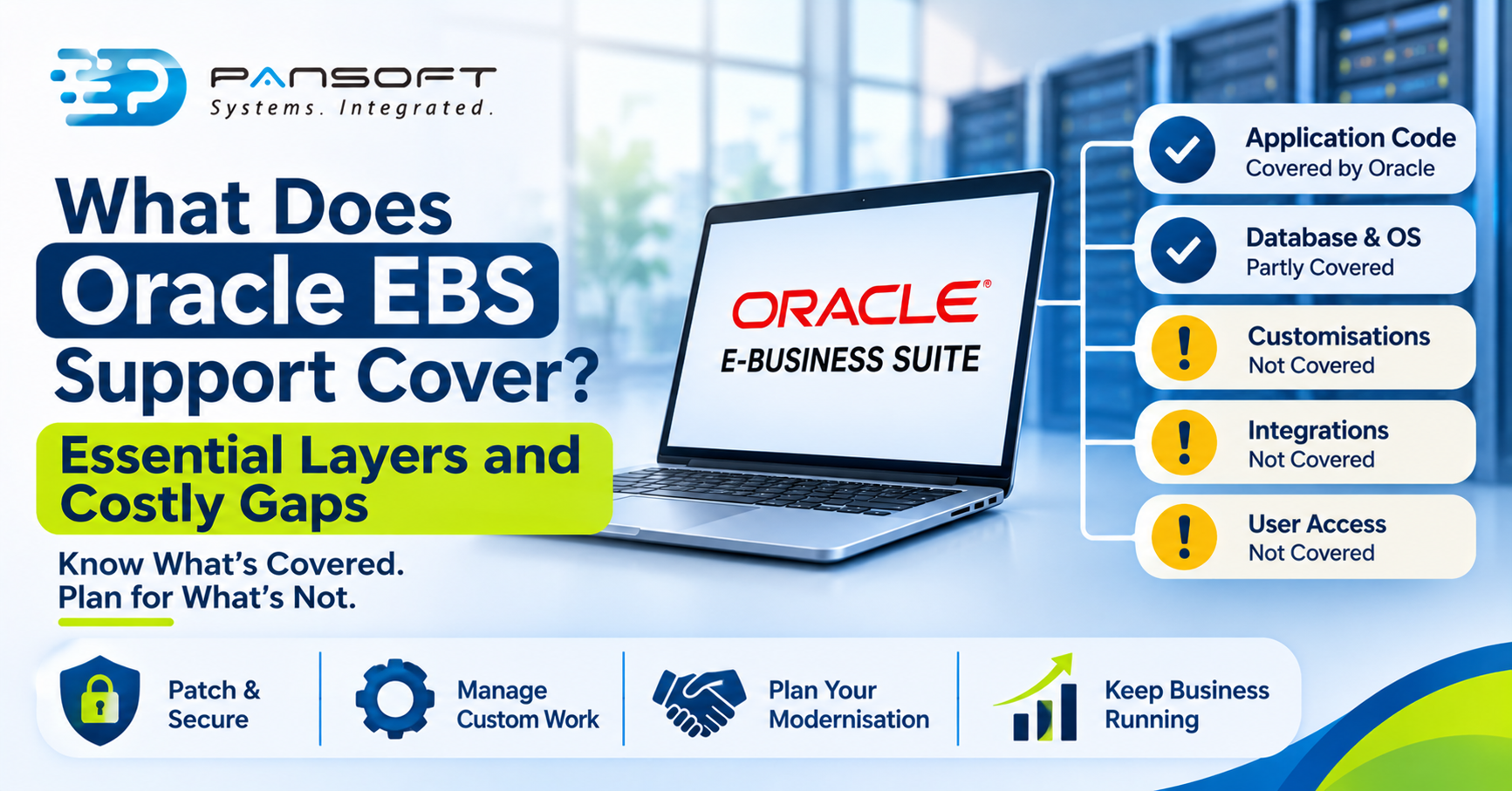
What Does Oracle EBS Support Cover? Essential Layers and Costly Gaps
By the Pansoft Technologies team | Published 5 November 2026 | Last reviewed: November 2026
Oracle EBS support covers fixing and patching the packaged Oracle application, plus certifying the technology it runs on. Your own customisations sit outside it, so someone else must own them. Ellucian Banner support splits the same way between vendor code and local work.
This is for IT managers and finance or student-systems owners who run a packaged enterprise application and want to know who owns what. Our application management page shows how we frame ongoing care for Application Management Services Australia buyers.
What is Oracle EBS support, and who provides it?
Oracle EBS support is the vendor’s commitment to fix defects, issue security patches and certify new technology for the delivered product. Oracle announced on 24 March 2025 that Premier Support for EBS 12.2 now runs through at least 2036, so the product isn’t going away soon.
Oracle’s older lifecycle post, written in 2016, listed what Premier Support covered. It named quarterly security updates through the Critical Patch Update process, new patches for product families such as Oracle Financials, and certifications for the technology stack and end-user devices. It also said every customer had to apply a minimum patching baseline to stay eligible (Oracle E-Business Suite Technology blog). That post is dated, so check Oracle’s current baseline before you plan any patch cycle.
Here’s the catch. Premier Support is an entitlement, not a team. It doesn’t schedule your patch windows, watch your batch jobs or answer the finance manager when month-end hangs.
What does Oracle EBS support leave out?
Customisations are the biggest gap. Oracle Licensing Experts, an independent advisory firm, reads Oracle’s position this way: modifications to Oracle software are excluded from support, and after a patch Oracle only confirms its own code is correct. Custom forms, reports, PL/SQL packages, concurrent programs and workflows stay with the customer to retest and fix.
Treat that as one adviser’s reading, not Oracle’s contract wording. The point still holds. Every local report and integration needs a named owner, and no vendor will assign one for you.
How is Banner support different?
Banner is a higher-education ERP and student information system. St Edwards University’s IT knowledge base describes it as an Ellucian product split into modules, including Student, Financial Aid, Human Resources and Finance.
The shape of the work is familiar. Texas A&M University-Corpus Christi explained that its Banner 8 forms depended on Oracle Forms 11gR2, which Oracle was ending support for. Banner 8 stopped being available there after 20 December 2018. A vendor lifecycle change forced a project, and the local team had to run it.
One US university’s job advertisement for a Banner systems administrator shows how wide in-house duties can get. It lists monitoring an Oracle 12c R2 database, upgrading Banner 9x, managing user security accounts and supporting integrations. That’s one employer’s list, so treat it as an example, not a standard.
Which layers does Oracle EBS support actually reach?
Vendor cover reaches the top of the stack and thins out below it. The table sets out five layers and who usually looks after each.
| Layer | Usually covered by the vendor? | What to watch |
|---|---|---|
| Delivered application code | Yes, for supported versions | Patch baselines and version end dates |
| Database and operating system | Partly, through certifications | Someone must apply patches and tune performance |
| Customisations and reports | No | Retesting after every patch |
| Integrations with other systems | No | Ownership when either side changes |
| User accounts and access | No | Joiners, leavers and role reviews |
The verdict: the vendor covers the top row well, and the rest is yours to staff or outsource. If your team is small, the gap grows fastest in rows three to five.
What does a specialist team add?
A specialist team adds the day-to-day work between vendor patches. That means scheduling patch cycles, testing customisations, monitoring jobs, handling server and network administration, and answering users. It’s the layer Oracle EBS support was never designed to be.
Here’s a hypothetical, not a client story. Picture a 600-staff organisation on EBS 12.2 with a dozen custom reports and a nightly payroll file. A quarterly security patch lands. The vendor code is fine, but two reports fail and the payroll file runs late. Nobody owned retesting, so finance finds out on pay day. A named team with a test checklist would have caught both before go-live.
How do you modernise without a big bang?
Most teams don’t rip out a working ERP. They close the support gaps first, then modernise in small steps. Agile delivery suits this because each change, such as a reporting layer or an API wrapper, can ship and be tested alone. Where a change needs new code, the build side sits with custom software development, and customer-facing screens belong with web development.
Legacy system integration is usually the hardest slice. The older the customisation, the less likely anyone documented it. Start by listing every custom object and every integration, then rank them by what breaks if they stop. That list becomes your support scope and your modernisation backlog at once, and it gives any provider of Oracle EBS support a fair brief to quote against.
What should you ask a provider?
- Which layers do you own? Get the application, database, servers and customisations named separately.
- How do you handle patching? Ask for the cycle, the test steps and who signs off.
- Who fixes custom code? If the answer is “Oracle” or “Ellucian”, ask for it in writing.
- How is handover documented? Runbooks you can read, not a login and a handshake.
- What does an outage look like? Response times belong in the contract, not the sales deck.
What are your next steps?
- List every custom report, integration and batch job you run.
- Write down the vendor lifecycle dates for your version.
- Name an owner for each layer in the table above.
- Review your last patch cycle and note what broke.
- Talk to a provider about the gaps, not the whole system.
FAQ
Does Oracle support my custom EBS reports?
Generally not. Oracle’s support covers the delivered product, and an independent adviser summarises its policy as excluding customisations. You, or a support partner, must fix and retest custom reports after patches. Check your own support contract for the exact wording before you rely on any assumption.
Is Banner support the same as Oracle EBS support?
They’re different products from different vendors. Banner is a higher-education ERP from Ellucian, and EBS is Oracle’s business suite. The support structure looks alike, though. Each vendor covers its delivered code, while customisations, integrations and day-to-day administration stay with your team or a partner.
How long will Oracle EBS 12.2 be supported?
Oracle announced on 24 March 2025 that Premier Support for EBS 12.2 runs through at least 2036. Dates can change, so check Oracle’s lifetime support policy before you plan. Support also depends on meeting the minimum patch levels Oracle sets, which it has published for earlier releases.
Want to talk it through?
If you’re unsure who owns which layer of your enterprise application, get in touch. We’re happy to talk through your setup, with no pressure to commit to anything.

Related Posts
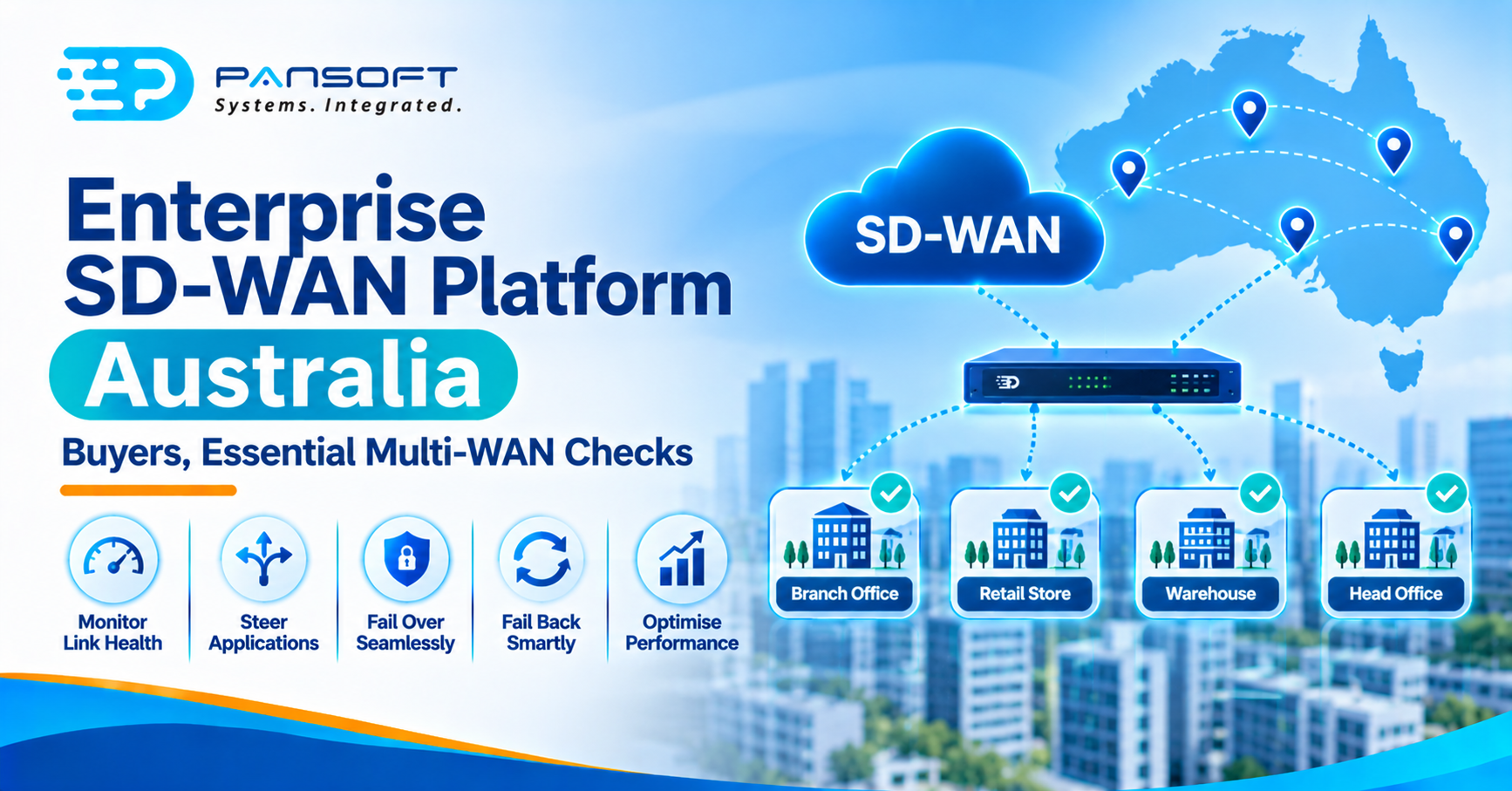
Enterprise SD-WAN Platform Australia Buyers, Essential Multi-WAN Checks
Enterprise SD-WAN Platform Australia Buyers, Essential Multi-WAN Checks By the Pansoft Technologies team | Published 6 November 2026 | Last reviewed: November 2026 An enterprise…
Read More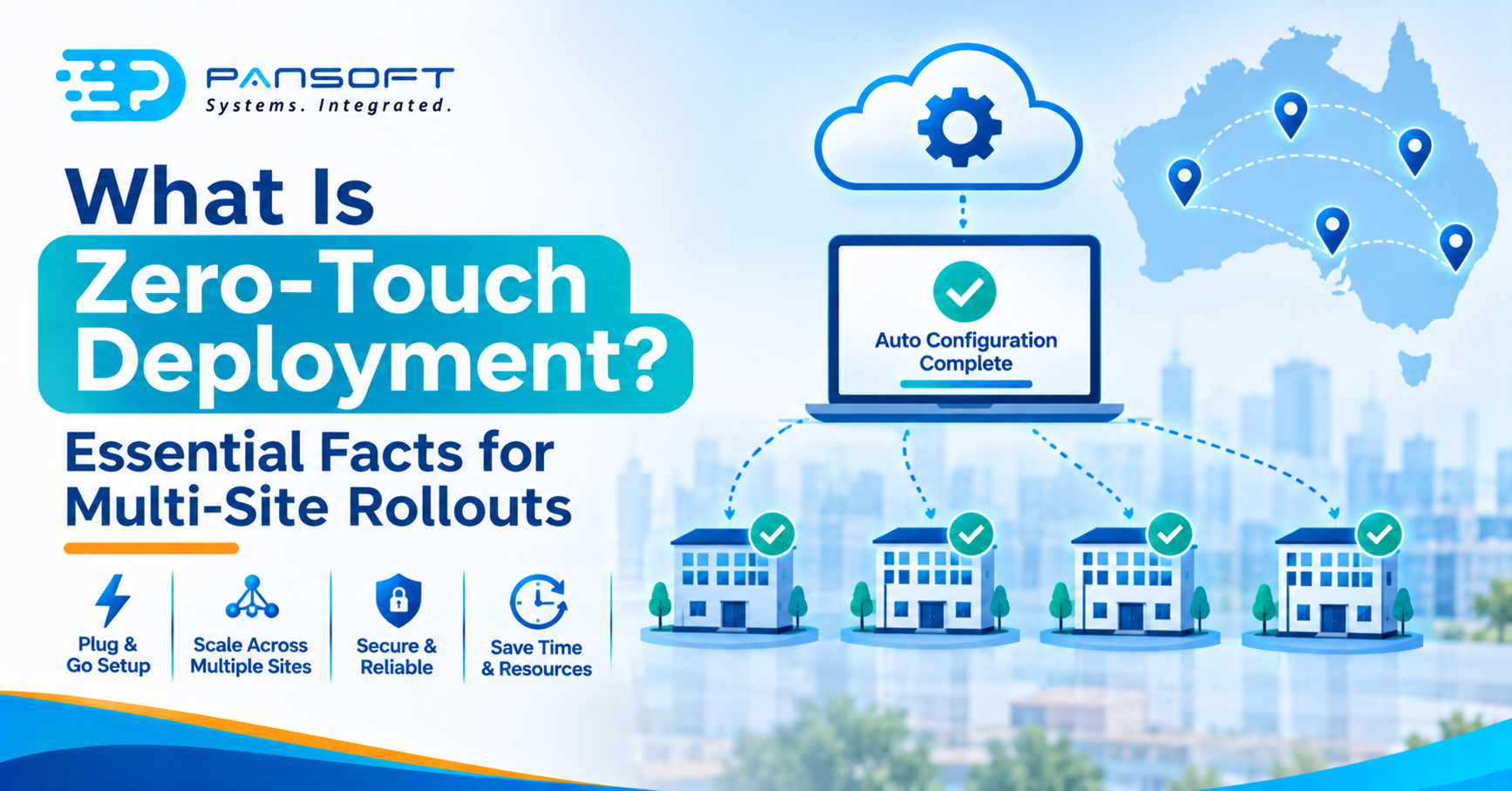
What Is Zero-Touch Deployment? Essential Facts for Multi-Site Rollouts
What Is Zero-Touch Deployment? Essential Facts for Multi-Site Rollouts By the Pansoft Technologies team | Published 6 November 2026 | Last reviewed: November 2026 Zero-touch…
Read More