
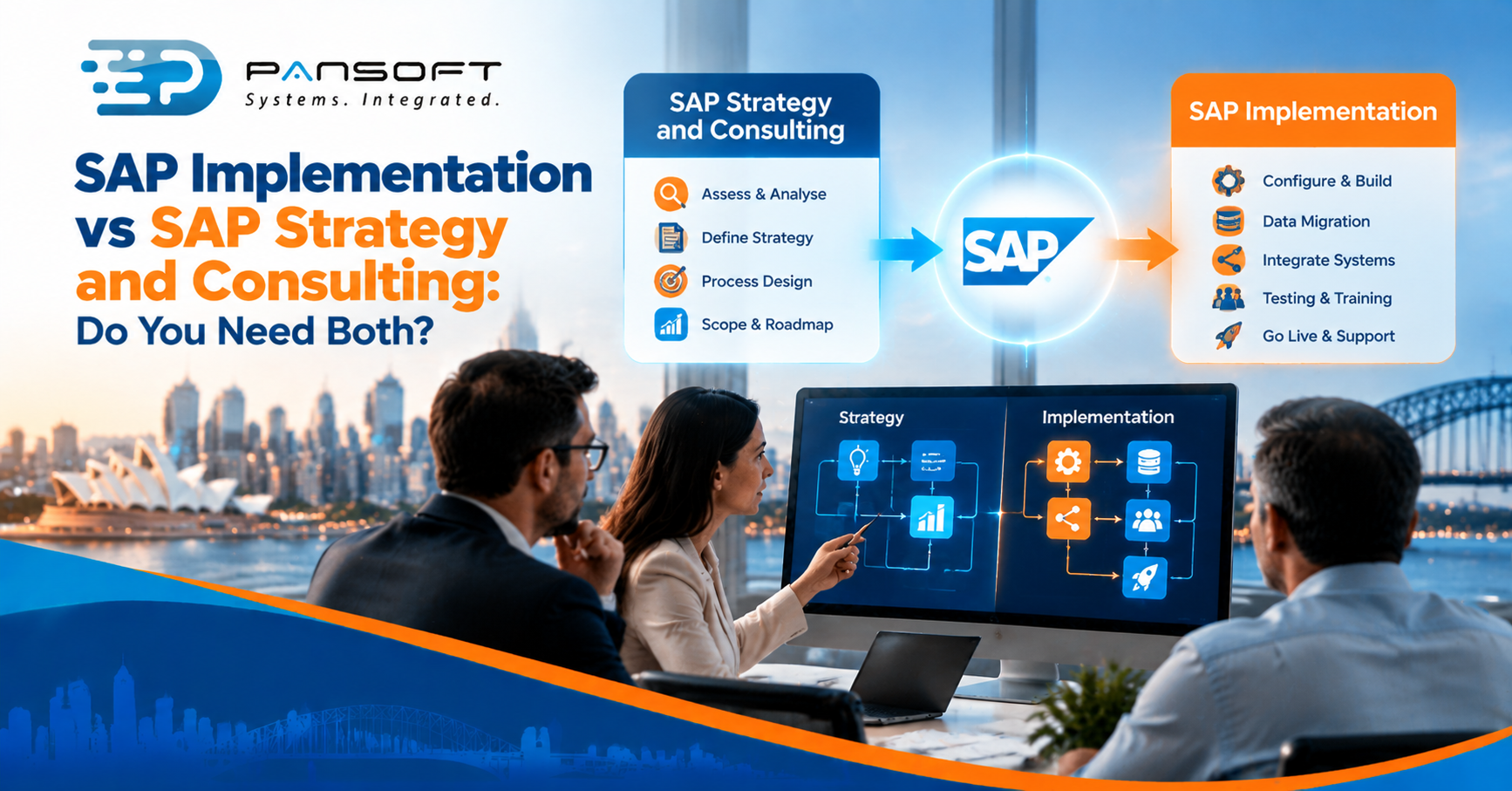
SAP Implementation vs SAP Strategy and Consulting: Do You Need Both?
Most SAP projects need both jobs, though not always from the same provider. Strategy decides which edition, scope and processes fit. Implementation builds and launches that decision. If you’ve already settled those choices, you can start with SAP implementation Australia teams directly.
This is for finance, operations and IT leaders planning an SAP project and unsure what to buy first. You’ll get a plain comparison, the line between the two jobs, and the signs that tell you whether to skip the strategy step.
What does each job actually cover?
Strategy answers “what should we do?” and implementation answers “now build it.” One produces decisions. The other produces a working system. Pansoft lists SAP strategy and consulting and implementation on its SAP page, alongside S/4HANA migration, integration and managed services.
| Strategy and consulting | Implementation | |
|---|---|---|
| Main question | Which SAP product, edition and scope suit us? | How do we configure, connect, test and launch it? |
| Typical output | A scope, a platform and edition choice, a plan | A working, tested system with trained users |
| Business input | Executives, process owners, finance and operations leads | Process owners, key users, testers |
| Main risk | Decisions made on thin information | A build that drifts from what was agreed |
If your scope is clear and your platform is chosen, you can go straight to implementation. If neither is true, you’re not ready to build yet.
Where does one job end and the other start?
The cleanest line is design sign-off. SAP’s own delivery methodology, SAP Activate, splits work into phases. In Explore, teams run fit-to-standard workshops to validate SAP’s standard functionality, collect gaps and build an initial backlog, finishing with a design sign-off. Realize is then described as the build phase, run in sprints of two to four weeks and ending with integration and user acceptance testing.
So decisions belong before sign-off, and building belongs after it. Providers may name their phases differently, but ask any supplier where their line is. If they can’t say, scope will wander.
Does the cloud choice change the answer?
Yes, and it’s a good reason to do the strategy step properly. A 2025 buyer’s guide from DX4 Research, published by TechTarget, describes SAP’s Public Edition as more restricted in customisation, with upgrades installed automatically four times a year and not optional, and says it suits greenfield projects, not direct migrations from older SAP systems. Private Edition and on-premises options are described as more flexible, and better for heavy integration with non-SAP tools.
That’s a big fork, and you want to choose it before you build. Pansoft lists SAP Cloud Solutions among its services, but edition choice isn’t a technical detail. It sets how much you can customise, how often change arrives, and how your processes have to work.
When can you skip the strategy step?
You can often skip it when the decisions are already made and written down. That usually means:
- Your platform and edition are chosen, with reasons.
- Your scope is documented and agreed by the business.
- You’ve reviewed your processes and know what you’re changing.
- Someone inside owns the project and the data.
Hand an implementation partner that package and they can start at the build. It saves time and money.
When shouldn’t you skip it?
When your system is old, heavily modified or touching many other systems, or when nobody agrees on scope. That’s when strategy pays for itself. It’s also where business process re-engineering belongs: deciding which processes to keep, change or drop before anyone configures them.
Data is another trigger. If your records are messy, ERP data migration needs an owner and a plan early, and strategy is the cheapest place to start. Our ERP solutions overview covers how that work fits the wider project.
Picture a 70-person manufacturer on a heavily modified older system. It skips strategy and jumps to implementation because the deadline feels close. Halfway through, two departments disagree on how approvals should work, and the build stalls. That’s a hypothetical, but it’s a very common shape of problem.
Should one provider do both?
It can, and one provider reduces handover gaps. The trade-off is independence. A separate consultant has no stake in what gets built, which matters if you suspect a recommendation might follow what the implementer sells.
If you do use one provider, ask them to explain why they recommend the edition and scope they do, and what they’d advise if you chose a different one. If you split the work, make sure the strategy documents are detailed enough for another team to build from.
Some businesses use the moment to compare vendors too, and Oracle is a common alternative. Pansoft works with Oracle as well as SAP, so we can talk through either, but switching vendors is a bigger project than choosing an SAP edition.
What should you ask before you buy?
- Where does strategy end and the build begin in your approach, and what’s signed off between them?
- Which SAP edition do you recommend for us, and why?
- What will we have to change in our processes, and what can be customised?
- Who owns data clean-up and migration?
- What do you need from our people, and how much of their time?
- How is SAP Solutions Australia support handled after go-live?
Frequently asked questions
Can we do strategy now and implementation later with a different provider?
Yes, if the strategy documents are detailed enough. They should cover scope, edition choice, process decisions and data ownership. Ask the consultant to write them so another team can build from them, and check that the implementer is happy with that handover.
Is the public cloud edition suitable if we’re moving from an older SAP system?
Often not directly. A 2025 buyer’s guide describes Public Edition as suited to greenfield projects and more restricted for customisation, so it doesn’t suit direct migrations from older systems. Check current options with SAP and test them during the strategy work.
How do I know the strategy work is finished?
You have a written scope, a chosen product and edition with reasons, agreed process changes and a named owner for each data set. The business should have signed the design off. If any of these is missing, you’re not ready to start building.
Want a second opinion on where to start?
If you’re deciding whether you need strategy, implementation or both, get in touch with Pansoft on (07) 5646 4560 or through the contact page. There’s no pressure. We’re happy to look at your scope and tell you where we’d start, even if that’s not with us.

Related Posts
Enterprise SD-WAN Platform Australia Buyers, Essential Multi-WAN Checks
Enterprise SD-WAN Platform Australia Buyers, Essential Multi-WAN Checks By the Pansoft Technologies team | Published 6 November 2026 | Last reviewed: November 2026 An enterprise…
Read More
What Is Zero-Touch Deployment? Essential Facts for Multi-Site Rollouts
What Is Zero-Touch Deployment? Essential Facts for Multi-Site Rollouts By the Pansoft Technologies team | Published 6 November 2026 | Last reviewed: November 2026 Zero-touch…
Read More