
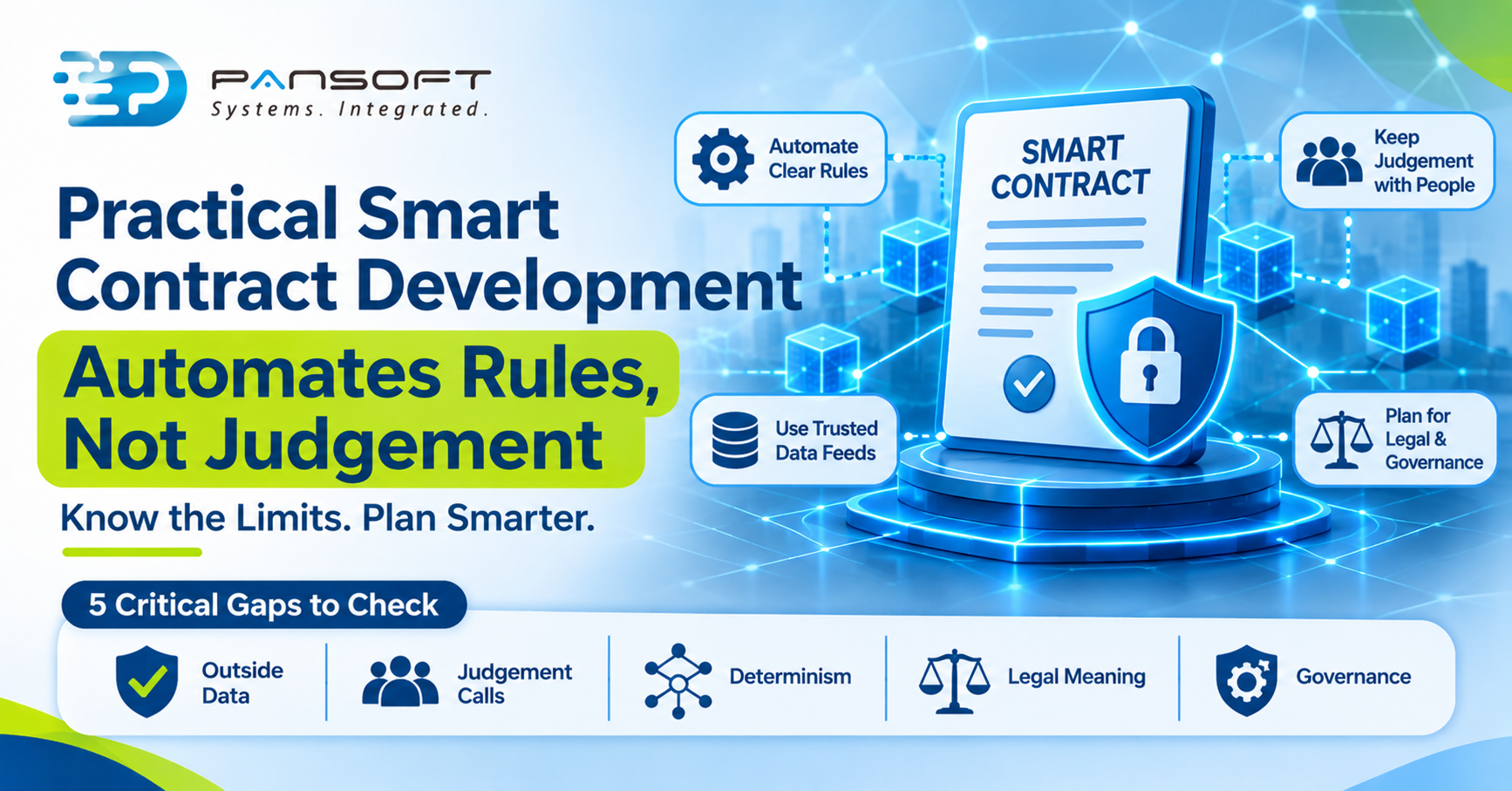
Practical Smart Contract Development Automates Rules, Not Judgement
Smart contract development automates clear, rule-based steps on data the system can verify, like releasing a payment once both parties confirm delivery. It can’t automate judgement, disputes or facts from outside the ledger without a trusted feed. Plan around that boundary.
This is for business and IT decision-makers weighing a blockchain project who want to know which parts of their process would actually be automated. It supports our blockchain services page, and the answer is narrower than most pitches suggest.
What does smart contract development actually automate?
Rules. If this condition is true, do that. A smart contract is code that runs on a shared ledger, and it’s good at steps that are the same every time: release a payment, update a status, record that a document was received.
In Hyperledger Fabric, the platform’s own documentation calls smart contracts chaincode. It can be written in general-purpose languages such as Java, Go and Node.js, and it runs in isolated containers without direct access to the ledger state. That tells you something useful: this is ordinary software with rules around it, not an autonomous agent.
What can’t a contract decide for you?
Anything that needs judgement. Was the goods’ condition acceptable? Did the supplier’s explanation count as a valid excuse? Code can only follow the rule you wrote down in advance, so edge cases fall back to people.
The practical approach is to split the process. Automate the clear steps, and route the unclear ones to a named person with a recorded outcome. Teams that try to encode every exception end up with contracts nobody can read or test.
Why can’t it just look up outside facts?
Because every node has to reach the same answer. OpenTezos’ explanation (an educational site for the Tezos platform) says contracts can’t safely fetch off-chain data themselves: if nodes got different responses from an API, the chain would lose consistency. Fabric points the same way. Its execute-order-validate design filters out non-deterministic results.
The workaround is a data feed, often called an oracle, that puts outside information on the ledger. But OpenTezos notes that this brings its own trust problem, since someone has to supply the data and users must trust them not to send false values. Some trust always remains, and the aim is to minimise it.
For your business, that means a contract is only as trustworthy as the delivery scan, price feed or sensor reading that triggers it.
Five limits worth checking before you commit
Smart contract development projects tend to stumble on the same five limits. The table summarises the boundary. A contract handles the middle column well and the right column badly.
| Task | Fits well | Needs people or a feed |
|---|---|---|
| Release payment when two parties confirm | Yes, if both confirmations are on the ledger | Disputed or partial delivery |
| Update a shared status | Yes | Deciding what the status should be |
| Check a certificate has been issued | Yes, if the issuer writes it to the ledger | Whether the certificate is genuine |
| Trigger on an outside event (price, weather, delivery) | Only via a trusted data feed | Who supplies and audits the feed |
| Interpret a vague clause | No | A person, or a lawyer |
The verdict: automate what you can state as a plain if-then rule using data already on the ledger. Everything else needs a person, a feed, or both.
And the five limits to test:
- Outside data. Who supplies it, and how is it checked?
- Judgement calls. Who decides, and where is that recorded?
- Determinism. Every node must get the same result, so no live lookups inside the code.
- Legal meaning. Code isn’t automatically a legal agreement. Monash Business School’s Impact article on smart contracts notes that parties may need experts to interpret code, and that if terms in code weren’t truly accessible to a party they may lack legal effect. Where a paper contract uses code for automated parts, the code is treated as an extension of the agreement. The authors say “we still don’t know for sure” how courts will handle disputes.
- Governance. Who can change the rules, and who approves new participants?
How does it fit with Hyperledger development and your wider data plans?
It’s one layer of a bigger build. A Fabric network also needs identity, network membership, private channels and upgrade rules, and the contract sits on top of all that. Getting the surrounding design right usually matters more than the contract’s code.
Once contracts are writing events to a shared ledger, you’ll want to read them. That’s a reporting job for data analytics and BI. If you later want to flag unusual patterns or forecast from the history, that’s where machine learning work starts, and it should come after the data is clean and agreed.
A hypothetical: pay on delivery
This is a hypothetical, not a client story. Picture a distributor and three suppliers who want invoices paid automatically when goods arrive. The rule is simple: when the warehouse scan and the supplier’s dispatch record match, release payment.
It works for the clean cases. The trouble is the rest. A short delivery, a damaged pallet or a scan that never uploaded. Someone has to own those exceptions, and the contract needs a defined route for them. The scan itself is the data feed, so the warehouse system’s accuracy now sets the quality of every payment. Good smart contract development plans for those exceptions first.
What should you ask a provider?
- Which steps in my process are pure rules? If the answer is “all of them”, push back.
- How do you handle exceptions?
- Where does outside data come from, and who audits it?
- How are contracts tested and changed after launch?
- Do I need a contract at all? A provider offering Blockchain Development Services should be willing to say no.
What are the next steps?
- List your process steps and mark each as rule, judgement or outside data.
- Pick one clean, rule-based step for a pilot.
- Decide who owns exceptions.
- Check the legal side with a lawyer before you rely on the code.
- Book a short blockchain consulting session if you’d like a second opinion on scope.
FAQ
Is a smart contract a legally binding contract?
Not automatically. Commentary from Monash Business School says it may depend on whether the terms were genuinely accessible and incorporated, and courts haven’t settled it. Where a paper contract uses code for parts of the deal, the code is treated as an extension of that agreement.
Can a smart contract change after it’s deployed?
It depends on the platform and how it’s governed. That’s why you should decide upfront who can approve changes, who signs off, and how they’re tested. Ask a provider to show you the upgrade process before launch, not after something goes wrong.
Do I need a smart contract to automate a business process?
Often no. If one organisation owns the data, ordinary workflow software can usually automate the same rule, with less overhead. Smart contracts earn their place when several organisations need one agreed record and none of them wants to own it.
Want to talk it through?
If you’re considering automating a multi-party process, you’re welcome to get in touch. We’ll talk through what’s rule-based, what isn’t, and whether a contract is the right tool.
Sources

Related Posts
Enterprise SD-WAN Platform Australia Buyers, Essential Multi-WAN Checks
Enterprise SD-WAN Platform Australia Buyers, Essential Multi-WAN Checks By the Pansoft Technologies team | Published 6 November 2026 | Last reviewed: November 2026 An enterprise…
Read More
What Is Zero-Touch Deployment? Essential Facts for Multi-Site Rollouts
What Is Zero-Touch Deployment? Essential Facts for Multi-Site Rollouts By the Pansoft Technologies team | Published 6 November 2026 | Last reviewed: November 2026 Zero-touch…
Read More